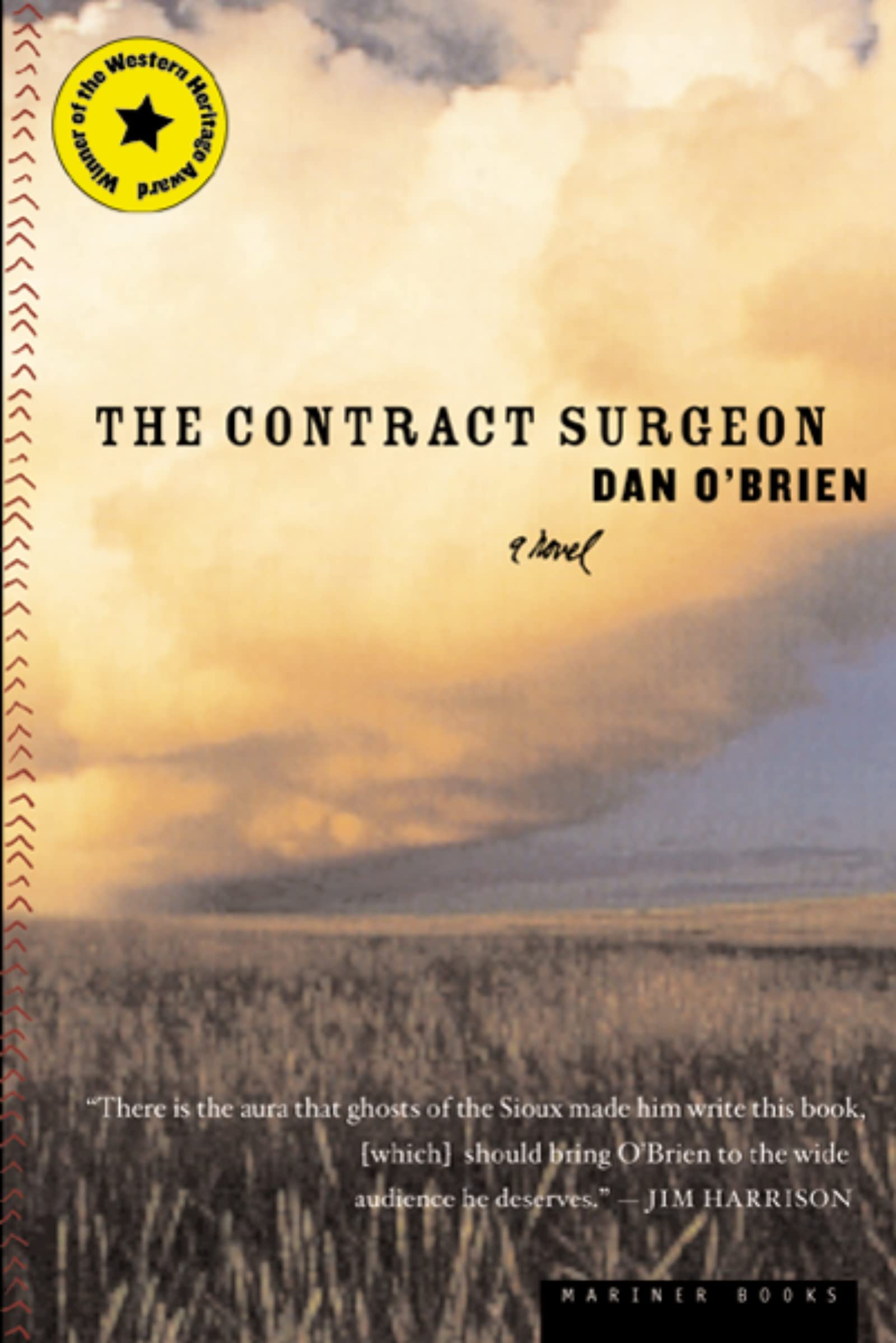



This beautifully written historical novel from one of the West's most popular writers tells the true story of the friendship between Valentine McGillicuddy, a young doctor plucked from his prestigious medical career and newly married wife to serve in the army during the Great Sioux War, and the great chief Crazy Horse. When Crazy Horse finally agrees to surrender to the United States, mistrust and treachery on both sides foster further conflict, and he is gravely wounded. McGillicuddy declares the chief his patient and struggles through a long night to keep him alive. Set in the sprawling Great Plains during the most tragic period in its history, this tale of bravery, justice, and love weaves a tapestry of time and events into the account of a single day--the last in the life of Crazy Horse--to reveal the secrets surrounding America's past. Dan O'Brien ranks among the West’s most celebrated writers. He divides his time between working as an endangered-species biologist, running a cattle ranch, and writing. He is the author of four novels, a short story collection, and three works of nonfiction, including Buffalo Bill for the Broken Heart: Restoring a Piece of the American West. He lives in South Dakota. Introduction The Sioux Indians of the nineteenth century were a loosely connected group of nomadic horsemen made up of several subgroups speaking a language with common roots. After acquiring the horse, the most tenacious subgroup, the Lakota Sioux, pushed the less aggressive inhabitants of the Great Plains south, west, and north. Within a hundred years they ruled a great portion of the high plains, from the Missouri River to the Rocky Mountains. By nature the Lakota were a combative people and, even before the United States took possession of the Louisiana Purchase in 1803, had made mortal enemies of nearly all the other tribes on the plains. From their first contact with representatives of the United States the Lakota were defiant. With the exception of a few incidents of petty thievery by West Coast tribes, Lewis and Clark had trouble only with the Lakota, who blocked their progress along the Missouri River and made war on Indian nations with whom the United States was making alliances. Between the Lewis and Clark Expedition and the opening of Montana’s gold fields, the Lakota concentrated their energies on keeping the Crows, Shoshones, Arikaras, Pawnees, and others in a subservient position with regard to the fertile buffalo hunting grounds of the northern plains. But once the people of the United States began to move into that same territory, the Lakota were forced to divert increasing amounts of resources to stemming the flow of pioneers. In the 1860s a chief of the Oglala band by the name of Red Cloud rose to prominence and led the Lakota and their allies in a successful war against the United States that stopped pioneer emigration into Montana over the Bozeman trail. After two years of war, Red Cloud, along with Spotted Tail of the Brules Sioux band, signed the treaty of 1868 that excluded whites from their territory and, after trips to Washington, settled in northwestern Nebraska on reservations named for them. They became known as friendlies,” living on the reservations and, in exchange for their passivity, receiving their subsistence from the United States government. Red Cloud and Spotted Tail had won their war and had been recognized as supreme leaders of their people by the U.S. But the political structure of the Lakota was very different from that of the United States. A Lakota leader was only a leader when the people followed him, and the fact that two chiefs had retired to reservations did not mean that the Lakota would cease hostilities toward the United States or any of the other nations on the northern plains. The Lakota, under other chiefs, continued to wage war on their neighbors, red and white. Two chiefs who emerged during the 1870s were Sitting Bull of the Hunkpapas band and a charismatic young warrior named Crazy Horse of the Oglalas. What were known as the northern Sioux or the hostiles” fought the United States Army nearly to a standstill in the Great Sioux War of 1876. But the superior resources of the United States finally wore the Sioux down. In the winter of 1876 Sitting Bull retreated into Canada, but Crazy Horse, with his defiant band of starving Oglalas, remained hostile in the north until the spring of 1877. Crazy Horse became a symbol of resistance for the Sioux, and though his position as chief was not hereditary, he ascended to that position and was, at once, held in increasing esteem by some of his people and loathed or envied by others. On the United States side the war was executed by an array of generals who had won their fame in the Civil War. At the head of the army was General Sherman. Under him was Sheridan. And under Sheridan, among others, were Generals Crook, Gibbon, Terry, and Custer. Perhaps the most experienced of these generals, in both Indian fighting