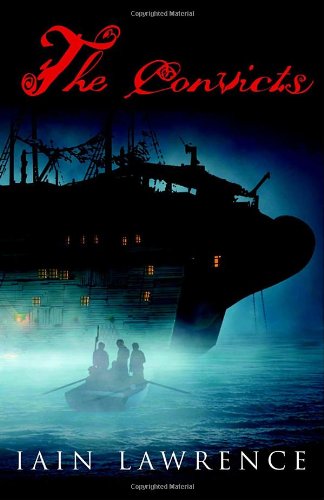



After seeing his father hauled off to debtor’s prison, Tom Tin sets out to take revenge on Mr. Goodfellow, the man responsible for his family’s misfortunes. But the fog-filled London streets are teeming with sinister characters. Tom encounters a blind man who scavenges the riverbed for treasure—and wants what Tom digs up; Worms, a body snatcher who reveals a shocking surprise; and a nasty gang of young pickpockets who mistake Tom for someone ominously known as the Smasher. And ultimately, Tom comes up against the cruel hand of the law. Accused of murder, Tom is given a seven-year sentence. He is to be transported to Van Diemen’s Land with other juvenile convicts. But Tom can’t abide life on the Hulk, the old ship where the boys are temporarily held. He decides to escape. But if he’s to succeed, his luck needs to turn. . . . Grade 5-8 -To say that this lively novel is Dickensian is to understate its debt to that author. The story abounds in terrifying villains, grime, misery, and cruelty. Yet it also serves up a fair share of optimism. The narrator, Tom Tin, has fallen on hard times through no fault of his own. When his father, an unemployed ship's captain, is taken to debtor's prison, Tom discovers the dark underbelly of 19th-century London. He has the incredible luck of finding a valuable diamond, only to lose it in a grave robbery. Then he is arrested for theft, convicted of murder, and incarcerated on a dismal prison ship for boys. There he is mistaken for a boy called Smasher, who was part of a dastardly gang of pickpockets. Unfortunately for Tom, one of Smasher's victims is also on the ship and vows revenge. A wretched and weak youngster named Midgely convinces Tom that they can escape to a better life, and they hatch a plan. The plot twists in this story rely on a series of coincidences that no reader will take seriously, but this is where the fun lies. One is never sure what lurks around the next corner. This book is as action packed and as thoroughly researched as the author's seafaring trilogy, but it will be accessible to a wider audience because of its easier reading level. Give it to reluctant readers who are looking for an exciting adventure. -Bruce Anne Shook, Mendenhall Middle School, Greensboro, NC Copyright © Reed Business Information, a division of Reed Elsevier Inc. All rights reserved. Gr. 7-10. When his father lands in debtors' prison, Tom, 14, tries to survive on the rough streets of early-nineteenth-century London. The setting is Dickensian, though more gruesome, and the story is packed with action and wild coincidence: Tom finds, and loses, a diamond; joins a street gang; and helps a grave robber steal a corpse. He is sentenced to seven years on a prison ship for boys, escapes, is recaptured, and is transported to Australia. Tom is no saint; in fact, he's ashamed of his meanness and cunning. Readers may not understand the message about social class or the parallels to the classics referred to in the story. What they will find unforgettable is the gritty historical fact, especially the horror of the young convicts' daily struggle and the wretched suffering of 500 children packed and punished on the ship.^B Hazel Rochman Copyright © American Library Association. All rights reserved Iain Lawrence is the author of numerous acclaimed novels, including The Lightkeeper’s Daughter, Lord of the Nutcracker Men, Ghost Boy , and the High Seas Trilogy: The Wreckers, The Smugglers, and The Buccaneers . The author lives on Gabriola Island, BC. I begin my adventure When she was six and I was eight, my little sister, Kitty, died. She fell from a bridge, into the Thames, and drowned before anyone could reach her. My mother was there when it happened. She heard a scream and turned to see my sister spinning through the air. She watched Kitty vanish into the eddies of brown water, and in that instant my mother's mind unhinged. She put on mourning clothes of the blackest black and hid herself from head to toe, like a beetle in a shell. As the sun went up, as the sun went down, she stood over Kitty's grave. Her veils aflutter in the wind, her shawls drooping in the rain, she became a phantom of the churchyard, a figure feared by children. Even I, who had known her all my life, never ventured near the place when the yellow fogs of autumn came swirling round the headstones. It was a day such as that, an autumn day, when my father had to drag her from my sister's grave. The fog was thick and putrid, like a vile custard poured among the tombstones. From the iron gate at the street I couldn't see as far as the church. But I saw the crosses and the marble angels, some distinct, some like shadows, and my father among them, as though battling with a demon. I heard my mother wailing. Her boots were black, her bonnets black, and the rippling of her clothes made her look more like a beast than a person. She shrieked and fought against him, clinging to the headstone, clawing at the earth. When at last my