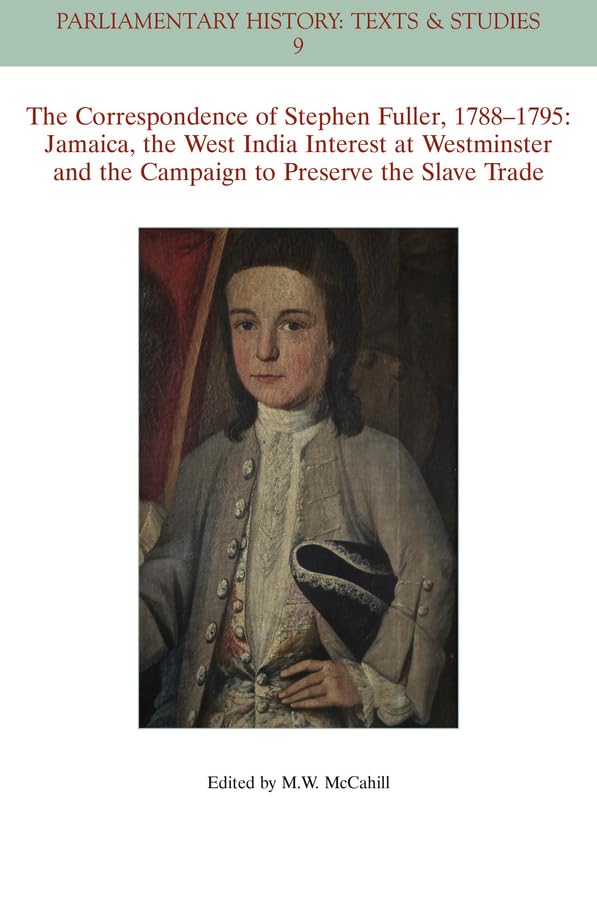
The Correspondence of Stephen Fuller, 1788 - 1795: Jamaica, The West India Interest at Westminster and the Campaign to Preserve the Slave Trade (
$36.25
by Michael W. McCahill



The Correspondence of Stephen Fuller, 1788-1795 , offers a much-needed accounting of how slavery supporters in Britain managed to preserve the slave trade in Jamaica during the last two decades of the 18th century. Represents the best single source on the efforts in Britain to prevent the abolition of the slave trade in Jamaica in the late 18th century - Offers background context for Fuller’s letters and provides new information about the effectiveness of the West India interest in Britain’s houses of parliament - Provides the fullest accounting of the campaign orchestrated by Jamaica and other Caribbean islands to turn back the abolitionist attack on the slave trade and plantation regime - Features a wealth of information about the slave trade, the conditions in which Jamaican slaves lived and worked, the racial attitudes of planters and their overseas representatives - Reveals the efforts made by Fuller to appease the abolition movement through modest steps to deflect criticisms of the planter regime Stephen Fuller (1716-1808) was the agent for the Caribbean island of Jamaica in the late eighteenth century. Edited by M.W. McCahill, The Correspondence of Stephen Fuller, 1788-1795 , offers a much-needed accounting of how slavery supporters in Britain managed to preserve the slave trade for a decade or more. They also serve as a mirror into the Caribbean past by illuminating a host of pressing issues and concern. For white settlers these included the constant need to provide for Jamaica’s defense against foreign rivals and their own restive slaves; to fend off challenges to the islands’ longstanding commercial privileges; and to counter abolitionist critiques of the planter regime by promoting higher birth rates among their slaves and adopting stronger, more humane slave codes. In addressing the latter points, the letters provide insights into the treatment and punishment of slaves, the conditions in which they worked and the racist attitudes of their masters. The correspondence also reveals how in confronting their opponents, Caribbean elites and their British allies discovered that many of Britain’s leaders no longer shared their priorities. Timeless and important, The Correspondence of Stephen Fuller, 1788-1795 highlights Britain’s changing and imperial and commercial priorities during the last two decades of the eighteenth century. Stephen Fuller (1716-1808) was the agent for the Caribbean island of Jamaica in the late eighteenth century. Edited by M.W. McCahill, The Correspondence of Stephen Fuller, 1788-1795 , offers a much-needed accounting of how slavery supporters in Britain managed to preserve the slave trade for a decade or more. They also serve as a mirror into the Caribbean past by illuminating a host of pressing issues and concern. For white settlers these included the constant need to provide for Jamaica’s defense against foreign rivals and their own restive slaves; to fend off challenges to the islands’ longstanding commercial privileges; and to counter abolitionist critiques of the planter regime by promoting higher birth rates among their slaves and adopting stronger, more humane slave codes. In addressing the latter points, the letters provide insights into the treatment and punishment of slaves, the conditions in which they worked and the racist attitudes of their masters. The correspondence also reveals how in confronting their opponents, Caribbean elites and their British allies discovered that many of Britain’s leaders no longer shared their priorities. Timeless and important, The Correspondence of Stephen Fuller, 1788-1795 highlights Britain’s changing and imperial and commercial priorities during the last two decades of the eighteenth century. After receiving his Ph.D. from Harvard University, M.W. McCahill taught at the University of Massachusetts at Boston and then, for 30 years, at Brooks School where he also served as dean. He is the author of Order and Equipoise: The Peerage and the House of Lords, 1783-1806 (1978) and The House of Lords in the Age of George III, 1760-1811 (2009).