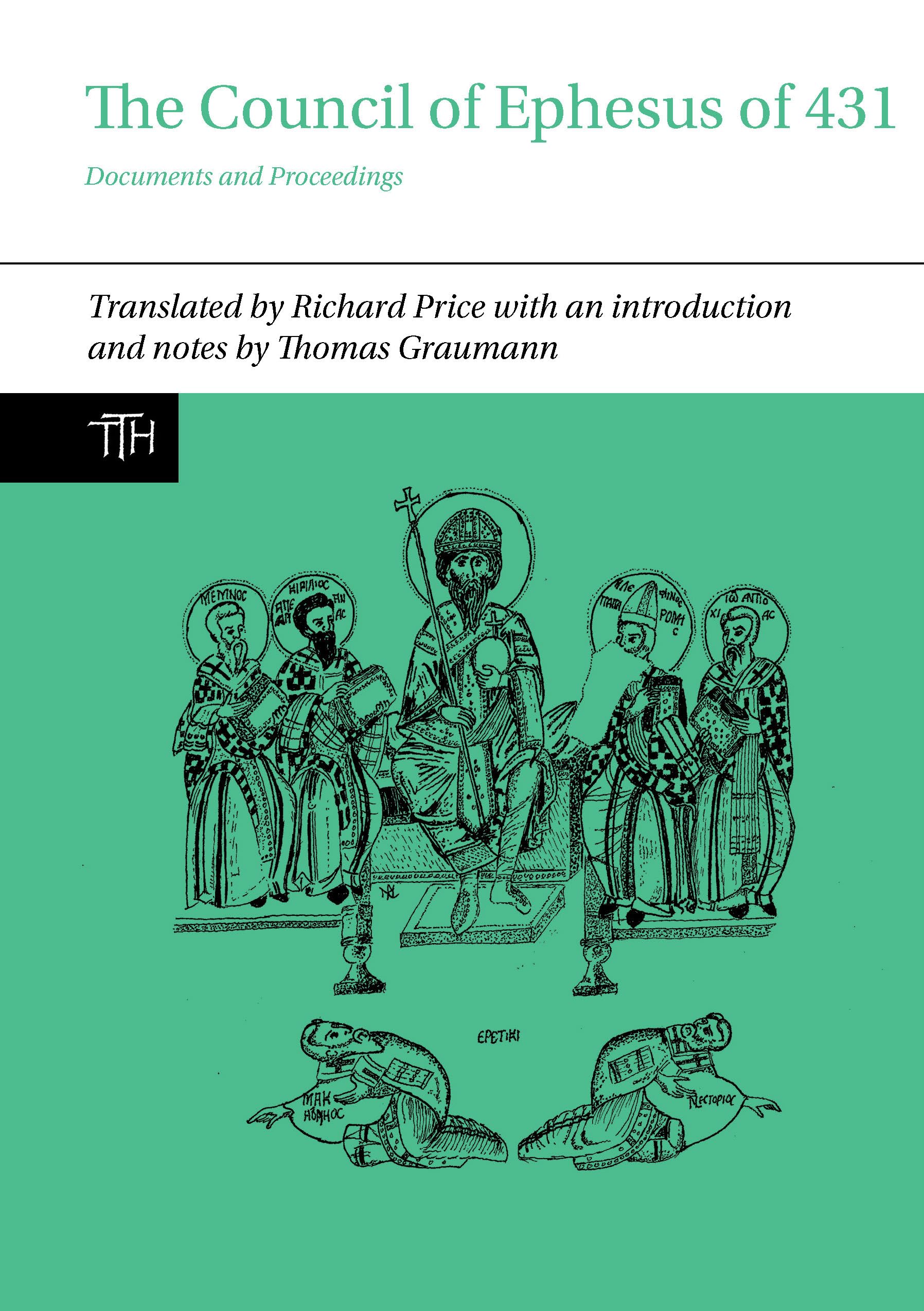
The Council of Ephesus of 431: Documents and Proceedings (Translated Texts for Historians, 72)
$71.50
by Richard Price



The First Council of Ephesus (431) was the climax of the so-called Nestorian Controversy. Convoked by the emperor Theodosius II to restore peace to the Church, it immediately divided into two rival councils, both meeting at Ephesus. Attempts by the emperor’s representatives to get the bishops on both sides to meet together had no success, and after four months the council was dissolved without having ever properly met. But a number of decrees by the larger of the two rival councils, in particular the condemnation of Nestorius of Constantinople, were subsequently accepted as the valid decrees of the ‘ecumenical council of Ephesus’. The documentation, consisting of conciliar proceedings, letters and other documents, provides information not only about events in Ephesus itself, but also about lobbying and public demonstrations in Constantinople. There is no episode in late Roman history where we are so well informed about how politics were conducted in the imperial capital. This makes the Acts a document of first importance for the history of the Later Roman Empire as well for that of the Church. ‘Richard Price [has made] translated texts for historians... available to a wider scholarly public... In this way, future research will have much easier access to difficult complex of traditions.’ Wolfram Kinzig, Plekos (translated from German) ‘[S]ophisticated and nuanced historical narrative... an extraordinary contribution to scholarship on the council and on the development of fifth-century theology and ecclesiastical politics.’ Nathan Porter, Vigiliae Christianae ?Richard Price [has made] translated texts for historians... available to a wider scholarly public... In this way, future research will have much easier access to difficult complex of traditions.? Wolfram Kinzig, Plekos (translated from German) ?[S]ophisticated and nuanced historical narrative... an extraordinary contribution to scholarship on the council and on the development of fifth-century theology and ecclesiastical politics.? Nathan Porter, Vigiliae Christianae The Acts of the Council of Ephesus of 431 consist of a wide variety of documents, including proceedings and letters, that provide a unique insight into how in the context of a major dispute opinion was manipulated and pressure applied on both church and state. https://global.oup.com/academic/product/9781789621471?cc=us Richard Price is Professor Emeritus of the History of Christianity, Heythrop College and Honorary Research Fellow, Royal Holloway, University of London. His many previous publications include The Acts of the Lateran Synod of 649 (with P. Booth & C. Cubitt, Liverpool 2014), The Acts of the Second Council of Nicaea (Liverpool 2018), The Council of Ephesus of 431 (with T. Graumann, Liverpool 2020), Canons of the Quinisext Council (691/2) (Liverpool 2020) and The Acts of the Council of Constantinople of 869-70 (with Federico Montinaro, Liverpool 2022). Thomas Graumann is Reader in Ancient Church History and Patristic Studies at Cambridge University. His previous publications include Die Kirche der Väter (Tübingen 2002); Theodosius II and the politics of the first Council of Ephesus, in: Theodosius II: Rethinking the Roman Empire in Late Antiquity (Cambridge 2013) 109–129; Documents, Acts and Archival Habits in Early Christian Church Councils: A case study, in: Manuscripts and Archives (Berlin 2018) 273-294.