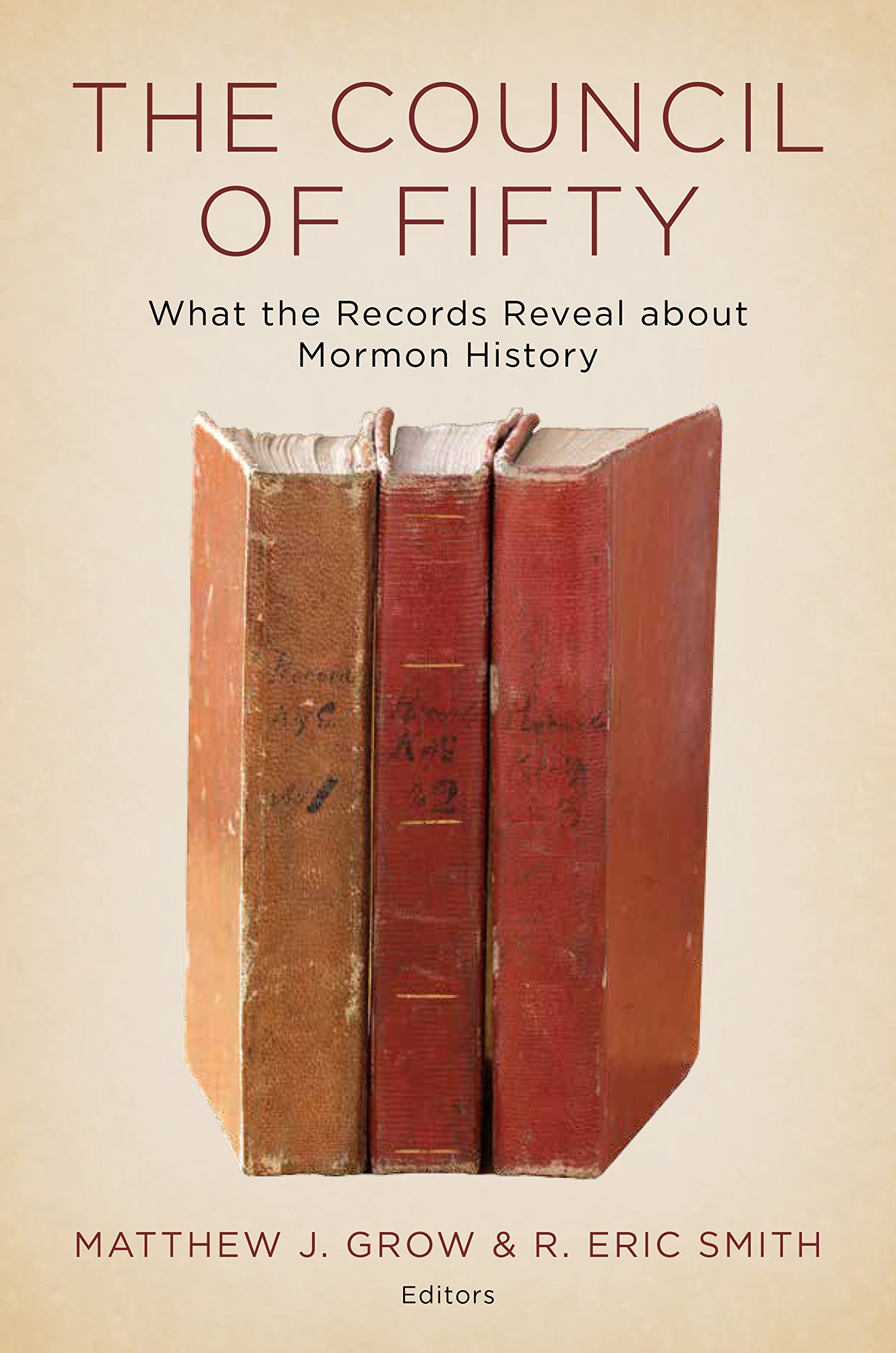
The Council of Fifty: What the Records Reveal about Mormon History
$38.56
by Matthew J. Grow



Three months before his death, Joseph Smith established the Council of Fifty, a confidential group that he believed would protect the Latter-day Saints in their political rights and one day serve as the government of the kingdom of God. The Council of Fifty operated under the leadership of Joseph Smith and then Brigham Young, playing a key role in Joseph Smith's presidential campaign and in preparing for the Mormon exodus to the West. The council's minutes had never been available until they were published by the Joseph Smith Papers in September 2016, meaning that the council has been the subject of intense speculation for 170 years. In this book of short essays, fifteen leading Mormon scholars explore how the newly available minutes alter and enhance our understanding of Mormon history. The scholars narrate and analyze the contributions of the records of the council to key questions, such as Joseph Smith's views of earthly and heavenly governments; the presidential campaign; Mormon relationships with American Indians; explorations of possible settlements sites, such as Texas and California; the "lost teachings" of Latter-day Saint leaders of that era; and the leadership style of Brigham Young. The fifteen essays in this collection are as follows: Richard Lyman Bushman, "The Separatist Impulse in the Nauvoo Council of Fifty"; Richard E. Turley Jr., "Injustices Leading to the Creation of the Council of Fifty"; Spencer W. McBride, "The Council of Fifty and Joseph Smith's Presidential Ambitions"; Patrick Q. Mason, "God and the People Reconsidered: Further Reflections on Theodemocracy in Early Mormonism"; Benjamin E. Park, "The Council of Fifty and the Perils of Democratic Governance"; Nathan B. Oman, "'We the People of the Kingdom of God': Constitution Writing in the Council of Fifty"; Gerrit J. Dirkmaat, "Lost Teachings of Joseph Smith, Brigham Young, and Other Church Leaders"; R. Eric Smith, "Insights into Mormon Record-Keeping Practices from the Council of Fifty Minutes"; Matthew J. Grow and Marilyn Bradford, "'To Carry Out Joseph's Measures Is Sweeter to Me Than Honey': Brigham Young and the Council of Fifty"; Jeffrey D. Mahas, "American Indians and the Nauvoo-Era Council of Fifty"; Matthew C. Godfrey, "A Monument to the Saints' Industry: The Nauvoo House and the Council of Fifty, 1845-46"; Christopher James Blythe, "'With Full Authority to Build Up the Kingdom of God on Earth': Lyman Wight on the Council of Fifty"; Richard E. Bennett, "'We Are a Kingdom to Ourselves': The Council of Fifty Minutes and the Mormon Exodus West"; Jedediah S. Rogers, "The Council of Fifty in Western History"; and W. Paul Reeve, "The Council of Fifty and the Search for Religious Liberty." "An excellent and up-to-date study of the Council of Fifty, a must-read for anyone interested in Mormon and American history." --Andrew H. Hedges, Associate Professor of Church History and Doctrine, Brigham Young University, and Coeditor of Journals 2 and Journals 3 of The Joseph Smith Papers "This volume will prove to be an invaluable asset to a broad audience of Latter-day Saints and those interested in the history of the American West in the mid-1800s. Its length and its concise treatment of the topic commends itself to a broad readership. A fine introduction to the Council of Fifty minutes." --Dale E. Luffman, for the Association for Mormon Letters "Accessible yet thought-provoking, The Council of Fifty is sure to be on the list of standard works on early Mormonism for years to come." --Stephen O. Smoot, for The Interpreter Foundation "An accessible and interesting first approach to the Council of Fifty." --Steve Evans, for By Common Consent "What makes the volume particularly helpful is the way in which the volume contributors analyze the Council of Fifty in relation to not only its specific Mormon environment but also the broader American and international historical context." --Courtney Jensen Peacock, for Juvenile Instructor Joseph Smith established the confidential group known as the Council of Fifty just months prior to his death. Before going to Carthage, he instructed William Clayton to destroy or hide the records of the council because he feared the candid conversations included in the minutes could be used against him in a court of law--or the court of public opinion. Clayton buried the records in his garden to protect them. While historians have known about the council, the minutes had never been released, and thus the mystique surrounding the minutes grew. What did they contain? Why had they been withheld? Indeed, the minutes became a sort of "holy grail" of early Mormon documents. The minutes have been a source of debate for over a hundred years. How will the Council of Fifty minutes change our understanding of Mormon history? Now, with the release of these documents we can see how the minutes of the Council of Fifty shape historical understanding, not just of Mormon history but of larger events in US and interna