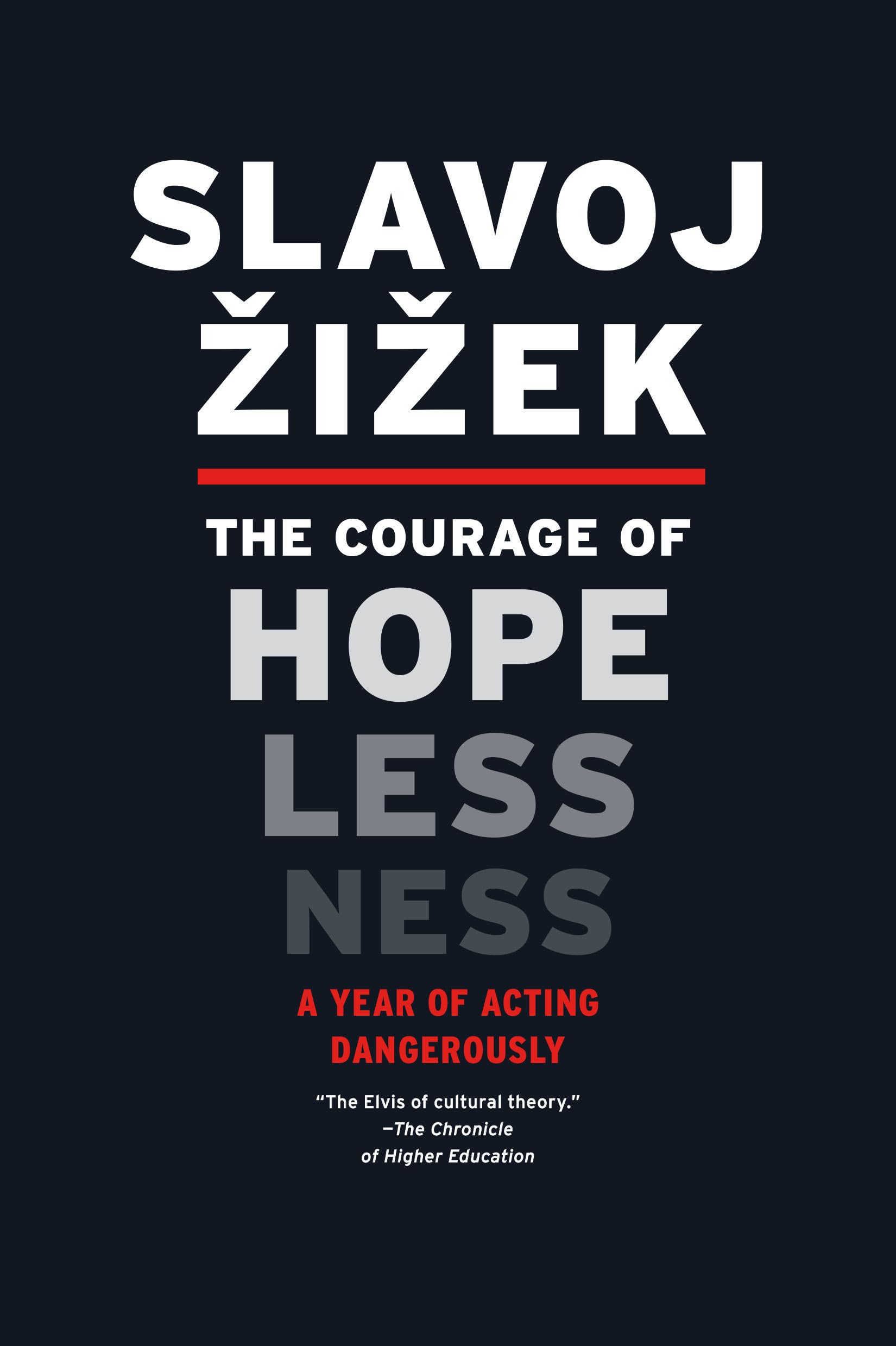



Maverick philosopher Slavoj Zizek returns to explore today's ideological, political and economic battles — and asks whether radical change is possible In these troubled times, even the most pessimistic diagnosis of our future ends with an uplifting hint that things might not be as bad as all that, that there is light at the end of the tunnel. Yet, argues Slavoj Zizek, it is only when we have admitted to ourselves that our situation is completely hopeless—that the light at the end of the tunnel is in fact the headlight of a train—that fundamental change can be brought about. Surveying the various challenges in the world today, from mass migration and geopolitical tensions to terrorism, the explosion of rightist populism and the emergence of new radical politics—all of which, in their own way, express the impasses of global capitalism—Zizek explores whether there still remains the possibility for genuine change. Today, he proposes, the only true question is,or should be, this: do we endorse the predominant acceptance of capitalism as fact of human nature, or does today's capitalism contain strong enough antagonisms to prevent its infinite reproduction? Can we, he asks, move beyond the failure of socialism, and beyond the current wave of populist rage, and initiate radical change before the train hits? “Zizek leaves no social or cultural phenomenon untheorized, and is master of the counterintuitive observation” — The New Yorker Slavoj Zizek is a Hegelian philosopher, Lacanian psychoanalyst, and political activist. He is international director of the Birkbeck Institute for the Humanities, and Global Distinguished Professor of German at New York University. He is the author of numerous books on dialectical materialism, critique of ideology and art, including Event, Trouble In Paradise , and Refugees, Terror and Other Troubles with the Neighbors , all published by Melville House. The Courage of Hopelessness Introduction: V for Vendetta, Part 2 In a wonderful comment on Italo Svevo’s novel Zeno’s Conscience , Alenka Zupančič deploys a systematic matrix of the relations between repetition and ending.1 The basic version is the false reference to the freedom of choice where (if we take the case of smoking) my awareness that I can stop smoking any time I want guarantees that I will never actually do it – the possibility of stopping smoking is what blocks the actual change; it allows me to accept our continuous smoking without bad conscience, so that the end of smoking is constantly present as the very source of its continuation. (As Zupančič perspicaciously notes, we should just imagine a situation in which the subject is under the sway of the following order: you can smoke or not, but once you start to smoke you have no choice, you are not allowed to end. Far fewer people would choose to smoke under this condition.) When I can no longer tolerate the hypocrisy of this endless excuse, the next step consists in an immanent reversal of this stance: I decide to smoke and I proclaim this to be the last cigarette in my life, so I enjoy smoking it with a special surplus provided by the awareness that this is my last cigarette…and I do this again and again, endlessly repeating the end, the last cigarette. The problem with this solution is that it only works (i.e., the surplus-enjoyment is only generated) if, each time that I proclaim this to be my last cigarette, I sincerely believe it is my last cigarette, so this strategy also breaks down. In Svevo’s novel, the next step is that the subject’s analyst (who, till now, has tried to convince Zeno that smoking is dangerous for his physical and mental health) changes his strategy and claims that Zeno should smoke as much as he wants since health is not really a problem – the only pathological feature is Zeno’s obsession with smoking, his passion to stop doing it. So what should be brought to an end is not smoking but the very attempt to smoke. Predictably (for anyone with analytic experience), the effect of this change is catastrophic: instead of finally feeling relieved and able to smoke (or not) without guilt, Zeno is totally perturbed and desperate. He smokes like crazy and nonetheless feels totally guilty, without getting any narcissistic satisfaction from this guilt. In despair, he breaks down. Whatever he does turns out to be wrong: neither prohibitions nor permissiveness work, there is no way out, no pleasurable compromise; and, since smoking has been the focus of his life, even smoking loses its sense, there is no point in it. So, in total despair – not as a great decision – he stops smoking …The way out thus emerges unexpectedly when Zeno accepts the total hopelessness of his predicament. And this same matrix should also be applied to the prospect of radical change. The predominant attitude among academic ‘radical Leftists’ is still the one that, back in 1937, George Orwell described apropos class difference: We all rail against class-distinctions, bu