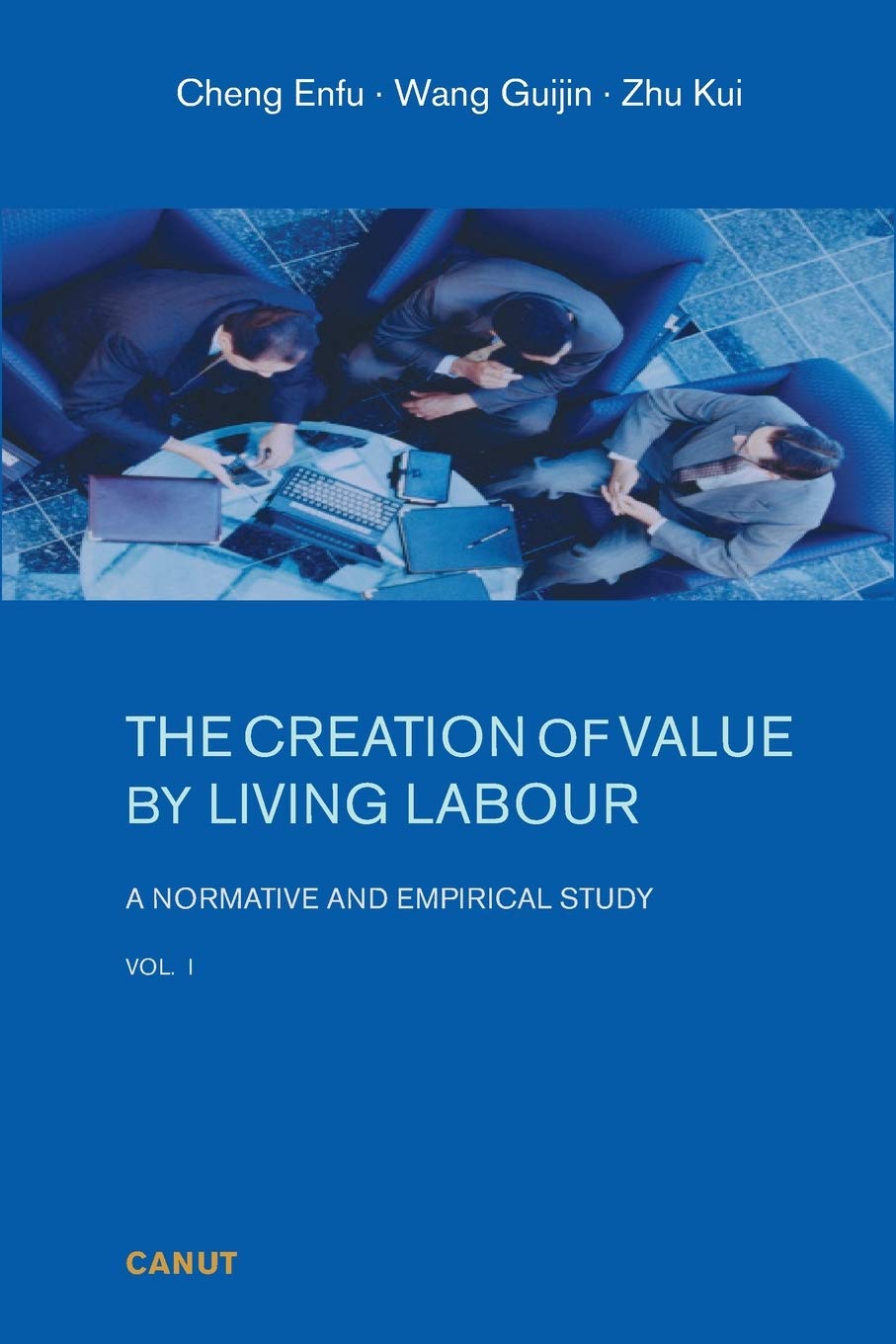
The Creation of Value by Living Labour: A Normative and Empirical Study - Vol. 1 (Volume)
$27.00
by Enfu Cheng



The book draws on Professor Cheng's "New Four Theory" on value, wealth, and distribution, among which the "new living labor value theory" is particularly creative. Its basic idea is as follows. According to Marx, all labor that directly produces physical and mental or cultural goods for exchange in the markets, or direct services for the production and reproduction of labor goods, including internal management labor and scientific and technical labor, falls in the category of value-creating labor or labor of production. The theory precisely follows Marx's train of thought in his analysis of material production, and extends it to all social and economic sectors. A second obstacle to understanding the specific role of labor in emergent labor-intensive technologies is the exclusive focus of neoclassical economics on private production. The underlying assumption is that of an ideal system of production conducted by entirely distinct legal entities, each producing only for the market and interacting with others only through the market. But the results of mental productive activities such as scientific labor, creative labor, and even management, increasingly take the form a general acquisition for society, which is therefore inherently social. Marx referred to this as "general social labor." Private labor, within an enterprise, draws both on this general social labor and on the inputs that it acquires through the market. The same also applies to much cultural labor, which forms part of the process through which labor power itself is reproduced, not least shaping its productive powers. The most obvious example of this is education, which even neoclassicals have to recognize, up to a point, as a "public good." China's economy involves a combination of ownership forms - public, private, and co-operative. Moreover, these ownership forms, under the definite and distinct conditions of Chinese society, are not necessarily the same as their formally identical equivalents in Western society, in exactly the same way that land ownership in 18th-century England, though formally the same as that prevailing in the French ancien régime of the same date, had already assumed capitalist characteristics far removed from those swept away in the revolution of 1789. Even completely private capital operates under significantly greater and even qualitatively different public constraints in China than those found in fully capitalist economies, and is able to call on public resources that are not found in the same form. It is of course true that public constraints and resources exist in all societies, even those that proudly proclaim their capitalist character. However much neoclassical economics ignores this fact, and speaks as if all production were as private as the monads of Leibnitz. As a result, it has to deploy elaborate circumlocutions to deny the obvious fact that government, education, health, caregiving, and countless other public activities not only contribute to the value and wealth of society, but form an indispensable mental infrastructure without which private production could not even take place, any more than it could subsist without air, water, or sunshine. Western theory does not even grant government, let alone the public realm, the status of a factor of production. No wonder it cannot account for China's growth. A breath of fresh air from China, this fascinating book lifts a veil from the influence of Marxist thinking in China's economic successes. It shows how debates initiated by Marxists lie at the forefront of a blend of policies whose striking achievements have little to do with Western economic orthodoxy. A major contribution to Marxist theory and a highly practical work, it confronts the complexity and uniqueness of China's economic miracle by developing Marxism in exciting and innovative ways. Offering Western readers an unparalleled introduction to the dynamism and breadth of Chinese Marxist thinking, it extends the boundaries of political economy in creative and productive directions of world-wide importance. Alan Freeman, Geopolitical Economy Research Group, University of Manitoba Prof. Cheng Enfu's "Shanghai School" of Marxist economics has brought together a group of Chinese scholars, whose work has unusual depth and breadth. Starting from classical Marxist foundations, with the theory of value at its center, they have studied both early and present-day sources, both Marxist and non-Marxist, from both China and around the world. The book uses qualitative analysis and quantitative methods, in theoretical and empirical applications. But this work is not just exposition and development of theory. The authors also apply their concept of value creation, derived from Marx but by no means rigidly confined to his ideas, to vital matters of policy, especially relevant to today's China and to the current explosion of high-tech services, managerial and cultural labor. Anyone interested in the Marxist politic