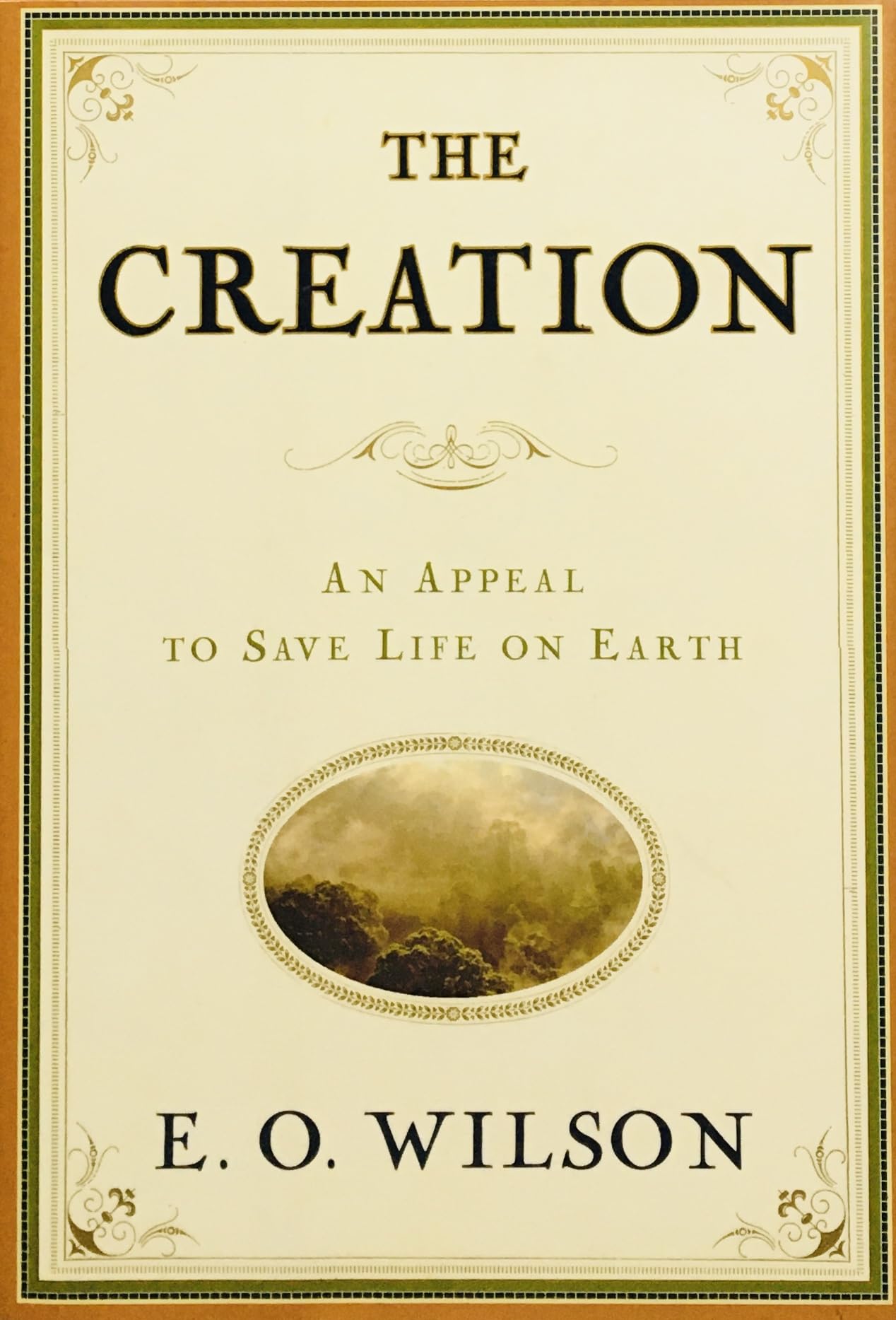



In this daring work, Edward O. Wilson proposes an alliance between science and religion to save Earth's vanishing biodiversity. Dear Pastor: We have not met, yet I feel I know you well enough to call you friend. First of all, we grew up in the same faith. Although I no longer belong to that faith, I am confident that if we met and spoke privately of our deepest beliefs, it would be in a spirit of mutual respect and goodwill. I write to you now for your counsel and help. Let us see if we can, and you are willing, to meet on the near side of metaphysics in order to deal with the real world we share. I suggest that we set aside our differences in order to save the Creation. The defense of living Nature is a universal value. It doesn't rise from nor does it promote any religious or ideological dogma. Rather, it serves without discrimination the interests of all humanity. Pastor, we need your help. The Creation―living Nature―is in deep trouble. The Creation is E. O. Wilson's most important work since the publications of Sociobiology and Biophilia . Like Rachel Carson's Silent Spring , it is a book about the fate of the earth and the survival of our planet. Yet while Carson was specifically concerned with insecticides and the ecological destruction of our natural resources, Wilson, the two-time Pulitzer Prize-winner, attempts his new social revolution by bridging the seemingly irreconcilable worlds of fundamentalism and science. Like Carson, Wilson passionately concerned about the state of the world, draws on his own personal experiences and expertise as an entomologist, and prophesies that half the species of plants and animals on Earth could either have gone or at least are fated for early extinction by the end of our present century. Astonishingly, The Creation is not a bitter, predictable rant against fundamentalist Christians or deniers of Darwin. Rather, Wilson, a leading "secular humanist," draws upon his own rich background as a boy in Alabama who "took the waters," and seeks not to condemn this new generations of Christians but to address them on their own terms. Conceiving the book as an extended letter to a southern Baptist minister, Wilson, in stirring language that can evoke Martin Luther King's "Letter from Birmingham Jail," tells this everyman minister how, in fact, the world really came to be. He pleads with these men of the cloth to understand the cataclysmic damage that is destroying our planet and asks for their help in preventing the destruction of our Earth before it is too late. Never a pessimist, Wilson avers that there are solutions that may yet save the planet, and believes that the vision that he presents in The Creation is one that both scientists and pastors can accept, and work on together in spite of their fundamental ideological differences. Famed entomologist, humanist thinker, and cogent writer Wilson issues a forthright call for unity between religion and science in order to save the "creation," or living nature, which is in "deep trouble." Addressing his commonsensical yet ardent discourse to "Dear Pastor," he asks why religious leaders haven't made protecting the creation part of their mission. Forget about life's origins, Wilson suggests, and focus on the fact that while nature achieves "sustainability through complexity," human activities are driving myriad species into extinction, thus depleting the biosphere and jeopardizing civilization. Wilson celebrates individual species, each a "masterpiece of biology," and acutely analyzes the nexus between nature and the human psyche. In the book's frankest passages, he neatly refutes fantasies about humanity's ability to re-create nature's intricate web, and deplores the use of religious belief (God will take care of it) as an impediment to conservation. Wilson's eloquent defense of nature, insights into our resistance to environmental preservation, and praise of scientific inquiry coalesce in a blueprint for a renaissance in biology reminiscent of the technological advances engendered by the space race. Donna Seaman Copyright © American Library Association. All rights reserved A blueprint for a renaissance in biology reminiscent of the technological advances engendered by the space race. -- Donna Seaman, Booklist One of his most disturbing, moving, and important books. Wilson speaks with a humane eloquence which calls to us all. -- Oliver Sacks [E. O. Wilson's] magnificent and world-changing contributions are brilliantly made accessible to the broad public. -- Jeffrey Sachs, Columbia University Edward O. Wilson (1929-2021) was the author of more than thirty books, including Anthill , Letters to a Young Scientist , and The Conquest of Nature . The winner of two Pulitzer Prizes, Wilson was a professor emeritus at Harvard University and lived with his wife in Lexington, Massachusetts.