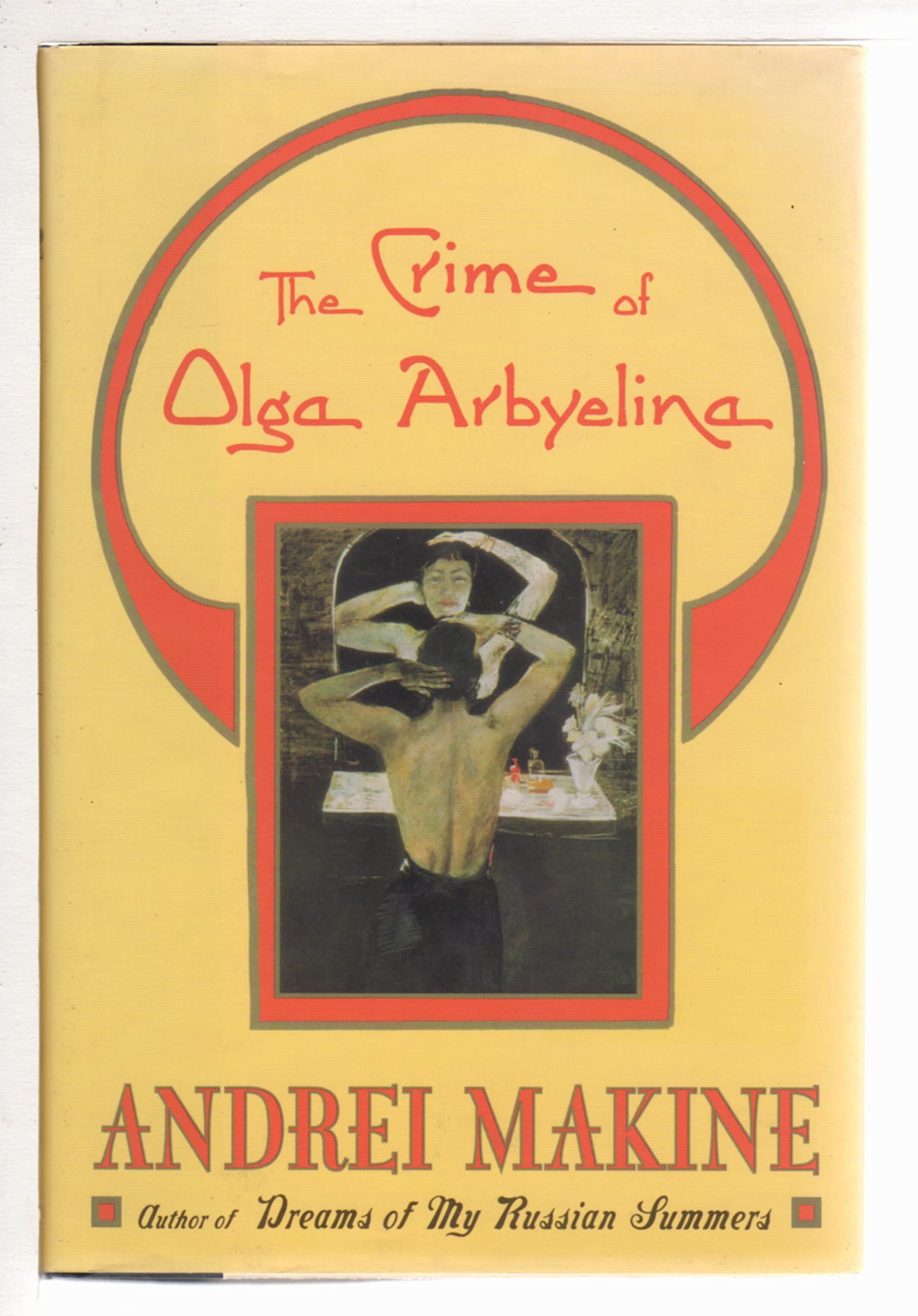



Olga Arbyelina--a Russian princess, refugee from the Bolsheviks, and abandoned wife--is found half-naked on the riverbank, next to the body of a man who mysteriously drowned, in a new novel by the critically acclaimed author of Dreams of My Russian Summers. 35,000 first printing. Tour. Olga Arbyelina is a princess who fled Russia during the revolution; now she lives in a town near Paris tending to her hemophiliac son, keeping ghosts at bay--an existence hollowed out by history. The town gossips obsess over her, making her into the prime character in their "game of a thousand voices." They "had a fleeting dream of figuring in a poignant melodrama called The Exiled Princess ." When she is found lying next to a dead man on the local riverbank, her fame only increases. The Crime of Olga Arbyelina begins with this grim discovery and moves backward, trying to find the erotic transgressions and terrible secrets that separate this exile from the tired and ordinary world. Andrei Makine resembles his heroine in that he is a kind of runaway; born in 1958, he fled the Soviet Union for France. There he wrote about his homeland in his adopted tongue. The well-received novels Once Upon the River Love and Dreams of My Russian Summers first appeared in French and have since been translated widely. Perhaps it is all these layers of language and memory that make his prose so thick and difficult; clearly there is a great clumsiness in this particular translation, which is rife with sentences like "She was breathing jerkily," and "A thought struck her with the painfulness and beauty of its truth." Ultimately, such writing sabotages The Crime of Olga Arbyelina , fogging up the book's exotic landscape. Translations can work two ways: they can transport you into a world of strange new music, or they can feel like schoolwork. This book is definitely the latter: you know it's supposed to be a learning experience, but the difficult, self-serious prose makes you want to resist, stare at the clock, play hooky. --Emily White As this moody tale opens, Olga, a beautiful Russian emigr? now estranged from her husband, Prince Arbyelin, and living in the little village of Villiers-la-For?t, is acquitted of murdering a fellow emigr? despite her protestations of guilt. The reader eventually discovers, however, that the real "crime" occupying Olga's mind is quite different. Over the past months, she has discovered a residue of sleeping powder in her nightly tea; her hemophiliac son, ever on the verge of death, has been drugging her so that he can engage in sexual explorationAsomething to which she finally consents, pretending to sleep. Of course, this being a novel by Makine (Dreams of My Russian Summers), this act of incest is nowhere near as baldly stated. Instead, in luminous, hypnotic prose that is a bit like a drug itself, he unfolds the delicate situation between mother and son, seen as if through half-closed eyes. These passages at times seem overlong and overwrought, but the description of Russia on the verge of revolution is gripping and the ending a melancholy shock well worth the wait.ABarbara Hoffert, "Library Journal" Copyright 1999 Reed Business Information, Inc. The third novel by the author of Dreams of My Russian Summers (1997), an impressionistic exploration of the inner life of a woman on an emotional tightwire, tries to out-Nabokov Nabokov. The story, which is told somewhat as a recollection by a narrator who seems to know more than he should, begins in 1947 in a French village, home to a small group of Russian emigres. One of the emigres has drowned, perhaps been murdered, and the prime suspect is another member of the expatriate circle, Princess Olga Arbyeline. Then the story jumps even further backward to her childhood and early adulthood amid the Russian elite, where, for Olga, illusion and reality often blend together. Indeed, her illusions are a refuge from the dull pain of reality, though in the end they take their toll upon her. All of this is made clear by her sexual history, a Freudian complex of pain and pleasure. Makine's style perfectly fits his subject, but for the most part it all seems a little too cloying, though the novel has garnered praise on the Continent. Frank Caso Another astonishingly beautiful story from Makine (Once Upon the River Love, 1998), this one unutterably sad, plumbing the depths of an migr Russian mother's despair at the course of her son's sexual awakening during the bitter postwar winter of 1946 in rural France. Fittingly enough, Princess Arbyelina's tragedy is related over the course of a long night by the gatekeeper at the cemetery where she's buried. He starts by describing a summer scene of two wet bodies on a riverbank: one, Olga's, alive but clothed in tatters and unmoving; the other, a corpulent, suited ex-Russian officer, freshly dead. How they came to be there involves the previous winter, the worst in a century, and the migr community settled in an abandoned brewe