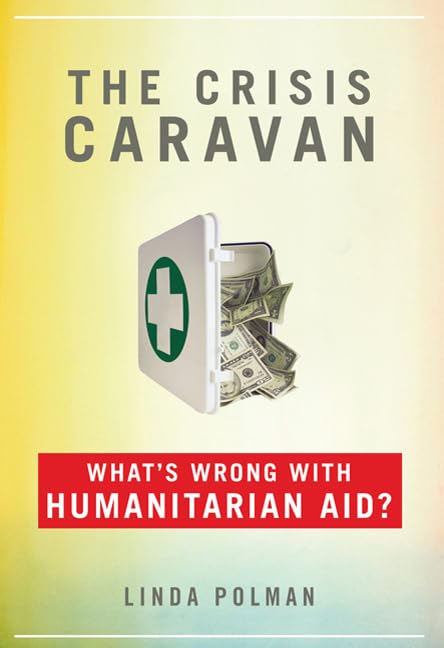



A no-holds-barred, controversial exposé of the financial profiteering and ambiguous ethics that pervade the world of humanitarian aid A vast industry has grown up around humanitarian aid: a cavalcade of organizations—some 37,000—compete for a share of the $160 billion annual prize, with "fact-inflation" sometimes ramping up disaster coverage to draw in more funds. Insurgents and warring governments, meanwhile, have made aid a permanent feature of military strategy: refugee camps serve as base camps for genocidaires, and aid supplies are diverted to feed the troops. Even as humanitarian groups continue to assert the holy principle of impartiality, they have increasingly become participants in aid's abuses. In a narrative that is impassioned, gripping, and even darkly absurd, journalist Linda Polman takes us to war zones around the globe—from the NGO-dense operations in "Afghaniscam" to the floating clinics of Texas Mercy Ships proselytizing off the shores of West Africa—to show the often compromised results of aid workers' best intentions. It is time, Polman argues, to impose ethical boundaries, to question whether doing something is always better than doing nothing, and to hold humanitarians responsible for the consequences of their deeds. “Particularly timely just now… Polman finds moral hazard on display wherever aid workers are deployed. In case after case, a persuasive argument can be made that, over-all, humanitarian aid did as much or even more harm than good… Her style is brusque, hard-boiled, with a satirist’s taste for gallows humor. Her basic stance is: J’accuse .” —Philip Gourevitch, The New Yorker Linda Polman is an Amsterdam-based journalist who for fifteen years has reported from war zones for a range of European radio stations and newspapers. She is the author of We Did Nothing , which was shortlisted for the Lettre Ulysses Award for the Art of Reportage. Introduction The humane desire to lighten a little the torments of all these poor wretches . . . creates a kind of energy which gives one a positive craving to relieve as many as one can. —Henri Dunant, humanitarian aid worker and founder of the International Committee of the Red Cross (ICRC)1 Imagine that you're an international humanitarian aid worker in a war zone and faithful to the principles of the Red Cross, as any good humanitarian should be. In other words, you're impartial, neutral, and independent. It's your responsibility to relieve human suffering, irrespective of the people involved and the situation on the ground. This time your mission has taken you to a refugee camp in Darfur. You do what you can for the victims, but soldiers exploit your efforts. They demand money for every well you dig and levy sky-high taxes, imposed on the spot, on all the sacks of rice and tents and medicines you arrange to have flown in. They consume a slice of your aid supplies and sell another slice. Among the items they buy with the proceeds are weapons, which they use to drive yet more people into your refugee camp or even to their deaths. What do you do? Do you conclude that it is no longer possible to cling to the principles of the Red Cross, pack your bags, and leave to help war victims elsewhere? Or do you remain true to your convictions, believing that even if you save only one human life, some relief is better than none? Leave, or continue providing aid at any price? It's a centuries-old dilemma. Two of the world's first international humanitarian aid workers, Florence Nightingale and Henri Dunant, fundamentally disagreed as to which would be the right choice. Nightingale was convinced that aid fails in its purpose if the warring parties use it to their own advantage. Dunant firmly believed in the duty to help no matter what. Dunant, born into a Calvinist milieu in Switzerland, was a banker and businessman in Geneva. In 1859, he witnessed the Battle of Solferino during the war between Austria and the Franco-Sardinian Alliance. Of the three hundred thousand men and boys on the sixteen-mile front line in Lombardy, forty thousand were killed. Another forty thousand soldiers were wounded. They lay on the battlefield, where most were left to die. In the book that Dunant published three years after this experience, Un Souvenir de Solferino (A Memory of Solferino), he describes the spectacle the morning after the engagement: Bodies of men and horses covered the battlefield; corpses were strewn over roads, ditches, ravines, thickets and fields; the approaches to Solferino were literally thick with dead. The poor wounded men were ghostly pale and exhausted. . . . Some, who had gaping wounds already beginning to show infection, were almost crazed with suffering. They begged to be put out of their misery, and writhed with faces distorted in the grip of the death struggle. . . . In some quarters there was no water, and the thirst was so terrible that officers and men alike fell to drinking from muddy pools whose water was foul and filled with