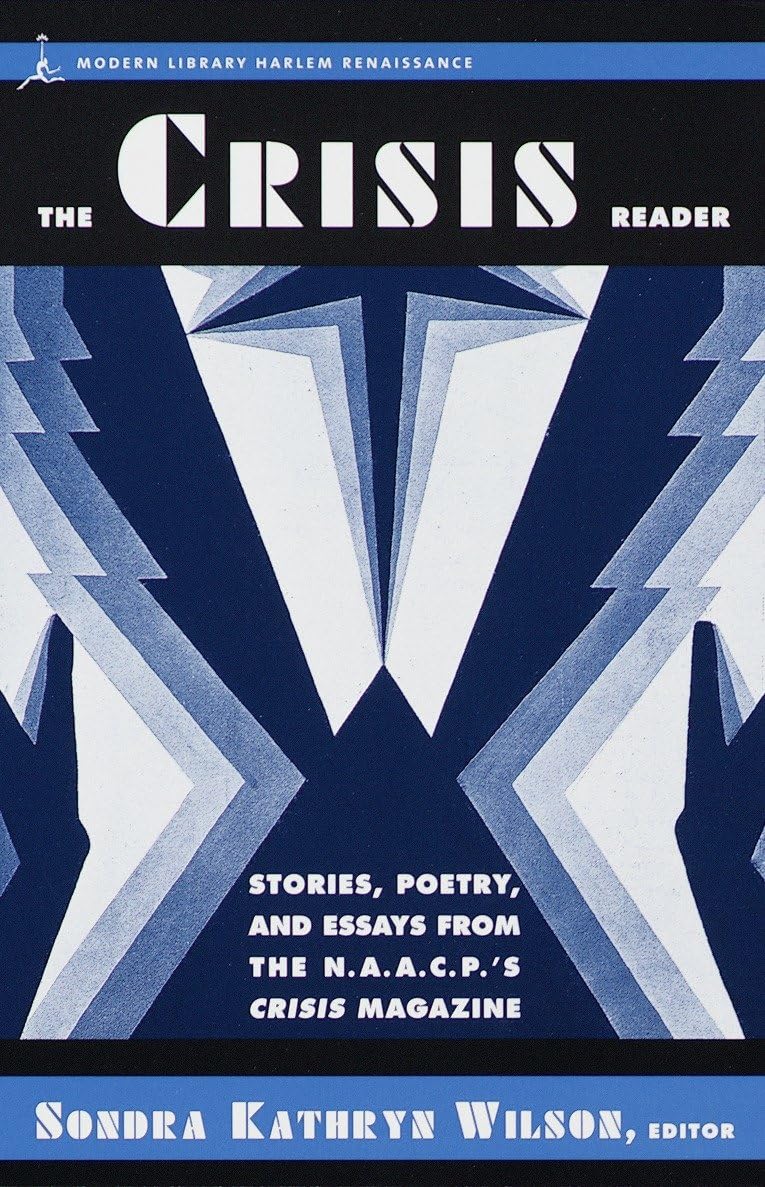
The Crisis Reader: Stories, Poetry, and Essays from the N.A.A.C.P.'s Crisis Magazine (Harlem Renaissance)
$17.26
by Dr. Sondra Kathryn Wilson



After its start in 1910, The Crisis: A Record of the Darker Races magazine became the major outlet for works by African American writers and intellectuals. In 1920, Langston Hughes's poem "The Negro Speaks of Rivers" was published in The Crisis and W. E. B. Du Bois, the magazine's editor, wrote about the coming "renaissance of American Negro literature," beginning what is now known as the Harlem Renaissance. The Crisis Reader is a collection of poems, short stories, plays, and essays from this great literary period and includes, in addition to four previously unpublished poems by James Weldon Johnson, work by Countee Cullen, Langston Hughes, Jessie Fauset, Charles Chesnutt, W. E. B. Du Bois, and Alain Locke. When the towering African American intellectual W.E.B. Du Bois helped found the National Association for the Advancement of Colored People in 1909, he also launched a magazine as a literary extension of the organization. The Crisis: A Record of the Darker Races was first published in 1910, articulating the social, political, and economic concerns of blacks on a national and international scale--and showcasing many Afro-American writers, playwrights, and intellectuals who later became household names. This collection--drawn mostly from material published in the 1920s--contains the race-examining fiction of Charles Chestnutt and Jessie Fauset; an early personal essay on racial relations from sociologist E. Franklin Frazier; Du Bois and philosopher Alain Locke's critique "The Younger Negro Movement"; and "The Work of a Mob," by activist Walter White, whose ability to pass for "white" enabled him to deliver chilling eyewitness accounts of lynching. As its editor, Sondra Kathryn Wilson, writes, "This rich collection ... written during some of the most egregiously racist times in American history, will be an affirmation that black American literature has long been the most sophisticated in the world." --Eugene Holley Jr. "The world does not know that a people is great until that people produces great literature and art." --James Weldon Johnson "Until The Crisis Reader, no broad collection of writings from one of America's most influential journals of opinion existed. Sondra Kathryn Wilson has remedied this amazing lacuna with her excellent edition. It will be an indispensable source from the moment of issue." --David Levering Lewis, author of the Pulitzer Prize-winning biography W. E. B. Du Bois "The Crisis Reader offers riches from the heyday of black America' s most significant journal. Here are all the now famous names and their now famous poems and articles, and others undeservedly unknown today. Any serious student of black literature and politics will want this volume, as will those many others who long for a look at yesterday, when black bards sang." --Julian Bond, chairman of the board, N.A.A.C.P. After its start in 1910, The Crisis: A Record of the Darker Races magazine became the major outlet for works by African American writers and intellectuals. In 1920, Langston Hughes's poem "The Negro Speaks of Rivers" was published in The Crisis and W. E. B. Du Bois, the magazine's editor, wrote about the coming "renaissance of American Negro literature," beginning what is now known as the Harlem Renaissance. The Crisis Reader is a collection of poems, short stories, plays, and essays from this great literary period and includes, in addition to four previously unpublished poems by James Weldon Johnson, work by Countee Cullen, Langston Hughes, Jessie Fauset, Charles Chesnutt, W. E. B. Du Bois, and Alain Locke. After its start in 1910, The Crisis: A Record of the Darker Races magazine became the major outlet for works by African American writers and intellectuals. In 1920, Langston Hughes's poem "The Negro Speaks of Rivers" was published in The Crisis and W. E. B. Du Bois, the magazine's editor, wrote about the coming "renaissance of American Negro literature," beginning what is now known as the Harlem Renaissance. The Crisis Reader is a collection of poems, short stories, plays, and essays from this great literary period and includes, in addition to four previously unpublished poems by James Weldon Johnson, work by Countee Cullen, Langston Hughes, Jessie Fauset, Charles Chesnutt, W. E. B. Du Bois, and Alain Locke. Sondra Kathryn Wilson is a senior researcher at Harvard's W. E. B. Du Bois Institute, and editor of several volumes of the work of James Weldon Johnson. She lives in New York City. Gwendolyn Bennett To Usward Let us be still As ginger jars are still Upon a Chinese shelf. And let us be contained By entities of Self. . . . Not still with lethargy and sloth, But quiet with the pushing of our growth. Not self-contained with smug identity But conscious of the strength in entity. If any have a song to sing That's different from the rest, Oh let them sing Before the urgency of Youth's behest! For some of us have songs to sing Of jungle heat and fires, And some of us are solemn