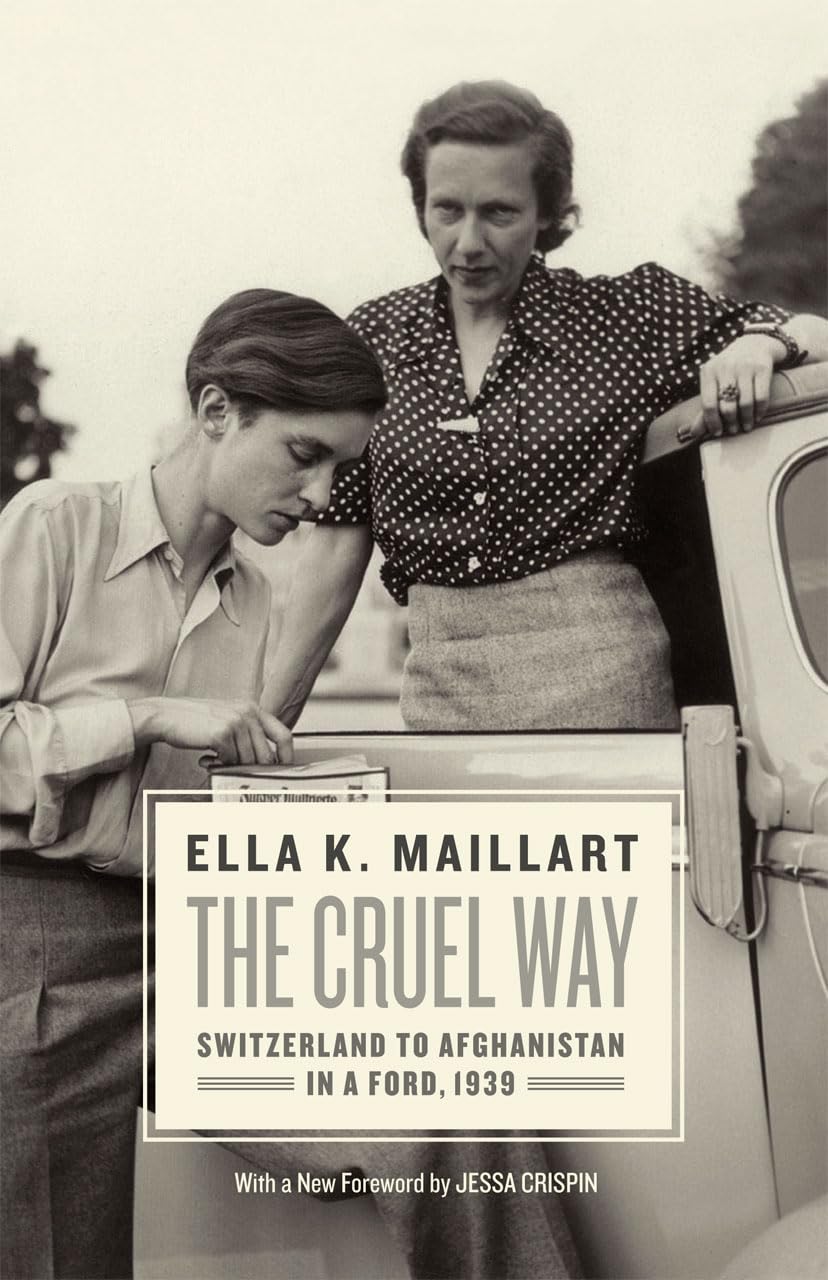



In 1939 Swiss travel writer and journalist Ella K. Maillart set off on an epic journey from Geneva to Kabul with fellow writer Annemarie Schwarzenbach in a brand new Ford. As the first European women to travel alone on Afghanistan’s Northern Road, Maillart and Schwarzenbach had a rare glimpse of life in Iran and Afghanistan at a time when their borders were rarely crossed by Westerners. As the two flash across Europe and the Near East in a streak of élan and daring, Maillart writes of comical mishaps, breathtaking landscapes, vitriolic religious clashes, and the ingenuity with which the women navigated what was often a dangerous journey. In beautiful, clear-eyed prose, The Cruel Way shows Maillart’s great ability to explore and experience other cultures in writing both lyrical and deeply empathetic. While the core of the book is the journey itself and their interactions with people oppressed by political conflict and poverty, towards the end of the trip the women’s increasingly troubled relationship takes center stage. By then the glamorous, androgynous Schwarzenbach, whose own account of the trip can be found in All the Roads Are Open , is fighting a losing battle with her own drug addiction, and Maillart’s frustrated attempts to cure her show the profound depth of their relationship. Complete with thirteen of Maillart’s own photographs from the journey, The Cruel Way is a classic of travel writing, and its protagonists are as gripping and fearless as any in literature. “Ella K. Maillart—it is she who matters, though her capital I’s are few. The picture of herself is better than many superb photographs: a woman of the twentieth century, with a nostalgia for the primitive; always hungry for new places and new people, but sufficient to herself." ― Pacific Affairs “We need [Maillart] to challenge what we think the story of two women traveling in the East can do. We need her to disrupt our detachment. . . . What she has found is a world of beauty and hope, a world worth going out into.” ― Jessa Crispin, editor-in-chief of Bookslut “Her descriptions and observations shine with intelligence and beauty. . . . Her abilities to grasp a region in all its dimensions, and to involve the emerging national character in her own drama, are the marks of the best kind of travel writer." -- Sara Neustadtl ― Women’s Review of Books “I love The Cruel Way for its silences. They point towards other horizons and suggest other journeys. To quote Celine, 'they put your imagination to work.'” -- Frédéric Vitoux Jessa Crispin is the author of Why I Am Not a Feminist: A Feminist Manifesto and The Dead Ladies Projec t, the latter also published by the University of Chicago Press. She has written for the New York Times , Guardian , and Spectator , among other publications. Originally from Lincoln, Kansas, she currently resides in Philadelphia. The Cruel Way Switzerland to Afghanistan in a Ford, 1939 By Ella K. Maillart The University of Chicago Press Copyright © 1947 Ella K. Maillart All rights reserved. ISBN: 978-0-226-03304-4 Contents 1. THE IDEA, 2. THE START, 3. ITALY, 4. YUGOSLAVIA, 5. SOFIA, 6. ISTANBUL, 7. BLACK SEA, 8. PONTIC RANGE, 9. BAYAZIT, 10. AZERBAIJAN, 11. ROADS, 12. NIKPEH, 13. SULTANIEH, 14. TEHERAN, 15. GUMBAD-I-KABUS, 16. KHORASSAN, 17. MESHED, 18. ABBAS ABAD, 19. THE BORDER, 20. HERAT, 21. BALA MURGHAU, 22. SHIBARGAN, 23. TURKESTAN, 24. POL-I-KHUMRI, 25. DO-AU, 26. BAMIAN, 27. BAND-I-AMIR, 28. BEGRAM, 29. KABUL, 30. MANDU, ENVOI, DATES, BIBLIOGRAPHY, HEIGHTS AND DISTANCES, INDEX, CHAPTER 1 THE IDEA "If it's not warmer to-morrow when I take you to the station, the car might easily break down: it can no longer cope with such frosts." Christina made that remark by the way and I hardly heard it, for my thoughts were still in Prague: she had just described the soul of that city, the life of her Czech friends, their utter helplessness and despair as the might of Hitler approached them with steady relentlessness. We were both looking through the small window-panes of her peasant's house in the Engadine. Winter ruled. Across the valley, clouds hid the slope of the Fextal where we had skied that morning between luminous red-brown larches. A dark, low sky oppressed the valley—shadowless, dead. Though high in the Alps, the land looked flat and broad, for the house stood by a lake now frozen hard under many layers of snow. Nothing but that desolate expanse barred us from the southern horizon where the Maloja pass leads into Italy. Christina must have added: "The car is worn out and Father has promised me a Ford"; I only heard that last name and it seems to have been responsible for all. That one word was enough; flocking ideas arranged themselves in the right order, vague tendencies crystallised into a solid plan. As if it were a kind of long-drawn echo, I heard a voice like mine begin to say: "A Ford! That's the car to climb