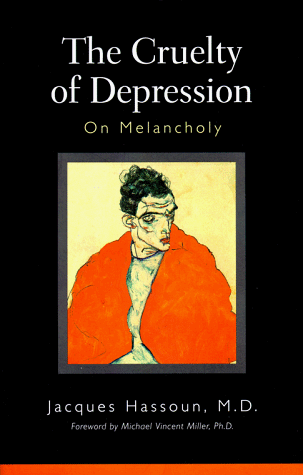



Melancholy, which came to be known as depression only in the twentieth century, continues to occupy a central place in psychoanalytic theory.The distinguished French psychoanalyst Jacques Hassoun offers here a brief but far-reaching treatise on the true nature and origins of depression, arguing that it is a matter of temperament, not a disease to by cured by Prozac or other drugs. Hassoun asserts that depression and all addictions are rooted in the same experience: a disruption in the weaning of the child from the mother that results in a profound sadness and an inability to experience loss. This disruption affects every aspect of the melancholic's life, and is at the core of his damaged existence.Hassoun believes that depression may be cured only by understanding the roots of the malady in early childhood. He analyzes the causes and manifestations of depressionusing moving case studies from his own practice, literary examples (from Melville and Kafka, among others), and a framework based on the theory of the influential French psychoanalyst Jacques Lacanto illustrate the melancholic's inability to grieve. Hassoun reinterprets Lacanian Theory to make it both more accessible and anecdotal, and he offers evidence that enlightened psychotherapy can treat the melancholic's agonizing condition.At once incisive and deeply personal, The Cruelty of Depression brings a sense of new possibilities fro relief from depressive suffering. It is an important and provocative addition to the growing debate on the treatment of depression. Eloquently introduced by psychotherapist and author Michael Vincent Miller, this is the first work by prolific French psychoanalyst Hassoun to be translated into English. Readers unfamiliar with the work of Jacques Lacan will have trouble with such sentences as "The exalted bond of passion is sustained by an imaginary situated in a beyond of desire." But there is much in this small, dense, literate work to reward those who want to grapple with philosophical psychology. Hassoun gives vivid cases (including Melville's Bartleby) to illustrate his thesis that melancholy is an enigmatic problem of desire, passion, and loss, "plunging the subject into the infinite sorrow of an impossible bereavement." Elsewhere, Hassoun addresses a great many topics, society and culture, the city and the century past, and evil and the need for meaning among them. Miller's foreword is a fine introduction to a deeply searching and humane contribution to psychoanalytic thought. The book's difficulty, however, makes it suitable mainly for specialized collections in psychology.?E. James Lieberman, George Washington Univ. Sch. of Medicine, Washington, D.C. Copyright 1997 Reed Business Information, Inc.