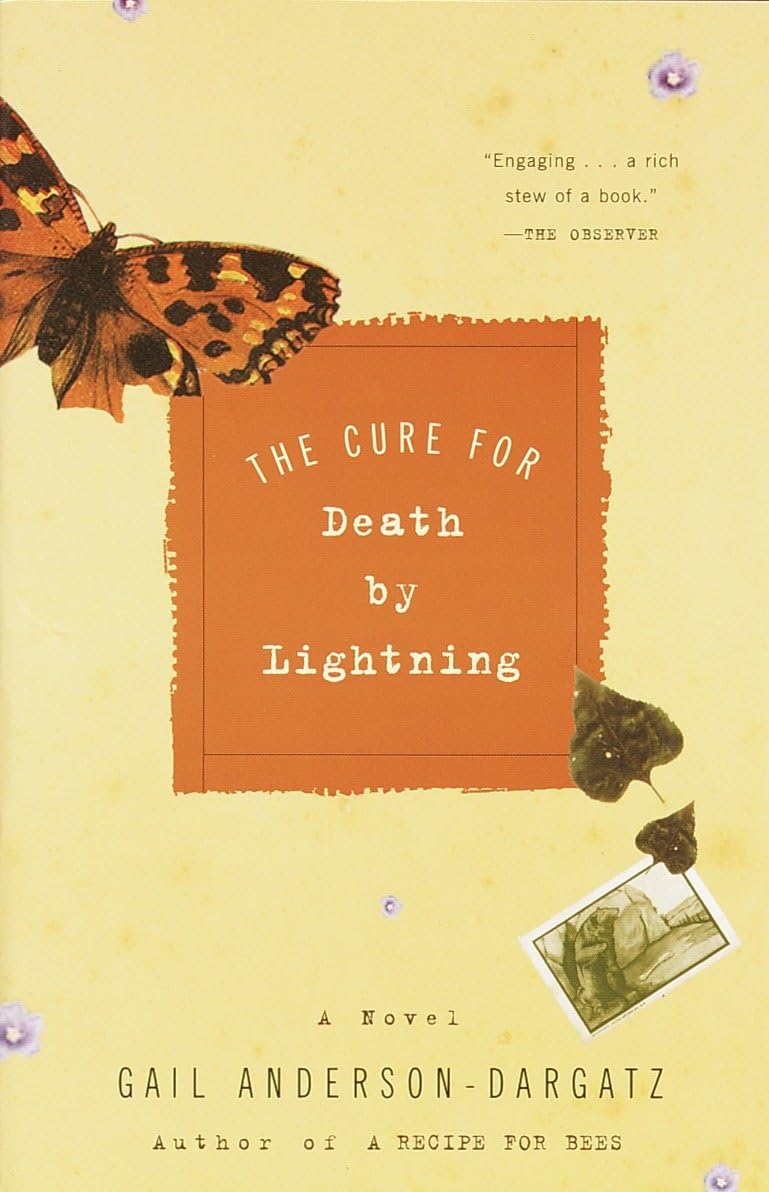



When fifteen-year-old Beth Week’s family is attacked by a grizzly, her father becomes increasingly violent, making him a danger to his neighbors, his family, and especially Beth. Meanwhile, several young children from the nearby Indian reservation have gone missing, and Beth fears that something is pursuing her in the bush. But friendship with an Indian girl connects her to a mythology that enriches her landscape; and an unexpected protector shores up her world. Set on an isolated Canadian farm in the midst of World War II, The Cure for Death by Lightning evokes a life at once harshly demanding and rich in sensory pleasures: the deafening chatter of starlings, the sight of thousands of painted turtles crossing a road, the smell of baking that fills the Weeks’s kitchen. The novel is sprinkled throughout with recipes and remedies from the scrapbook Beth’s mother keeps, a boon to Beth as she learns to face down her demons--and one of many elements that give The Cure for Death by Lightning its enchanting vitality. “Engaging…a rich stew of a book.”– The Observer “Haunting, stunning…. Anderson-Dargatz creates a multi-layered tale of power and suspense.”– Toronto Star “Superlative.… Flowers rain from the sky in this book.”– Toronto Globe and Mail “Brilliant. . . . A wonderful and challenging, truly bewitching novel.” – Edmonton Journal When fifteen-year-old Beth Week?s family is attacked by a grizzly, her father becomes increasingly violent, making him a danger to his neighbors, his family, and especially Beth. Meanwhile, several young children from the nearby Indian reservation have gone missing, and Beth fears that something is pursuing her in the bush. But friendship with an Indian girl connects her to a mythology that enriches her landscape; and an unexpected protector shores up her world. Set on an isolated Canadian farm in the midst of World War II, The Cure for Death by Lightning evokes a life at once harshly demanding and rich in sensory pleasures: the deafening chatter of starlings, the sight of thousands of painted turtles crossing a road, the smell of baking that fills the Weeks?s kitchen. The novel is sprinkled throughout with recipes and remedies from the scrapbook Beth?s mother keeps, a boon to Beth as she learns to face down her demons--and one of many elements that give The Cure for Death by Lightning its enchanting vitality. When fifteen-year-old Beth Week's family is attacked by a grizzly, her father becomes increasingly violent, making him a danger to his neighbors, his family, and especially Beth. Meanwhile, several young children from the nearby Indian reservation have gone missing, and Beth fears that something is pursuing her in the bush. But friendship with an Indian girl connects her to a mythology that enriches her landscape; and an unexpected protector shores up her world. Set on an isolated Canadian farm in the midst of World War II, The Cure for Death by Lightning evokes a life at once harshly demanding and rich in sensory pleasures: the deafening chatter of starlings, the sight of thousands of painted turtles crossing a road, the smell of baking that fills the Weeks's kitchen. The novel is sprinkled throughout with recipes and remedies from the scrapbook Beth's mother keeps, a boon to Beth as she learns to face down her demons--and one of many elements that give The Cure for Death by Lightning its enchanting vitality. Gail Anderson-Dargatz, whose fictional style has been coined as “Pacific Northwest Gothic” by the Boston Globe , has been compared by critics to John Steinbeck, William Faulkner, Flannery O’Connor, Margaret Atwood, Alice Munro, Salman Rushdie and Gabriel García Márquez. Her novels have been published worldwide in English and in many other languages. A Recipe for Bees and The Cure for Death by Lighting were international bestsellers, published worldwide in English and in many other languages, and were both short-listed for the prestigious Giller Prize in Canada. The Cure for Death by Lightning won the UK’s Betty Trask Prize among other awards. A Rhinestone Button was a national bestseller in Canada and her first book, The Miss Hereford Stories , was short-listed for the Leacock Award for humour. Her mother, who also wrote, instilled literary confidence in Gail, so that by the age of eighteen, Gail knew she wanted to be the next Margaret Laurence, writing about Canadian women in rural settings. "Laurence's interest in them made me feel that their and my experience was important." In her early twenties, the future author got a job as a reporter for her hometown paper, the Salmon Arm Observer , but continued to enter her fiction in competitions, and she started to win. One submission caught the attention of the writer Jack Hodgins, who encouraged her to enroll in his course at the University of Victoria. She graduated from there with a B.A. in creative writing. Gail's literary career began to take off when she won first prize in the CBC Lite