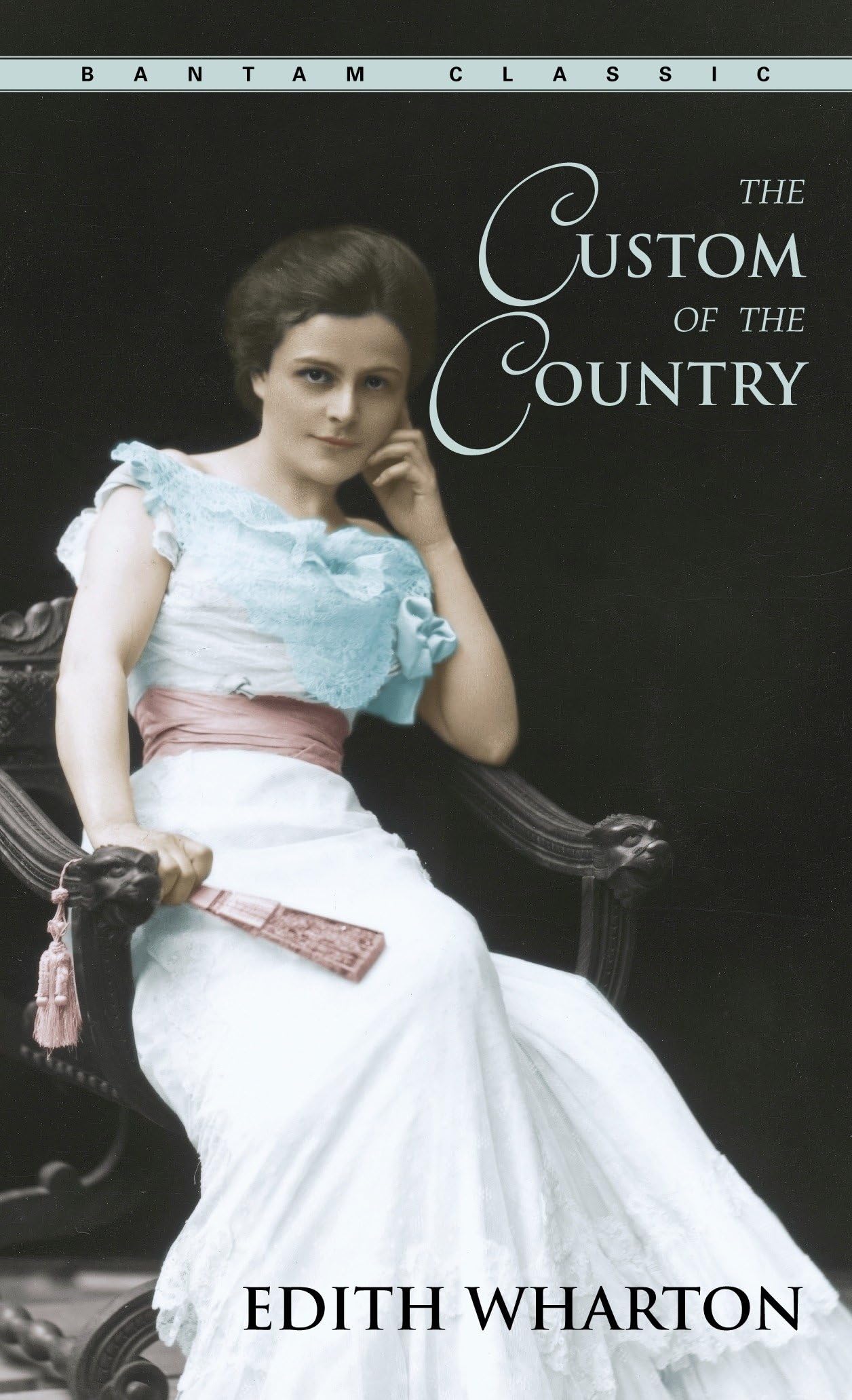



The classic satire of New York society and the American Dream through the misadventures of an insatiable young striver Ambitious and wholeheartedly materialistic, Undine Spragg is a beautiful heiress who sees men as a means to an end. New York millionaires and French aristocrats fall at her feet, but each conquest is merely a stepping-stone in Undine’s quest for power and position—and in her elusive search for happiness. A biting satire from one of America’s greatest writers, The Custom of the Country features a compelling and driven antiheroine, a sharp-eyed critique of the marriage market and its objectification of women, and a knowing send-up of Gilded Age snobbery. "Edith Wharton's finest achievement."—Elizabeth Hardwick First published in 1913, Edith Wharton's The Custom Of The Country is scathing novel of ambition featuring one of the most ruthless heroines in literature. Undine Spragg is as unscrupulous as she is magnetically beautiful. Her rise to the top of New York's high society from the nouveau riche provides a provocative commentary on the upwardly mobile and the aspirations that eventually cause their ruin. One of Wharton's most acclaimed works, The Custom Of The Country is a stunning indictment of materialism and misplaced values that is as powerful today for its astute observations about greed and power as when it was written nearly a century ago. First published in 1913, Edith Wharton's "The Custom Of The Country is scathing novel of ambition featuring one of the most ruthless heroines in literature. Undine Spragg is as unscrupulous as she is magnetically beautiful. Her rise to the top of New York's high society from the nouveau riche provides a provocative commentary on the upwardly mobile and the aspirations that eventually cause their ruin. One of Wharton's most acclaimed works, "The Custom Of The Country is a stunning indictment of materialism and misplaced values that is as powerful today for its astute observations about greed and power as when it was written nearly a century ago. A woman of extraordinary ambition and exuberant vitality, Undine is consigned by virtue of her sex to the shadow-world of the drawing room and boudoir. The upper stratum of New York society into which Edith Wharton was born in 1862 provided her with an abundance of material as a novelist but did not encourage her growth as an artist. Educated by tutors and governesses, she was raised for only one career: marriage. But her marriage, in 1885, to Edward Wharton was an emotional disappointment, if not a disaster. She suffered the first of a series of nervous breakdowns in 1894. In spite of the strain of her marriage, or perhaps because of it, she began to write fiction and published her first story in 1889. Her first published book was a guide to interior decorating, but this was followed by several novels and story collections. They were written while the Whartons lived in Newport and New York, traveled in Europe, and built their grand home, The Mount, in Lenox, Massachusetts. In Europe, she met Henry James, who became her good friend, traveling companion, and the sternest but most careful critic of her fiction. The House of Mirth (1905) was both a resounding critical success and a bestseller, as was Ethan Frome (1911). In 1913 the Whartons were divorced, and Edith took up permanent residence in France. Her subject, however, remained America, especially the moneyed New York of her youth. Her great satiric novel, The Custom of the Country was published in 1913 and The Age of Innocence won her the Pulitzer Prize in 1921. In her later years, she enjoyed the admiration of a new generation of writers, including Sinclair Lewis and F. Scott Fitzgerald. In all, she wrote some thirty books, including an autobiography. A Backwards Glance (1934). She died at her villa near Paris in 1937. Book One Chapter One "Undine Spragg!-how can you?" her mother wailed, raising a prematurely wrinkled hand heavy with rings to defend the note which a languid "bell-boy" had just brought in. But her defense was as feeble as her protest, and she continued to smile on her visitor while Miss Spragg, with a turn of her quick young fingers, possessed herself of the missive and withdrew to the window to read it. "I guess it's meant for me," she merely threw over her shoulder at her mother. "Did you ever, Mrs. Heeny?" Mrs. Spragg murmured with deprecating pride. Mrs. Heeny, a stout professional-looking person in a waterproof, her rusty veil thrown back, and a shabby alligator bag at her feet, followed the mother's glance with good-humored approval. "I never met with a lovelier form," she agreed, answering the spirit rather than the letter of her hostess's inquiry. Mrs. Spragg and her visitor were enthroned in two heavy gilt armchairs in one of the private drawing rooms of the Hotel Stentorian. The Spragg rooms were known as one of the Looey suites,and the drawing room walls, above their wainscoting of highly var