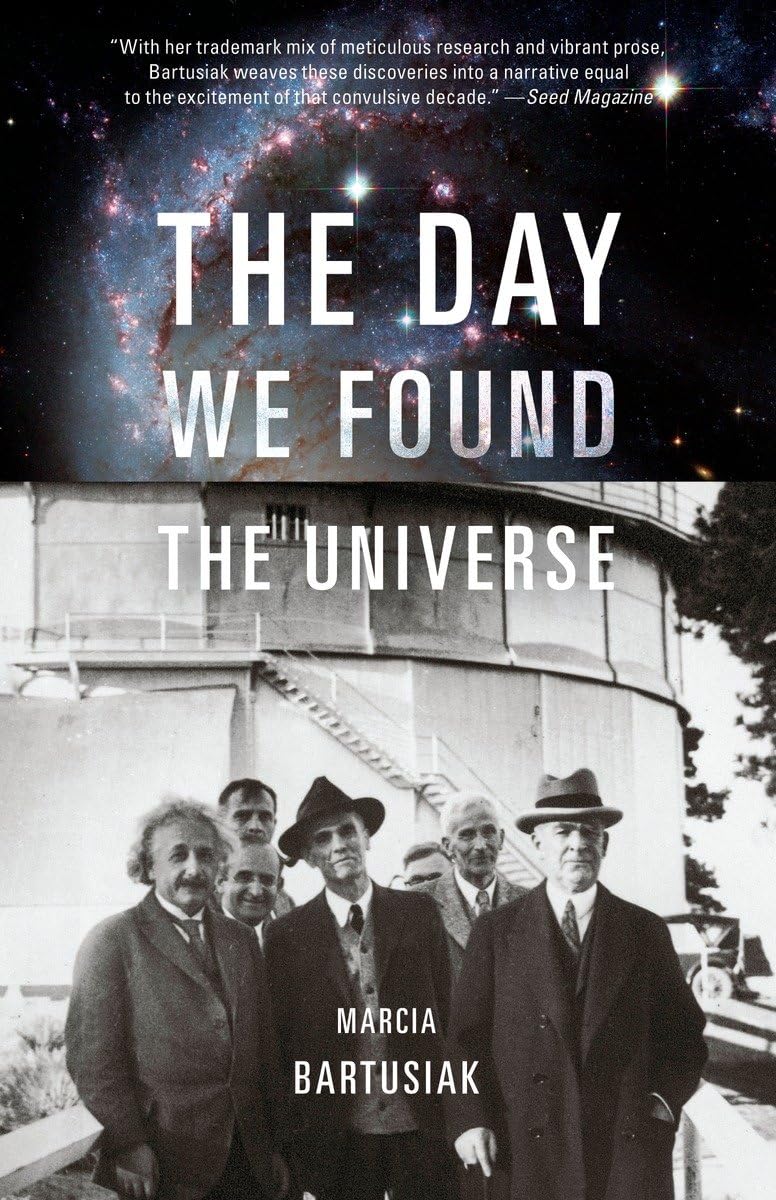



The riveting and mesmerizing story behind a watershed period in human history, the discovery of the startling size and true nature of our universe. On New Years Day in 1925, a young Edwin Hubble released his finding that our Universe was far bigger, eventually measured as a thousand trillion times larger than previously believed. Hubble’s proclamation sent shock waves through the scientific community. Six years later, in a series of meetings at Mount Wilson Observatory, Hubble and others convinced Albert Einstein that the Universe was not static but in fact expanding. Here Marcia Bartusiak reveals the key players, battles of will, clever insights, incredible technology, ground-breaking research, and wrong turns made by the early investigators of the heavens as they raced to uncover what many consider one of most significant discoveries in scientific history. “With her trademark mix of meticulous research and vibrant prose, Bartusiak weaves these discoveries into a narrative equal to the excitement of that convulsive decade.” — Seed Magazine "Bartusiak's intelligent and engaging book may well become the standard popular account."-- Washington Post "Fascinating." — The Boston Globe "A science writer of rare gifts. . . . Bartusiak manages to convey the mind-bending complexity of the astronomers' task . . . while never losing sight of the human elements." — San Francisco Chronicle “Compelling. . . . Meticulously researched . . . highly readable.” --New Scientist “Bartusiak chronicles the cosmic explorations that helped make [Edwin] Hubble a star. . . . Her account is informative, dramatic, and accessible....She sings songs to unsung heroes.”-- Tulsa World “Bartusiak lovingly and meticulously traces the origins and development of a big idea....Her enjoyable book is an exhaustively researched exploration of both major and minor players.” — New Haven Review “Focuses on the dramatic insights, sidesteps and missed opportunities, persistence, pride and bits of luck that accompany the scientific process.” — Science News “Peopled with a fascinating cast of characters . . . . The Day We Found the Universe is a scientific thriller that brings to life the many scientists who laid the foundation for Hubble's groundbreaking accomplishments. . . . A great read, for anyone who enjoys a compelling yarn.” — Montreal Gazette Marcia Bartusiak is an award-winning author whose previous books include Through a Universe Darkly , Thursday’s Universe , Einstein’s Unfinished Symphony , and Archives of the Universe . Her work has appeared in such publications as National Geographic , Smithsonian , Discover , The New York Times , and The Washington Post . She teaches at MIT and lives in Sudbury, Massachusetts. [1] The Little Republic of Science An immense continent of rock known as the North American plate slid inexorably over an oceanic slab of Earth’s crust moving eastward. At the tectonic juncture, where the two gargantuan plates smashed together, the ocean floor plunged downward, the tremendous compression forging massive blocks of shale and sandstone. In due course some of this material lifted upward from its depths, relentlessly rising toward the sky to form the Diablo Mountain Range—two hundred miles of peaks and vales stretching from the San Francisco Bay southward along California’s coastline. As if readying for a performance, nature sculpted the landscape that, millions of years later, offered astronomers a unique observing platform for their studies of the cosmos. Situated on the eastern edge of the Pacific, this lofty terrain became the perfect vantage point from which to make the first great discoveries in twentieth-century astronomy. One noticeable peak in the Diablo Range, some forty miles from the sea, was known to early settlers as La Sierra de Ysabel. The first to record an ascent to its uppermost reaches were William Brewer, a geologist who worked on California’s first complete geological survey, and Charles Hoffman, a topographer. Laurentine Hamilton, then a Presbyterian minister from San Jose, tagged along for the 1861 summertime adventure. While journeying over the lower elevations the men used mules but struggled over the last three miles on foot. With the two scientists burdened down by their heavy equipment, the minister was able to sprint ahead, pushing through the chaparral, mesquite, and thick groves of scrub oak that filled the mountain’s furrowed sides like well-sprinkled seasoning. Upon reaching the summit, Hamilton waved his hat in the air and exclaimed, “First on top, for this is the highest point.” In honor of the achievement, Brewer graciously named the peak after his “noble and true” friend. Within three decades Mount Hamilton was the site of a radical new endeavor in astronomy. Fueled by America’s escalating wealth, “the public mind in this country is now directed to the importance of original scientific research,” wrote Joseph Henry, head of the Smit