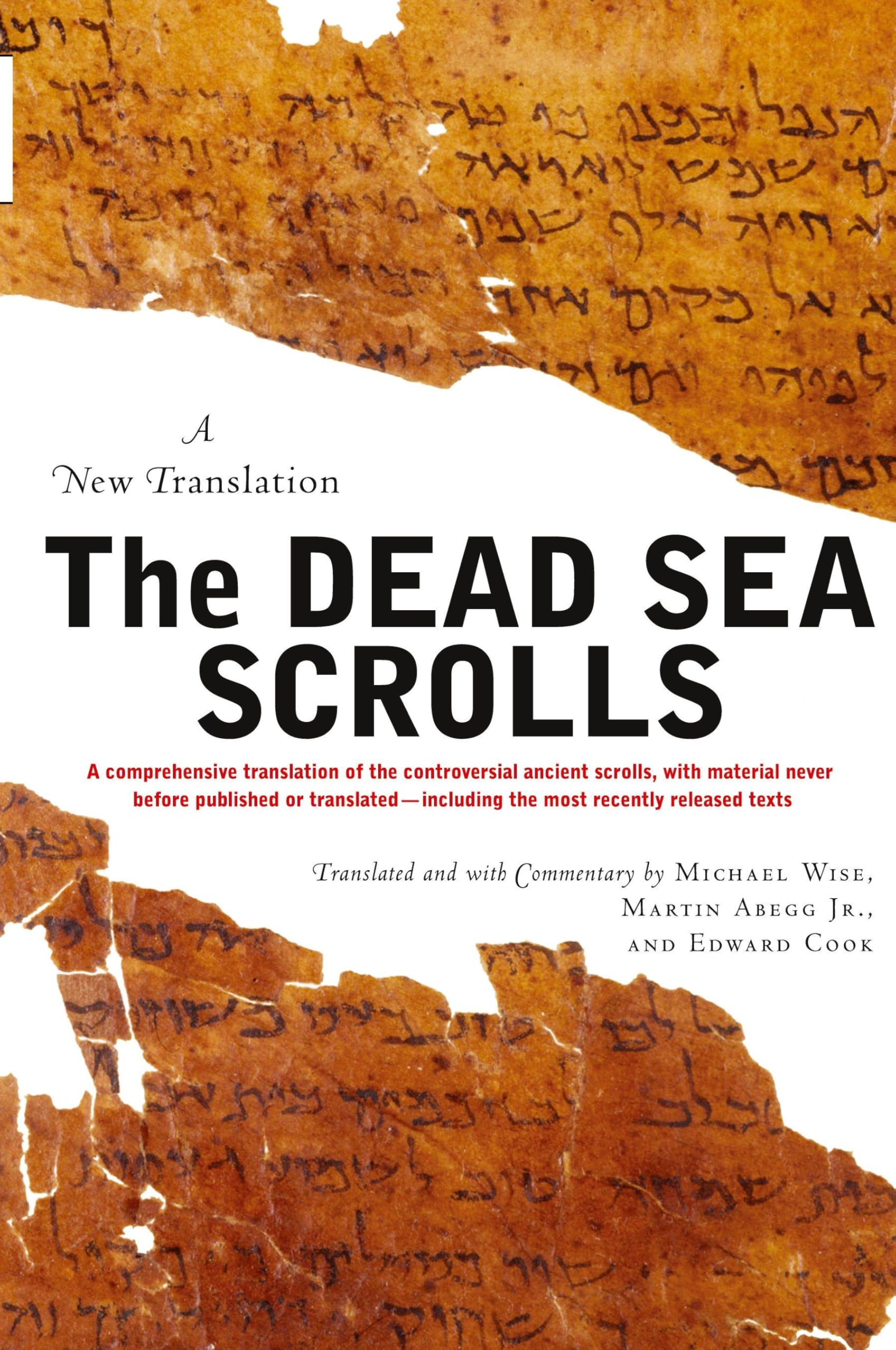



A fully revised and updated edition of our translation of the complete Dead Sea Scrolls, making it the definitive translation of the Scrolls in English. With new texts, updated introductions, a glossary of terms, and other new additions, this will become the definitive translation of the Scrolls, and the lead companion to our other Dead Sea Scrolls Guides: The Meaning of the Dead Sea Scrolls and the Dead Sea Scrolls Bible . ..".the spirit of debate and critique, reappraisal and revision is here very much present. The brief discussions of the languages and scripts of the scrolls are a nice and somewhat unusual touch in a volume of this kind."-- Bible Review..".a rather readable presentation of a large portion of the non-biblical scrolls, which commends itself to the general reader."-- Journal of Biblical Literature"The Dead Sea Scrolls are not just for scholars anymore. They are here in a book that anyone can understand. "Read these texts." Hidden in their caves, they survived the ravages of time and decay to speak to us today across two thousand years. They have survived their authors and will survive us, their readers."-- John Dominic Crossan, professor emeritus, De Paul University and author of "The Birth of Christianity" and "The Historical Jesus" A fully revised and updated edition of our translation of the complete Dead Sea Scrolls, making it the definitive translation of the Scrolls in English. With new texts, updated introductions, a glossary of terms, and other new additions, this will become the definitive translation of the Scrolls, and the lead companion to our other Dead Sea Scrolls Guides: The Meaning of the Dead Sea Scrolls and the Dead Sea Scrolls Bible . Michael Wise, who is among the foremost young scholars translating the Scrolls today, has been profiled in Time, The New York Times, and the Chicago Tribune. He is Scholar-in-Residence and Professor of Ancient Languages at Northwestern College, St. Paul, Minnesota. Martin Abegg Jr. is co-director of the Dead Sea Scrolls Institute at Trinity Western University in British Columbia. He is one of the translators of The Dead Sea Scrolls (HarperSanFrancisco, 1996). The Dead Sea Scrolls - Revised Edition A New Translation By Michael Wise HarperCollins Publishers, Inc. Copyright ©2005 Michael Wise All right reserved. ISBN: 006076662X Chapter One Reading a Dead Sea Scroll In order to read a Dead Sea Scroll with proper appreciation and a modicum of critical acumen, it's important to know what you are reading. That may seem trite, but it's true. How does one go from a hugger-mugger of over 15,000 tiny scraps of skin and ink to about 900 full-blown manuscripts, and from there to published texts and translations? You should have some idea of the various steps involved in the process. Only then can you begin to think for yourself about what you will be reading in the following pages. Understanding the process by which the scrolls have been put together will help you to avoid the reader's cardinal sin -- trusting an author too much. If we have certain ideas to present, we want you to be persuaded, not simply take our word for it. We want you to know just how much reconstructing the scrolls can be a matter of judgment (possibly mistaken) and uncertainty. We also want you to be able to make sense of the various sigla, brackets, and other paraphernalia that decorate the translations in this book. As noted in the Introduction, the first seven Dead Sea Scrolls were discovered more or less intact. That can be said of very few of the hundreds of works that came to light subsequently. The early members of the scrolls editorial team found themselves facing an enormously complex jigsaw puzzle. After a short time, they worked out a modus operandi . Thousands of fragments were spread out on the tables of the Palestine Archaeological Museum, flattened under glass. The editors would walk from table to table, scrutinizing the fragments and trying to match them with this or that grouping they had already isolated. One of the editors, John Allegro, has described the guiding principle of those early efforts: One of the saving factors has been that of the four hundred [later, eight hundred] or so manuscripts we have had to deal with, surprisingly few were written by the same scribe, so that by recognizing the idiosyncrasies of one's own scribes one could be fairly sure that the piece belonged to his document. Handwriting was thus the foremost criterion that the editors used to separate fragments into piles and then into manuscripts. A second important guide was the skin on which the texts were inscribed. The treated hides of goats, ibex, and even gazelle used for the scrolls are not uniform in thickness or color. Each skin is, so to speak, its own animal: one might be thick, another thin; one might have a reddish cast, another could be nearly black. Study of the differences in the skins was therefore important for figuring out how t