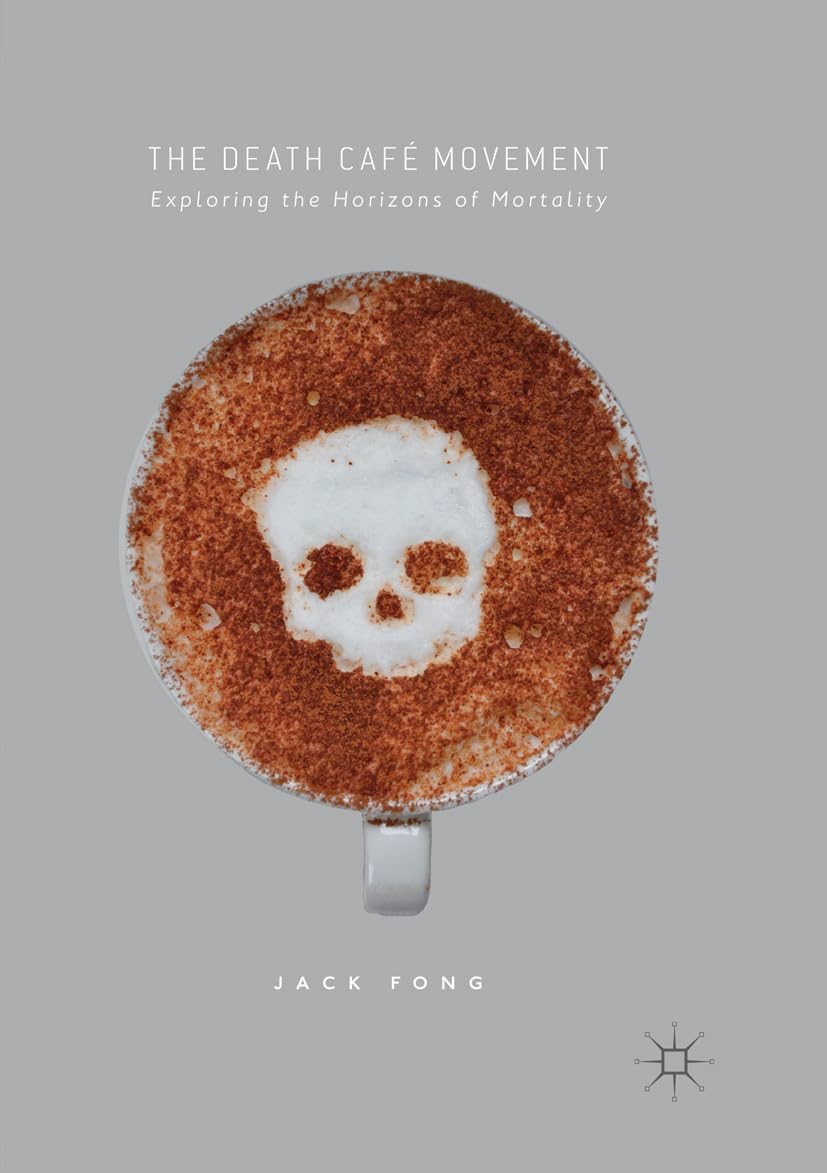



This sociological work examines the phenomenon of the Death Café, a regular gathering of strangers from all walks of life who engage in “death talk” over coffee, tea, and desserts. Using insightful theoretical frameworks, Fong explores the common themes that constitute a “death identity” and reveals how Café attendees are inspired to live in light of death because of death. Fong examines how the participants’ embrace of self-sovereignty and confrontation of mortality revive their awareness of and appreciation for shared humanity. While divisive identity politics continue to foster neo-tribalisms and the construction of myriad “others,” Fong makes visible how those who participate in Death Cafés end up building community while being inspired toward living more fulfilling lives. Through death talk unfettered from systemic control, they end up feeling more agency over their own lived lives as well as being more conscious of the possibility of a good death. According to Fong, participants in this phenomenon offer us a sublime way to confront the facticity of our own demise―by gathering as one. This work takes readers on a remarkable journey across the terrain of social responses to mortality through the distinctive Death Cafe movement. It demonstrates how the movement confronts core challenges of mortality, as well as the deleterious grip that the market, medicine, and media arms have on our thinking about death and life. Through Jack Fong's incisive ethnography, a major step forward in the development of a 21st century humanistic social science is illuminated. -- Dr. John Brown Childs , Professor of Sociology, Emeritus, at the University of California, Santa Cruz and author of Transcommunality: From the Politics of Conversion to the Ethics of Respect . For many, the prospect of death and dying in post-industrial society is as terrifying as it is isolating. Employing Habermas, Fromm, and Wolf, Jack Fong's analyses illuminates how the media, medicine, and market sanitizes the subjectivitiy of dying, and how the Death Cafe movement is responding by inspiring its members to reimagine and reclaim what it means to be mortal. Fong's nuanced, timely, and empathetic sociological study is of the highest, most urgent order. -- Dr. Kevin McCaffree , Assistant Professor of Sociology at Indiana University-Purdue University, Fort Wayne and author of The Secular Landscape: The Decline of Religion in America . The analysis of the death café data makes use of Habermas's theory of communicative action, and also draws on the ideas of Erich Fromm and Karl Wolff. For readers who are unfamiliar with the work of these theorists the chapters covering their work may be rather heavy going, as the discussions seem not to be written for the general reader. Fong views the death café movement as a social movement which involves communities around the world. He argues that, in this role, the death café simultaneously acts as a critique of contemporary risk society and a celebration of the ability to transcend risk society. Through communicative action, participants in the death café, largely strangers to each other, bridge the gap between fear and acceptance of their own dying. In doing so, they are sometimes able to generate a degree of ontological security which enables them to feel secure in their worlds. This is an interesting book, offering a theoretical approach to the death café movement that requires further exploration. -- Dr. Glenys Caswell , Mortality , Vol. 24 (3), 2019; University of Nottingham. Jack Fong, an American sociologist who gathered regularly at Death Cafe events to collect data, ended up defining the phenomenon as a social movement whose participants, in our age of individuality, are inspired by death when talking about living a more rewarding life, and thus became aware of the potential of a good death while building a community in the process. -- Milja Vaipuro and Leena Voutilainen , in "Puhutaan kuolemasta: Käsittelyssä kuolemanpelko, menetelmänä Death Cafe" ("Let's talk about Death: Dealing with the Fear of Death as a Method of the Death Cafe"), 2019 Education Programme thesis on elder care submitted to Metropolia University of Applied Sciences, Finland. Fong published The Death Café Movement: Exploring the Horizons of Mortality , the first such work on the topic. In researching the book he attended seven three-hour-long Death Cafés. During discussions Fong focused on spotting recurring themes and observing how participants interacted with one another. Much of the book is a critique of modernity's relationship with death...the "trinity of the market, media, and medicine," the key outlets through which polite societies acknowledge death. Such institutions, Fong writes, serve more to terrify and keep us in the dark than nurture acceptance, understanding or comfort. -- Brent Crane , Folks: A Pillpack Magazine , December 5, 2017. Partly as a nod to the "death café" movement (Fong, 2017; Miles and