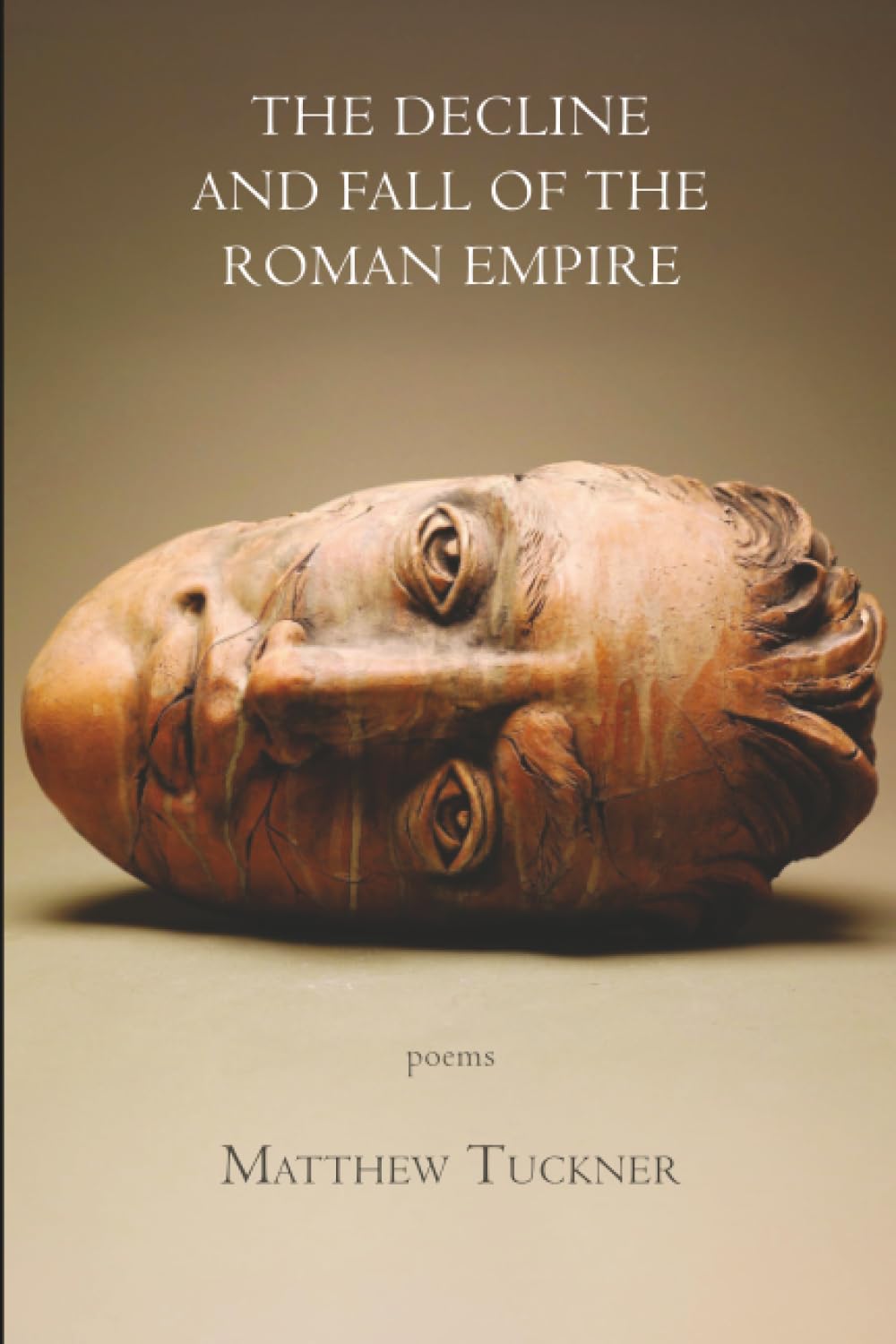



The Decline and Fall of the Roman Empire is a book-length sequence of 53 poems with identical eponymous titles. Heartbreaking and searingly lucid, this debut collection from poet Matthew Tuckner chronicles his best friend's illness and subsequent death from cancer. Its brilliance is not only in recognizing the vastness and particularity of grief — how the loss of a beloved is so personally all encompassing that it splits time irrevocably, separating our personal history into distinct eras of before and after as the governing principles of our lives crumble — but also in joining the discrete experience of one person's sickness to a carcinogenic imperial core, the late-capitalist global order that ensnares all people in toxic landscapes that make us sick. Describing a trip to Japan, Tuckner evokes the brute force of appetite alongside the delicacy of life as he recalls "memories of its greedy koi fish, a ceramic bowl / of goji berries perfectly balanced on a tree branch." Beholden to a ticking clock, we catalogue, becoming evidentiary and encyclopedic in our impulses. "We fatten the time until it bursts into artifacts: / sixteen photographs of a single puddle // taking shape in the red glow of your darkroom." In borrowing the title of Edward Gibbon's seminal 6-volume history, Tuckner anchors the associative detours of his sprawling intellect and executes a stunning metacommentary on his own lyrics: time collapses every era into a spattering of sentences, tyrannical as it forcibly converts the present to the past, and yet the barbarous recursion of human feeling resists oblivion, evoking the eternity of emotional significance. Tuckner's shrewd balance of irony and tenderness make this cerebral inversion possible: this friendship is the poet's canon event, the Rome at which every road in his mind arrives, and yet it is also the singular dialect that will not cede to death's subsuming lingua franca. Damien Hirst's taxidermy art, The John Keats House, superfund sites in Rome, NY, the 2023 Ohio Train Derailment, a children's book titled Oil Spill! — these poems travel widely in their topics to understand the specific ravages of disease on the human body, and in turn, the ravages of human beings on the planet. Its trenchant criticism isn't pessimistic, though — its redemption is the restorative, unending love that made these elegies possible. Equally gutted and mesmerized by our infinite, arbitrary ability to discern meaning in mess, these poems ask us to bear witness to what we can develop if we will sit in the darkness. To read the photo essay of a storm's aftermath. It tells an ancient story that becomes brand new, the one about "a puddle you glimpsed the moon in & stopped for. // A puddle that was just plain rain until it fell." "Matthew Tuckner's recurring title, The Decline and Fall of the Roman Empire , cues us to the haunted irreverence of these amazing poems, while every opening line cues us to the idiosyncratic moods and modes to unfold. Tuckner journeys inside Ron's Bargain Barn, inside Derrida's lecture on Heidegger, inside the whale in Melville, and 'the precambrian drone of jetliners' to reckon with the forms and functions of elegy. Dream and witness power these Orphic, electric, micro-epics. This is a magnificent debut." —Terrance Hayes "From the chasm of the everyday confusion of U.S. culture, where we 'stir-fry the pork shoulder' one minute and weep 'over the extinction / of the mountain mist frog' the next, Tuckner's voice rises 'as a plume, or as shroud, or as whatever word…is the most accurate container for this immensity / tottering on the brink.' Enormous in its scope yet vividly precise, sea-swept in sorrow but buoyed by the poet's wit, The Decline and Fall of the Roman Empire may prove powerless to cure the conditions it diagnoses, but it reminds us that agency begins in a clear-eyed appraisal of circumstances. 'The ancient fables of Greece,' Gibbon writes in his own History, 'were saved from oblivion by the genius of poetry.' So too will Tuckner's miracle of a book—which knows 'how to hack up a diseased tree into useful pieces of lumber'—preserve the feeling of what it means to 'stumble into the future' through the 'fresh mess' and 'toxic mass' of our times." —Timothy Donnelly "Though all fifty-three poems in Matthew Tuckner's spectacular debut have the same magisterial title-a title stolen from and now shared with Edward Gibbon's 18th-century study The Decline and Fall of the Roman Empire -they upend expectation in their tendernesses, in the way they braid the personal and the political, in the sly and sometimes humorous complicities dramatized throughout this collection. They hitch quicksilver perception to language even as they call out the failures of language, a failure that becomes one of the main preoccupations in a book preoccupied with loss, the environment, art, love, and the corruptions of power. Tuckner's poems move in unpredictable ways, full of swerving and le