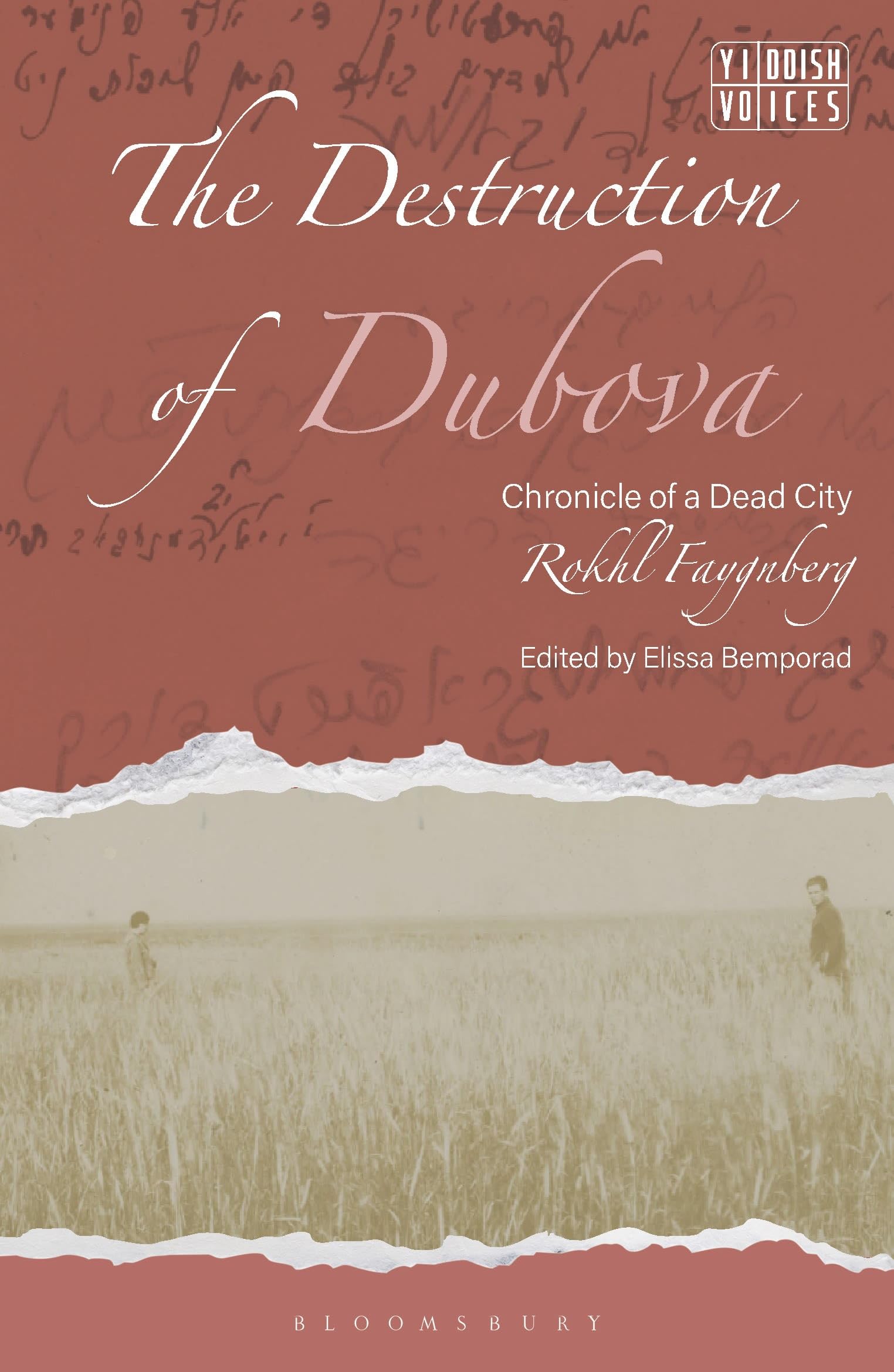
The Destruction of Dubova: Chronicle of a Dead City (Yiddish Voices)
$22.95
by Rokhl Faygnberg



Written by Yiddish writer Rokhl Faygnberg, The Destruction of the Dubova Shtetl is a powerful account of the elimination of the Jewish community of one shtetl during the pogroms of the Russian Civil War, 1918-1921. Based on her personal interviews with survivors, Faygnberg presents a detailed description of the evisceration of the vibrant Jewish community of Dubova, which, after enduring torture, killings, and destruction-was ultimately wiped off the map of Ukraine. In this unique memorial book, translated into English here for the first time, Faygnberg chronicles the demise of a typical shtetl, which like so many others at the time, was caught up in the genocidal violence of the civil war, a period that is largely forgotten, overshadowed by the Holocaust that took place in these same lands some twenty years later. The biographical details of the Jewish community members of Dubova provide a moving portrait of the familiar and neighborly relations, as well as of the pettiness of everyday life on the eve of destruction, made of conflict, class tension, and intermarriage. Faygnberg's narrative also captures the extreme violence of the pogroms of the Russian Civil War, by dwelling on the perpetrators' actions and motivations, and on the intimacy of genocide made of neighbors killing neighbors, and by bringing to life the Jewish community's desperate attempts to resist and survive the brutality. By building on the most recent historiography on the Russian Civil War and anti-Jewish violence, Elissa Bemporad expertly contextualizes the destruction of the shtetl of Dubova within the political and military events of 1918-1921 in the volume's introduction. Bemporad explores both the perpetrators' motivations and the victims' responses to the pogroms, as well as examining the original writing produced by Rokhl Faygnberg, whose genre straddles between a historical chronicle based on witness accounts, and a work of literature. Lastly, the introduction discusses the fascinating history of Faygnberg's text, uncovering the different political and cultural purposes it served at different times and what it can tell us about anti-Jewish violence today. “Haunting and horrifying. Faygnberg meticulously documented the genocidal pogroms of the Russian Civil War at a human level through the story of a single town, Dubova, and the complete destruction of its Jews and their community. A century later, English readers can read her important account for the first time. The editor and translators have helped to recover the traumatic memory of the single worst episode of anti-Jewish violence in modern history before the Holocaust.” ― Polly Zavadivker, Associate Professor of History and Jewish Studies, University of Delaware, USA Born in the Belarusian shtetl Lyuban in 1885, Rokhl Faygnberg witnessed and wrote about many of the defining events of modern Jewish history-wars, pogroms, and the birth of the State of Israel. She became the first professional Jewish female author who earned a living from writing novels and penning essays for the Yiddish and Hebrew press. After the pogroms of the civil war in Ukraine 1918-1921, which she powerfully chronicled in her work, she moved to Poland and eventually settled in Mandate Palestine in 1933, where she published largely in Hebrew under the name Rakhel Imri. She died in Tel Aviv in 1972. Elissa Bemporad is Professor of History and Chair in East European Jewish History and the Holocaust at Queens College and CUNY Graduate Center, USA. Her most recent books include Legacy of Blood: Jews, Pogroms, and Ritual Murder in the Lands of the Soviets (Oxford, 2019), and Revolution, Civil War, and New Ways of Life (NYU, 2025). Alyssa Quint is a writer based in New York City, USA. She is a Visiting Fellow at Yeshiva University, USA and Associate Editor at Tablet Magazine . She is the author of The Rise of the Modern Yiddish Theater (2019), a finalist for the National Jewish Book Award and a finalist for the Jordan Schnitzer Award. She is also the editor of two forthcoming volumes on the Yiddish theater - Women on the Yiddish Stage and Avrom Goldfaden's Shulamis : a Critical Edition . She is a contributing editor of the online Digital Yiddish Theater Project and a curator of a number of exhibits at the YIVO Institute for Jewish Research where she served as senior scholar for many years.