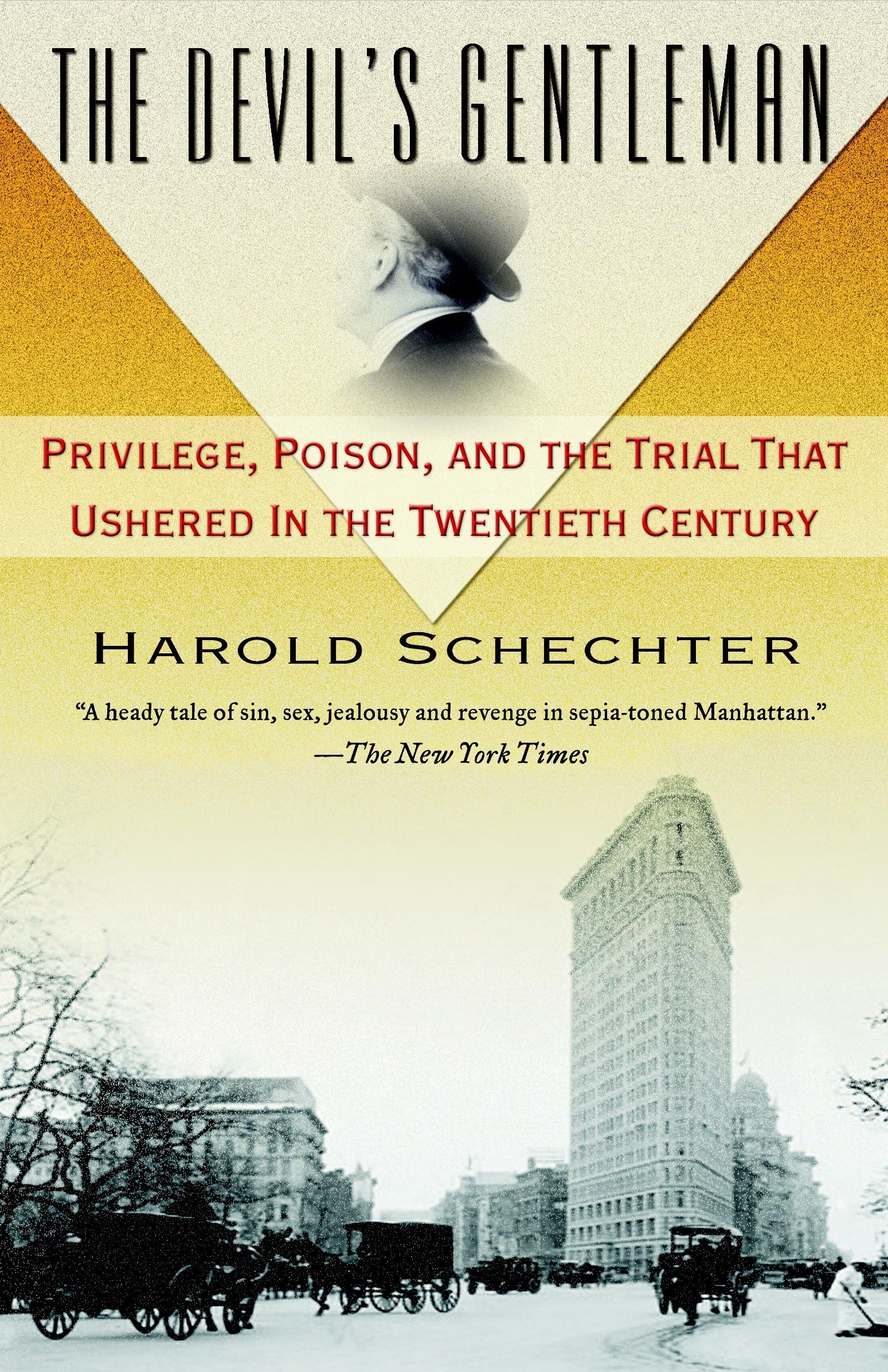
The Devil's Gentleman: Privilege, Poison, and the Trial That Ushered in the Twentieth Century
$11.83
by Harold Schechter



From renowned true-crime historian Harold Schechter comes the riveting exploration of a notorious New York City murder in the 1890s, the fascinating forensic science of an earlier time, and the grisly court case that became a tabloid spectacle. The wayward son of a revered Civil War general, Roland Molineux enjoyed good looks, status, and fortune–hardly the qualities of a prime suspect in a series of shocking, merciless cyanide killings. Molineux’s subsequent indictment for murder led to two explosive trials and a sex-infused scandal that shocked the nation. Bringing to life Manhattan’s Gilded Age, Schechter captures all the colors of the tumultuous legal proceedings, gathering his own evidence and tackling subjects no one dared address at the time–all in hopes of answering a tantalizing question: What powerfully dark motives could drive the wealthy scion of an eminent New York family to murder? Praise for The Devil's Gentleman : “A heady tale of sin, sex, jealousy and revenge in sepia-toned Manhattan.” –The New York Times “A dark chronicle of ghoulish revenge [and] journalistic sensationalism . . . [a] well-wrought anatomy of a murder and portrait of an age.” –The Wall Street Journal “Schechter peppers his account of one of America’s earliest media circuses with peacock characters and deliciously tawdry details. . . . For scandal sweet tooths, this one’s a beaut.” –Entertainment Weekly “In the hands of an artist and historian as gifted as Schechter, the material becomes a superbly evocative reconstruction of the fascinating period in American life that gave birth to our media-crazed society.” – Bomb magazine “Well told and powerfully written . . . Through newspaper accounts of the day and memoirs of the principals . . . Schechter brings [a crime] to vivid life.” –San Antonio Express-News Advance praise for The Devil’s Gentleman “A thrilling account of a murder case that rocked Manhattan at the turn of the 20th century . . . Schechter expertly weaves a rich historical tapestry–exploring everything from the birth of ‘yellow’ journalism to the history of poison as a murder weapon–without sacrificing a novelistic sense of character, pacing and suspense. The result is a riveting tale of murder, seduction and tabloid journalism run rampant in a New York not so different from today’s.” –Publishers Weekly (starred review) Praise for the true-crime books of Harold Schechter “The scholarship is both genuine and fascinating.” –The Boston Book Review, on The A to Z Encyclopedia of Serial Killers “Top-drawer true-crime.” –Booklist, on Deviant “Reads like fiction but it’s chillingly real.” –The Philadelphia Inquirer, on Deranged “Riveting . . . brilliantly detailed . . . Schechter has done his usual sterling job in resurrecting this amazing tale.” –Caleb Carr, on Depraved Harold Schechter is a professor of American literature and culture at Queens College, the City University of New York. He is widely celebrated for both fiction and true-crime writing, including The Serial Killer Files. He lives in Brooklyn and Mattituck, Long Island, with his wife, the poet Kimiko Hahn. Visit the author’s website at www.haroldschechter.com. 1 On July 15, 1852, Edward Leslie Molineux--still three months shy of his nineteenth birthday--began what he called his "scrapbook." It was not a pasted-in collection of newspaper and magazine clippings (though in later years, when his own name began to appear regularly in the press, he would assemble several of those, too). Rather, this ledger-sized volume was a handwritten miscellany of striking facts, inspirational sayings, and practical information on everything from military tactics to medicinal recipes. There is nothing remotely confessional to be found in this journal. His book has all the introspective quality of the official Boy Scout Manual, which it resembles in its single-minded emphasis on self-improvement and the cultivation of the higher civic virtues: industry, tolerance, charity, and a keen sense of duty to one's country. The very look of the pages--inscribed in a flawless hand, perfectly free of blots or corrections, and meticulously labeled with solemn headlines ("The Importance of Physical Exercise," "Useful Rules," "Maxims for the Wise")--speaks vividly of the young writer's capacity for self-discipline, concentrated effort, and high moral seriousness. "Be virtuous in mind & body & let your thoughts be pure," he counsels himself in an early entry labeled "Rules for Living." This injunction is followed by a score of precepts designed to promote physical, mental, and moral soundness: Use dumbbells twice a day. Bathe every morning. Always get up when you first awake, no matter what time it is. One hour in the morning is worth two at night! Do everything in a cool, active, and energetic manner. In times of danger or trouble, first think--then act coolly and decisively. Never be idle--always have something to do. Never shrink from an unpleasant duty.