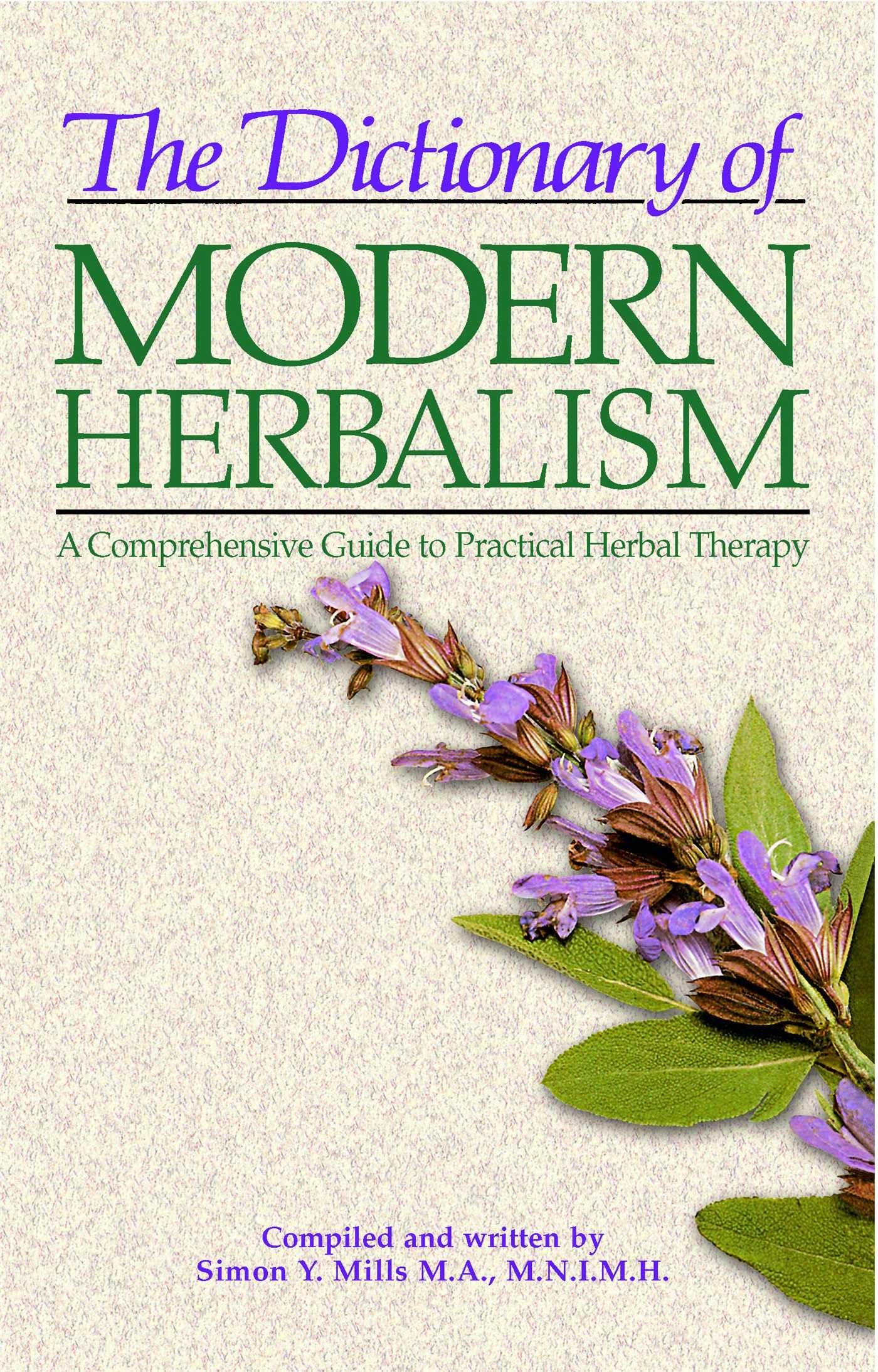



As seen on The Diary of a CEO! A clear and comprehensive reference on the full range of healing herbs and remedies • An indispensable guide to the herbal remedies most used in the Anglo-American and European traditions • Defines each remedy in terms of its main pharmacological actions and usual therapeutic applications • A useful reference to the application of traditional medicines for modern health problems for the professional and lay use. •An indispensible guide to the herbal remedies most used in the Anglo-American and European traditions. • Defines each remedy in terms of its main pharmacological actions and usual therapeutic applications. •A useful reference to the application of traditional medicines for modern health problems, for both professional and lay use. • SIMON MILLS is President and Director of Research of The National Institute of Medical Herbalists, and he runs a private medical herbal practice in Devonshire, England. Simon Mills is President and Director of Research of The National Institute of Medical Herbalists, and he runs a private medical herbal practice in Devonshire, England. That Odd Mary Magdalene It seems that even among Jesus’ disciples, Mary played a privileged role. Why, then, did the Roman Catholic Church feel obliged to almost entirely erase this female figure and her role? Was it because of a now proven anti-feminism that existed at the heart of the Church from the early Middle Ages? The Christian conception of femininity, which has certainly greatly evolved in the modern world, especially since the council of Vatican II, is due both to Greco-Roman legacy and to the Hebraic options. With the exception of the female characters of Genesis, who are gripping figures to say the least, the scribes of the Bible lowered the status of Woman by making her impure and thus not apt, for example, to play a sacerdotal role. The idea that Mary Magdalene enjoyed total equality with the apostles has never crossed the minds of Church theologians. Because priests are the legitimate heirs of the apostles, such a standing would make Mary Magdalene, on the one hand, a priestess--how horrible!--and on the other, one of those on whom the apostolic sacerdotal filiation was founded. Yet, when Mary of Bethany washes Jesus’ feet and anoints him with precious perfume, which Judas, the group’s treasurer, believes could be put to a more profitable use, she and Jesus are enacting a kind of sacerdotal and royal ordination--with Mary serving as the priestess who performs the ritual. Is it forbidden to think that Mary of Bethany, over the course of those long moments spent at the feet of the Lord, could have heard what he had to say or at least sensed the full scope of Christ’s mystery even if she did not grasp it in its entirety? Jesus persistently tried to lead his disciples to realize this--if only in the ?at of the Transfiguration!--but their hearts remained curiously closed all the way to the end. Mary, however, did perceive and accept it. On that day she knew the moment had come to manifest this mystery in chiaroscuro. In a kind of prophetic intuition . . . Mary anointed the head of Jesus, recognizing and presenting him as King and Priest, and anointed his feet as Messiah sent from God. Such a presentation obviously involves a rite of enthronement that can be performed only by a person vested symbolically with sacerdotal powers. Jesus was fully aware of this when he answered Martha’s reproaches by saying that Mary “had the best part.” At that time there were two sites named Bethany: a town two miles east of Jerusalem, where Mary, Martha, and Lazarus lived; and on the left bank of the Jordan, at a ford just before the Dead Sea, where John the Baptist baptized. In addition, there was a place called Bethabara, “house of passage,” by the gates to the desert. John the Baptist and later Mary, each in their own way, granted baptism, initiation, the right of passage, or the means of crossing the threshold. The two Bethanys, then, seem to mirror each other. Magdalene extends the echo of her precursor, John the Baptist. One is a man clad in hides and the other is a woman clad in her long mane of hair. The chief difference between them is that John remains in a harsh and terrible place, screaming in Essenian rigor his curses and his calls to repent, whereas Mary in Bethany, on the opposite where all is blooming and gay, speaks of love and forgiveness and the transition from one world to the next. While Jesus received from John a baptism in water, he did not receive, as the ancient kings had, a consecrating anointing with oil. Just before his Passion and “baptism by spirit and fire”--the crucifixion--he received the perfumed oil from the female Magdalene. The old and ancient notion of the priest-king applies to Jesus, but this royal unction, let me repeat, can only be performed by a priest--or priestess. The unction in Bethany is surely one of the most important events in the life of Jesus. Furthe