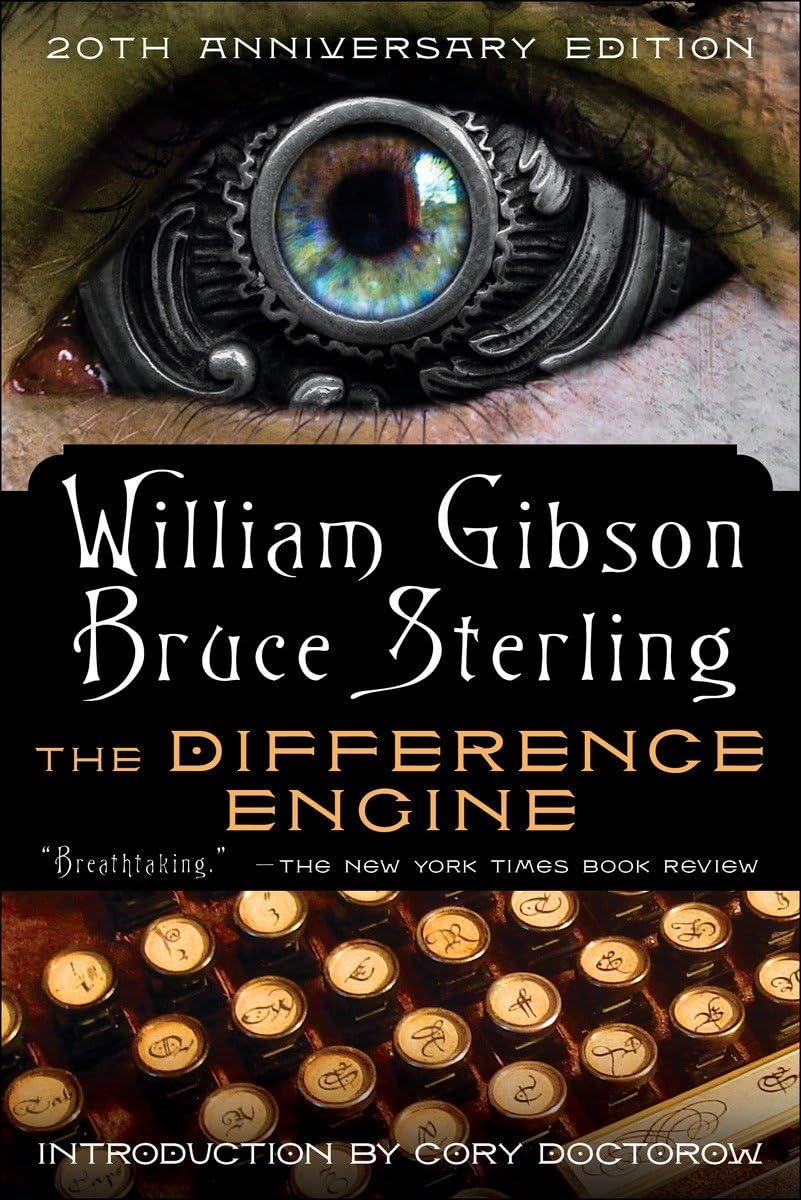



The 20th anniversary edition of the classic steampunk novel With new commentary by the authors 1855: The Industrial Revolution is in full swing, powered by steam-driven cybernetic Engines. Charles Babbage perfects his Analytical Engine, and the computer age arrives a century ahead of its time. Three extraordinary characters race toward a rendezvous with the future: Sybil Gerard—fallen woman, politician’s tart, daughter of a Luddite agitator; Edward “Leviathan” Mallory—explorer and paleontologist; Laurence Oliphant—diplomat, mystic, and spy. Their adventure begins with the discovery of a box of punched Engine cards of unknown origin and purpose. Cards someone wants badly enough to kill for. Part detective story, part historical thriller, The Difference Engine took the science fiction community by storm when it was first published twenty years ago. This special anniversary edition features an Introduction by Cory Doctorow and a collaborative essay from the authors looking back on their creation. Provocative, compelling, intensely imagined, this novel is poised to impress a whole new generation. “Breathtaking.”— The New York Times Book Review “Smartly plotted, wonderfully crafted, and written with sly literary wit . . . spins marvelously and runs like a dream.”— Entertainment Weekly “Splendid . . . highly imaginative.”— Chicago Tribune “A ripping adventure yarn.”— Los Angeles Times “[A] tour-de-force.”— The Philadelphia Inquirer William Gibson is credited with having coined the term "cyberspace" and having envisioned both the Internet and virtual reality before either existed. He is the author of Neuromancer , Count Zero , Mona Lisa Overdrive , Burning Chrome , Virtual Light , Idoru , All Tomorrow's Parties , Pattern Recognition , Spook Country , Zero History , Distrust That Particular Flavor , and The Peripheral . He lives in Vancouver, British Columbia, with his wife. Bruce Sterling is an Austin-born science fiction writer and Net critic, internationally recognized as a cyberspace theorist who is also considered one of the forefathers of the cyberpunk movement in science fiction. He has won a John W. Campbell Award, two Hugo Awards, and an Arthur C. Clarke Award. First Iteration The Angel of Goliad Composite image, optically encoded by escort-craft of the trans-Channel airship Lord Brunel: aerial view of suburban Cherbourg, October 14, 1905. A villa, a garden, a balcony. Erase the balcony’s wrought-iron curves, exposing a bath-chair and its occupant. Reflected sunset glints from the nickel-plate of the chair’s wheel-spokes. The occupant, owner of the villa, rests her arthritic hands upon fabric woven by a Jacquard loom. These hands consist of tendons, tissue, jointed bone. Through quiet processes of time and information, threads within the human cells have woven themselves into a woman. Her name is Sybil Gerard. Below her, in a neglected formal garden, leafless vines lace wooden trellises on whitewashed, flaking walls. From the open windows of her sickroom, a warm draft stirs the loose white hair at her neck, bringing scents of coal-smoke, jasmine, opium. Her attention is fixed upon the sky, upon a silhouette of vast and irresistible grace--metal, in her lifetime, having taught itself to fly. In advance of that magnificence, tiny unmanned aeroplanes dip and skirl against the red horizon. Like starlings, Sybil thinks. The airship’s lights, square golden windows, hint at human warmth. Effortlessly, with the incomparable grace of organic function, she imagines a distant music there, the music of London: the passengers promenade, they drink, they flirt, perhaps they dance. Thoughts come unbidden, the mind weaving its perspectives, assembling meaning from emotion and memory. She recalls her life in London. Recalls herself, so long ago, making her way along the Strand, pressing past the crush at Temple Bar. Pressing on, the city of Memory winding itself about her--till, by the walls on Newgate, the shadow of her father’s hanging falls . . . And Memory turns, deflected swift as light, down another byway--one where it is always evening. . . . It is January 15, 1855. A room in Grand’s Hotel, Piccadilly. One chair was propped backward, wedged securely beneath the door’s cut-glass knob. Another was draped with clothing: a woman’s fringed mantelet, a mud-crusted skirt of heavy worsted, a man’s checked trousers and cutaway coat. Two forms lay beneath the bedclothes of the laminated-maple four-poster, and off in the iron grip of winter Big Ben bellowed ten o’clock, great hoarse calliope sounds, the coal-fired breath of London. Sybil slid her feet through icy linens to the warmth of the ceramic bottle in its wrap of flannel. Her toes brushed his shin. The touch seemed to start him from deep deliberation. That was how he was, this Dandy Mick Radley. She’d met Mick Radley at Laurent’s Dancing Academy, down Windmill Street. Now that she knew him, he seemed more the sor