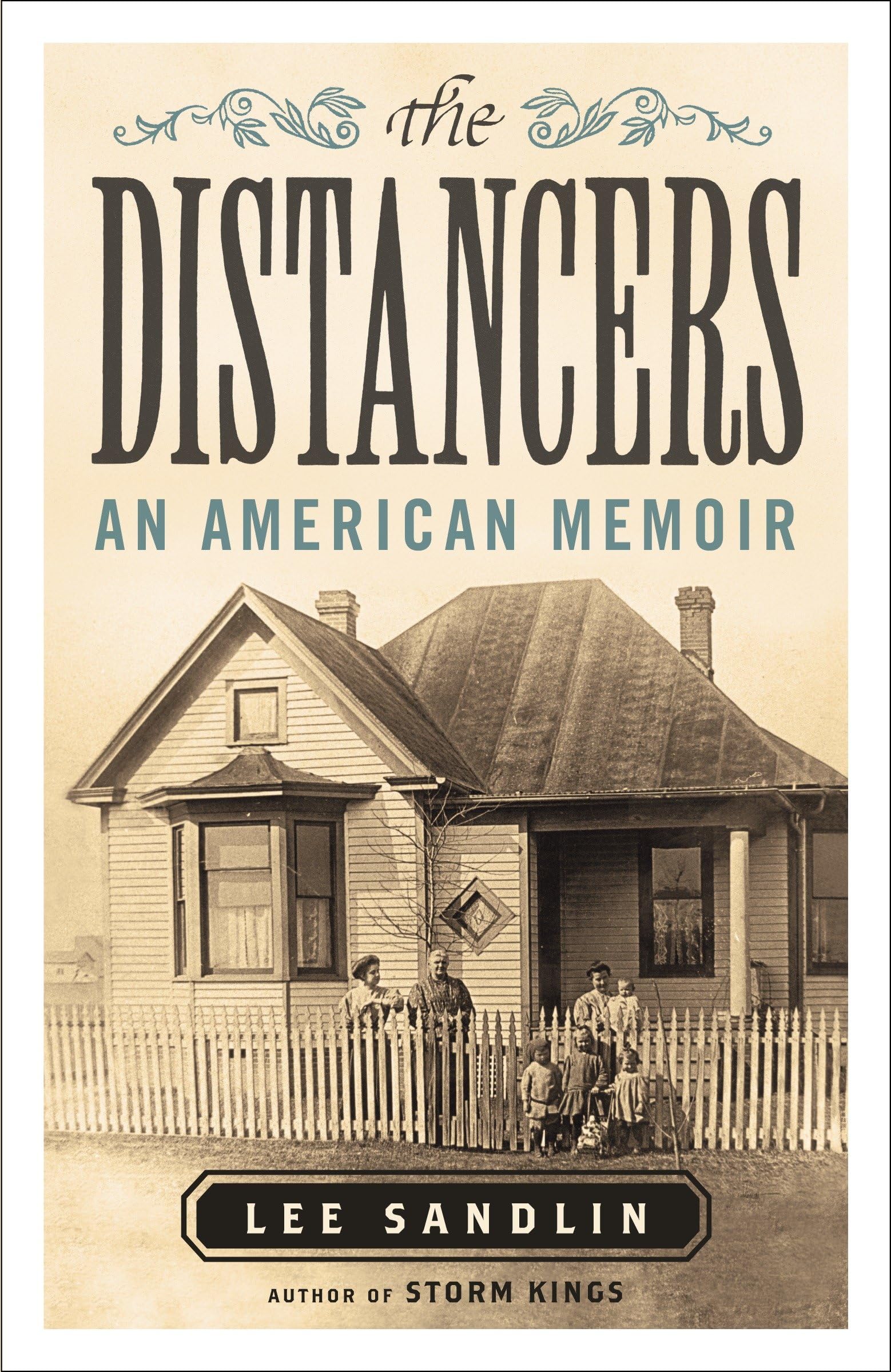



In The Distancers , seven generations worth of joy and heartache is artfully forged into a family portrait that is at once universally American yet singularly Lee Sandlin's own. From the nineteenth century German immigrants who settled on a small Midwestern farm, to the proud and upright aunts and uncles with whom Sandlin spent the summers of his youth, a whole history of quiet ambition and stoic pride—of successes, failures, and above all endurance—leaps off the page in a sweeping American family epic. Touching on The Great Depression, WWII, and the American immigrant experience, The Distancers is a beautiful and stark Midwestern drama, about a time and place long since vanished, where the author learned the value of family and the art of keeping one's distance. The author reaches back into the past to tell the story of his family: stoic midwestern German immigrants. Beginning with his great-great-great-grandparents in 1850, he records a uniquely American, multigenerational odyssey. Though seemingly ordinary and straightforward, the family journey takes some surprising and often poignant twists and turns along the way. Recalling his idyllic childhood summers in Edwardsville, Illinois, Sandlin is inspired to use the lives of his two great-aunts and two great-uncles as the starting point to illuminate the history of seven generations of his clan. As in every family, there are eccentricities as well as extreme moments of darkness and light, and he discovers that the ties that bind across the years are stronger than he expected. This charming memoir serves as a reminder of the significance of understanding and respecting your roots. --Margaret Flanagan Praise for Storm Kings : "The awe and terror that American weather inspired in early settlers is one of the most compelling motifs of Lee Sandlin's compulsively readable Storm Kings . . . . [A] cautionary tale about the frequently unpredictable role that weather continues to play in our lives."-- Christian Science Monitor "Using his skills as a brilliant storyteller, Lee Sandlin places the reader in the middle of a storm, where he becomes an eyewitness to the helplessness, fear, destruction, and psychological aftermath of tornados."-- New York Journal of Books Praise for Wicked River : "Sandlin has reclaimed a precious piece of our history." -- American Scholar "In this lush, exuberant, action-packed and history-drenched book, Sandlin has brought the river back home again. . . . A vivid torrent of facts and passions, in an inspired agitation of water and words. . . . Wicked River is the best kind of history book."-- Chicago Tribune Lee Sandlin is the author of Wicked River , Storm Kings , and The Distancers . He was also an award-winning journalist, essayist, and book reviewer for The Wall Street Journal . Born in Wildwood, Illinois, he grew up in the suburbs of Chicago. He died in 2014. 1 Just Shy of the Mississippi my great-great-great-grandparents Peter and Elizabeth Sehnert came to America from Germany around 1850. They had no friends or family waiting for them when their ship landed, and they knew absolutely nothing about the New World. So they used a simple method to find a home. They rode the trains inland as far as the trains could go. It took them more than a week. They traveled in swaying monotony from the industrialized cities of the Northeast through the newly cleared farmlands of Ohio and Indiana. Only west of Chicago did the settlements thin out and the landscape start to look almost pristine. The train service out there was sporadic and the cars were almost always empty. People said you could ride a train through Illinois from sunup to sundown and not see another living soul except the conductor. The Sehnerts reached the end of the line at a country station just shy of the Mississippi River. They could have kept going; a lot of people did. Those were the years of the Gold Rush and the great westward migration: as fast as new settlers were arriving in Illinois, the old ones were packing up, selling out, and heading west to California. There weren’t any bridges yet across the Mississippi, and there were so many people, wagons, and animals piling up at the ferry points that the wait for a crossing sometimes lasted for days. But the Sehnerts weren’t tempted. The journey west was overland through Kansas, or by steamship up the Missouri, through a dangerous country that seemed to be over the edge of the world. So they stayed on what they thought of as the civilized side of the river. They bought a small farm in the open country near Greenville, Illinois. The name Sehnert is an old one. It goes back deep into the Middle Ages and the ancient farming communities along the Rhine. (It has an archaic and peculiar sound even to a lot of Germans, who tend to think it’s a misprint of Schnert.) Peter and Elizabeth arrived in America with the vast weight of their ancestral values still intact. They were humble, God-fearing, churchgoi