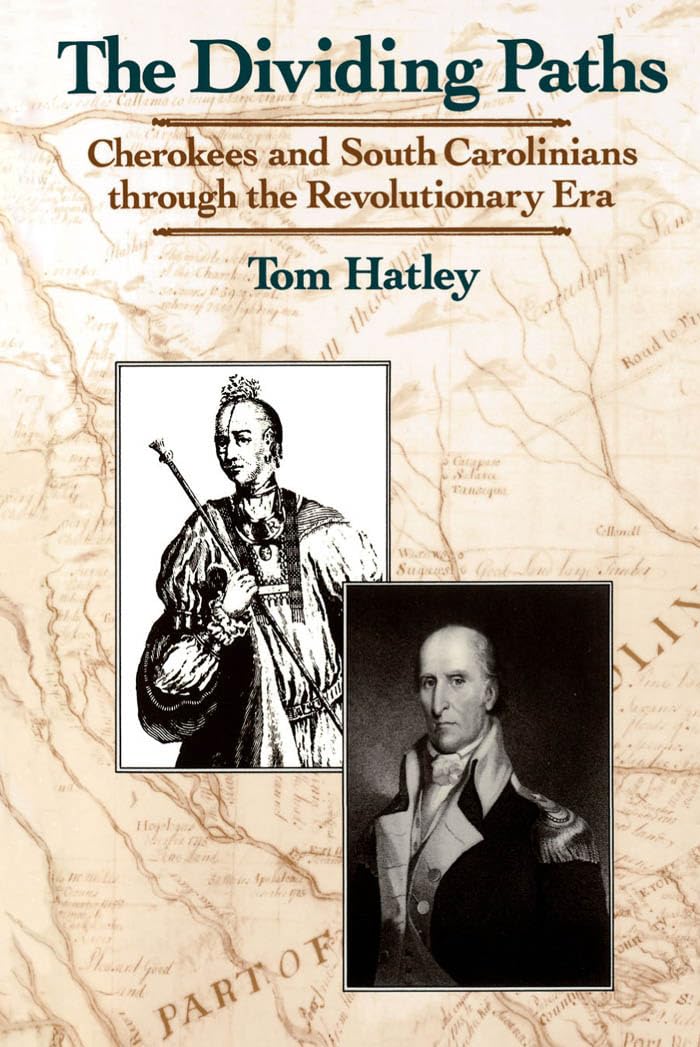
The Dividing Paths: Cherokees and South Carolinians through the Era of Revolution
$54.28
by Tom Hatley



Focusing on the American Cherokee people and the South Carolina settlers, this book traces the two cultures and their interactions from 1680, when Charleston was established as the main town in the region, until 1785, when the Cherokees first signed a treaty with the United States. Hatley retrieves the unfamiliar dimensions of a world in which Native Americans were at the center of Southern geopolitics and in which radically different social assumptions about the obligations of power, the place of women, and the use of the land fed the formative cultural psychology of the colonial South. Weaving together firsthand accounts, journals, and letters to give a human reality to the facts of war, politics, and the economy, he pinpoints the revolutionary decade--from the little known but decisive Cherokee war through the Revolution itself--in which both societies struggled over their own identities. Rather than focusing on the Cherokees and Carolinians separately, this book focuses on contacts, encounters, exchanges, intersections: their mutual history. Hatley argues that Cherokee and colonial histories cannot be understood separately--that they are inextricably linked--and that the origins of distinctive features of Native American and colonial ethnicity and seemingly unrelated twists in the political history of each society are rooted in this encounter. "[A] fine book....Hatley...displays a profound understanding of the Cherokee culture....[A] beautifully written elegy."-- The New York Times Book Review "Both finely detailed and very readable; it is an admirable piece of ethnohistory."-- CHOICE "This fascinating study deepens our understanding of encounters between the Cherokees and South Carolinians by placing gender at the center of the analysis. In the process, Hatley offers an important reinterpretation of the development of the southern backcountry in the eighteenth century."--Rachel N. Klein, University of California, San Diego "One of the rare historical works that makes sense of the encounter between Europeans and American Indians from the native, as well as the white, perspective."--Bernd Lambert, Cornell University "Goes much beyond the normal bounds of a scholarly treatise."-- Catskill Mountain News "Hatley's treatment of history has the veneer of fiction. He sets up a powder keg situation headed for explosion. He charts the origins of trouble, then the manner in which irony plays its wicked ways. His focus on small portions of the larger picture helps to fill in the panorama....Heady stuff....The book's insistence on the importance of small occurrences to influence the sweep of history makes it a seminal work."-- Hudson Valley Literary Supplement "Presents some fresh views on the role of gender in Cherokee life and the psychology of political and economic identities."-- The State (South Carolina) "A very successful work....Hatley has done a fine job of making a coherent whole out of scattered and unwieldy evidence. This is an ambitious and thought-provoking book, well worth pondering."-- Georgia Historical Quarterly "A welcomed addition to the literature on the southern frontier and should be of interest to historians of Colonial America and Native Americans."-- History: Reviews of New Books "This is much more than a narrative of Cherokee or colonial history. It is a demographic, agricultural, political, gender-oriented ethnohistory revealing new ideas about the interrelationship of white and Cherokee society, and it is better than any previous work. This will be required reading for any serious student of Cherokee and colonial history."-- American Indian Culture and Research Journal "Certain to become an often-cited reference."-- American Historical Review "This is an ambitious, valuable, and idiosyncratic work on colonial south."-- The Historian " The Dividing Paths represents a valuable contribution to the literature of Indian and early American history."--illiam and Mary Quarterly "Hatley successfully presents the theme of two societies shaping each other and two societies that lost...Although The Dividing Paths is likely to remain controversial, it places the Cherokee more toward center in the arena of discussions about colonial South Carolina than generally has been the case, and unites into a single work the previously segmented information about the Cherokee and South Carolina during much of the eighteenth century."-- South Carolina Historical Magazine "Hatley's imagination and creativity advance our understanding of both Cherokee and Carolina history and force us to reconceptualize a colonial South."-- Pacific Historical Review "Well researched and well written."--Mark Fernandez, Assistant Professor of History, Loyola University "A fresh view at a neglected area of colonial history."--P.J. Furlong, Indiana University, South Bend "Hatley has produced an insightful study based on excellent research and analysis....I highly recommend this book to anyone interested in intercul