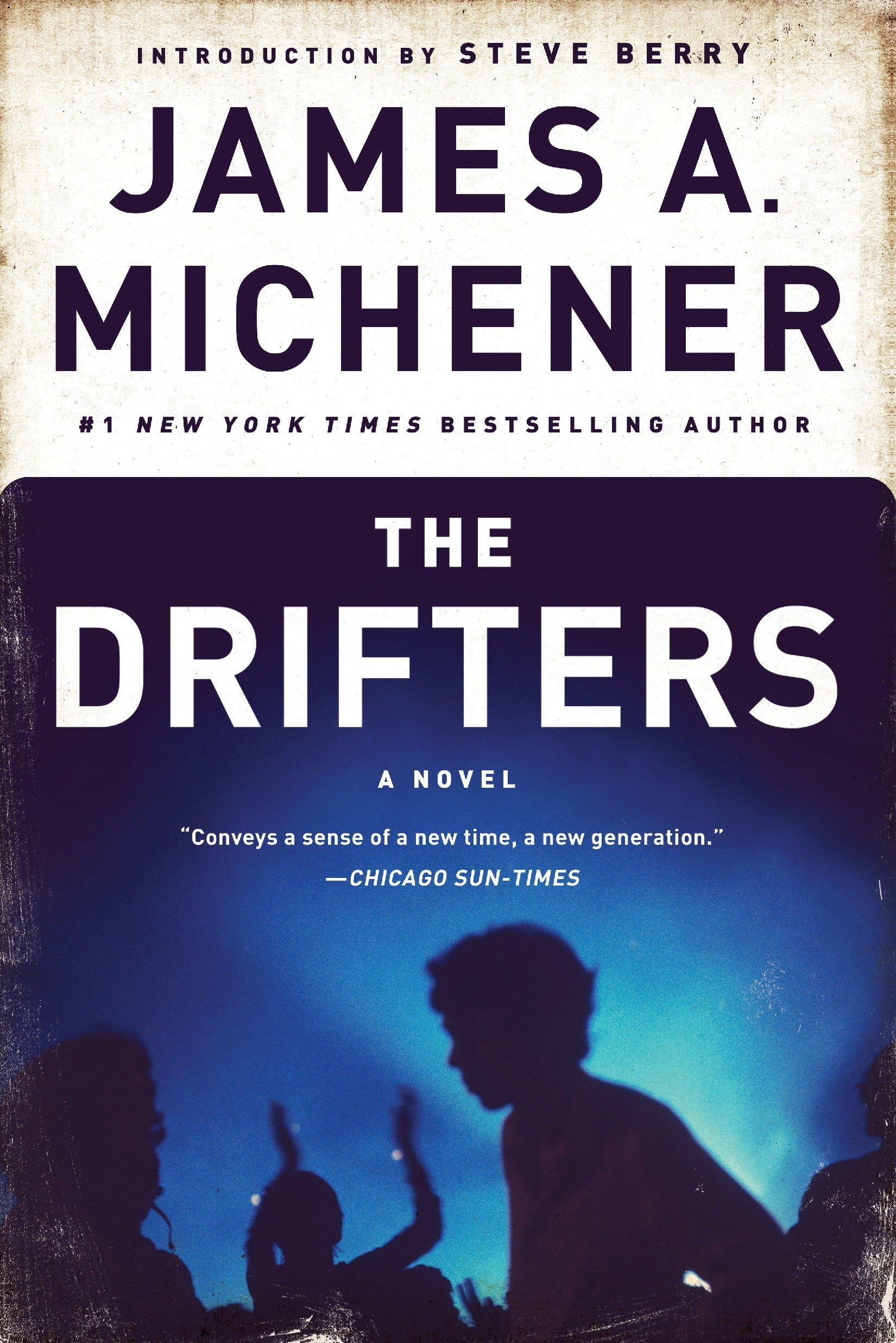



In this triumphant bestseller, renowned novelist James A. Michener unfolds a powerful and poignant drama of disenchanted youth during the Vietnam era. Against exotic backdrops including Spain, Morocco, and Mozambique, he weaves together the heady dreams, shocking tribulations, and heartwarming bonds of six young runaways cast adrift in the world—as well as the hedonistic pursuit of drugs and pleasure that collapses all around them. With the sure touch of a master, Michener pulls us into the private world of these unforgettable characters, exposing their innermost desires with remarkable candor and infinite compassion. Praise for The Drifters “A blockbuster of a book . . . full of surprise, drama, and fascination.” —Philadelphia Bulletin “Rings with authentic detail and clearly descriptive sights and smells . . . The Drifters is to the generation gap what The Source was to Israel.” — Publishers Weekly “[ The Drifters ] conveys a sense of a new time, a new generation.” — Chicago Sun-Times “Michener has slid open a window on the world of the dropout and has spared no effort to make the reader aware of this new world.” — The Salt Lake Tribune “A blockbuster of a book . . . full of surprise, drama, and fascination.” —Philadelphia Bulletin “Rings with authentic detail and clearly descriptive sights and smells . . . The Drifters is to the generation gap what The Source was to Israel.” — Publishers Weekly “[ The Drifters ] conveys a sense of a new time, a new generation.” — Chicago Sun-Times “Michener has slid open a window on the world of the dropout and has spared no effort to make the reader aware of this new world.” — The Salt Lake Tribune James A. Michener was one of the world’s most popular writers, the author of more than forty books of fiction and nonfiction, including the Pulitzer Prize–winning Tales of the South Pacific, the bestselling novels The Source, Hawaii, Alaska, Chesapeake, Centennial, Texas, Caribbean, and Caravans, and the memoir The World Is My Home . Michener served on the advisory council to NASA and the International Broadcast Board, which oversees the Voice of America. Among dozens of awards and honors, he received America’s highest civilian award, the Presidential Medal of Freedom, in 1977, and an award from the President’s Committee on the Arts and Humanities in 1983 for his commitment to art in America. Michener died in 1997 at the age of ninety. Youth is truth. No man is so foolish as to desire war more than peace: for in peace sons bury their fathers, but in war fathers bury their sons.—Herodotus The greatest coup engineered by the university in recent years had been the employment of Dr. Richard Conover, Nobel Prize winner in biology. He added much luster to the faculty, but his principal work continued to focus in Washington, where he was conducting experiments on nerve gases for the Department of Defense. This meant that he was unable to do any actual teaching at the university; his courses were handled by a series of attractive young men who were, on the average, two and one half years older than the university students, four per cent more intelligent, and six per cent better adjusted. Of course, students could sometimes catch a glimpse of Dr. Conover heading for the airport on Sunday afternoon, and this reassured them. War is good business. Invest your sons. The university had lost its way and everyone knew it except the Board of Regents, the alumni, the faculty and ninety per cent of the students. I am a serious student. Please do not spindle, fold or staple me. He was looking through all the markets to find a Christmas present for L.B.J. What he had in mind was a set of dominoes. Goddammit, I wish you’d listen to my main argument. Thirty years from now the government, the banks, the important businesses, the universities and everything that counts in this world will be run by today’s humanities majors. The scientists will never run anything except laboratories, they never have, they never can. Yet in this university we spend all our time and money training scientists and we ignore the humanities people on whom the welfare and guidance of the world have always depended and will always depend. I say this is stupidity, and if the Board of Regents and the faculty aren’t smart enough to stop it, we must. Better a certain peace than a hoped-for victory.—Livy When they conk you on the head with their billysticks, zap them right back with superlove. With men, the normal state of nature is not peace but war.—Kant Political exile has been the last refuge of many noble minds. In exile Dante Alighieri wrote his finest poetry and Vladimir Ilyich Ulyanov forged the ideas that were to paralyze the world. It was in exile from German militarism that Carl Schurz made his scintillating contributions to American life, and in exile from Spanish reaction that Duque de Rivas wrote his