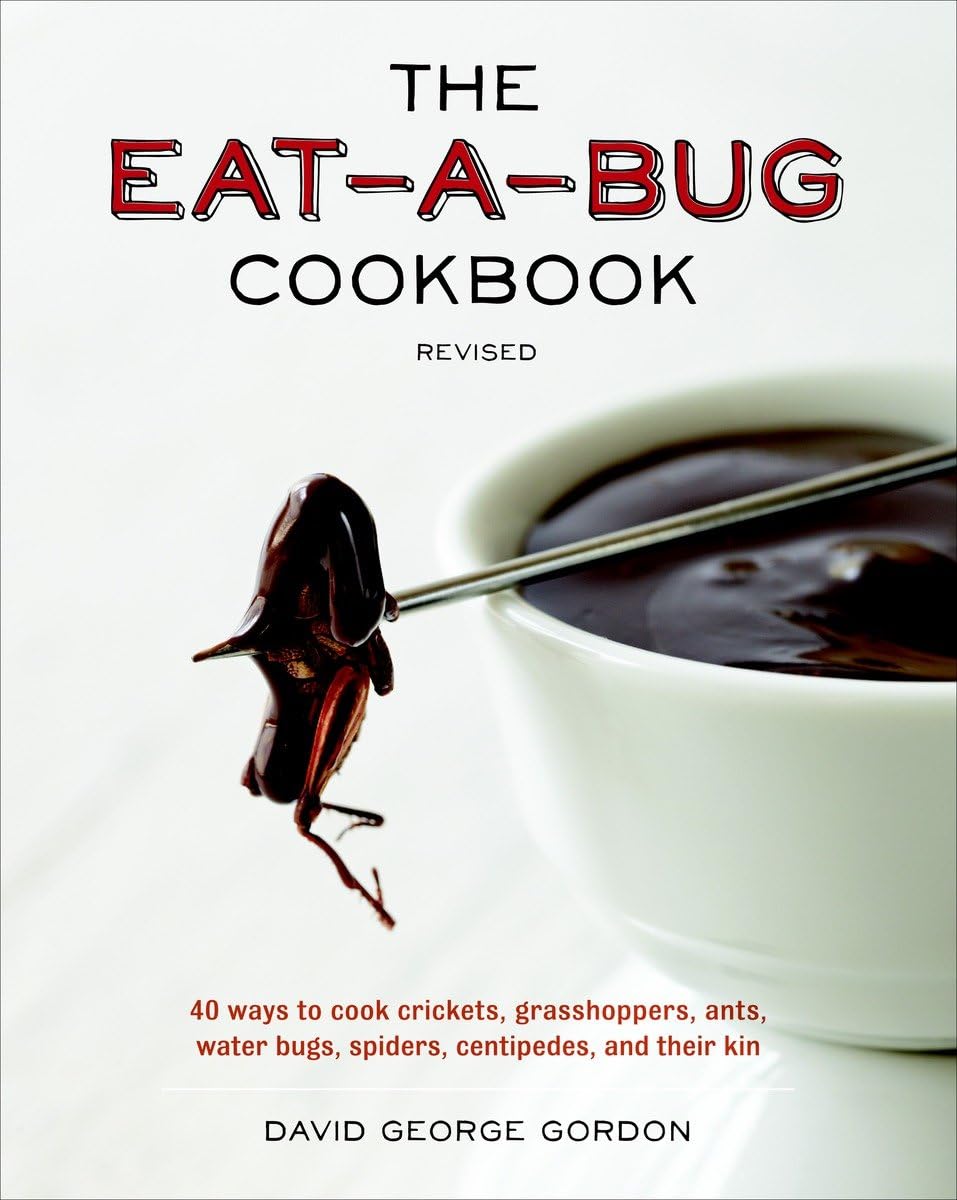
The Eat-a-Bug Cookbook, Revised: 40 Ways to Cook Crickets, Grasshoppers, Ants, Water Bugs, Spiders, Centipedes, and Their Kin
$39.00
by David George Gordon



With its stylish new package, updated information on the health and environmental benefits of insect eating, and breed-your-own instructions, this new edition of The Eat-a-Bug Cookbook is the go-to resource for anyone interested in becoming an entomological epicure. For many Americans, eating a lowly insect is something you’d only do on a dare. But with naturalist and noted bug chef David George Gordon, bug-eating is fun, exciting, and downright delicious! Now you can impress, enlighten, and entertain your family and friends with Gordon’s one-of-a-kind recipes. Spice things up at the next neighborhood potluck with a big bowl of Orthopteran Orzo—pasta salad with a cricket-y twist. Conquer your fear of spiders with a Deep-Fried Tarantula. And for dessert, why not try a White Chocolate and Wax Worm Cookie? (They’re so tasty, the kids will be begging for seconds!) Today, there are more reasons than ever before to explore entomophagy (that’s bug-eating, by the way). It’s an environmentally-friendly source of protein: Research shows that bug farming reduces greenhouse gas emissions and is exponentially more water-efficient than farming for beef, chicken, or pigs. Mail-order bugs are readily available online—but if you’re more of a DIY-type, The Eat-A-Bug Cookbook includes plenty of tips for sustainably harvesting or raising your own. Filled with anecdotes, insights, and practical how-tos, The Eat-A-Bug Cookbook is a perfect primer for anyone interested in becoming an entomological epicure. "Less earnest than cheeky, his cookbook aims to lure you to try bugs the old-fashioned way: by making them sound – and look – like epicurean delights." — The Salt, NPR Praise for the previous edition: “A smorgasbord of information.” — Science News “Gordon’s recipes are tasty and well chosen, as are the many informative slices of arthropod lore.” — Discover “The ultimate edible insect cookbook.“ — Ento Nation DAVID GEORGE GORDON, a.k.a. the Bug Chef, is an award-winning author of nineteen books. The freewheeling naturalist is a popular guest speaker and regularly gives lectures and cooking demonstrations at venues such as the American Museum of Natural History, the San Diego Zoo, California Academy of Sciences, and Ripley’s Believe It or Not. He has also showcased his bug-based cuisine at schools and colleges in thirty-two states and four foreign countries. KAREN LUKE FILDES was born and raised in Tacoma, Washington. She conveys her enthusiasm for wildlife and wild places by using pen and ink, and oil on canvas. David and Karen are married and live in Seattle. Who Eats Bugs? Entomophagy (pronounced en-tuh-MOFF-a-gee)—that’s bug eating to you—has been practiced for many centuries throughout Africa, Asia, Australia, the Middle East, and North, South, and Central America. And the feasting continues according to Marcel Dicke, professor of entomology at Wageningen University and winner of the Dutch version of the Nobel Prize, with an estimated 80 percent of the world’s population eating bugs. Insects and their kin are enjoyed nearly everywhere except for Europe and the United States and Canada. That’s right: we’re the weirdos for not eating bugs. It’s hard to say what motivated some of our forefathers to refrain from this widespread, nutritionally beneficial, and unquestionably wholesome practice. Quite possibly, our current disdain for bug cuisine was shared by the first farmers of northern Europe and, by extension, European colonists in the New World. They regarded most land arthropods, and insects in particular, as crop- and livestock-robbing pests. To these early agronomists, eating bugs was probably akin to sleeping with the enemy. To discourage anyone from going over to the “other side,” they manufactured all manner of bad press for bugs. Hundreds of years later, fear-mongering pest control companies took the insect hate ball and ran with it. In their eyes, the only good bug was a dead one. Nowadays, most people in Europe and North America regard insects and other land arthropods as unclean, germ-laden, and foul tasting—three views that have little, if any, basis in fact. Many of the world’s indigenous people still harvest and eat bugs, just as we do artichokes, oysters, and many of the myriad gifts from the land and sea. Did you know, for instance, that when faced with a cloud of locusts, native Algerians will break out the brooms and start sweeping their sudden bounty of insects into baskets and bags? Or that honey gatherers in Malaysia will sell the liquid bounty from a wild hive, but they’ll save any larval bees still in the honeycomb for themselves? How many of you have heard about the mopane worm business in rural South Africa? The fat, juicy caterpillars of the emperor moth are plucked from the mopane trees at Christmastime, after which they are gutted, dried, and sold at markets. The first people of North America were avid bug eaters. I’ve read that members of the Klamath