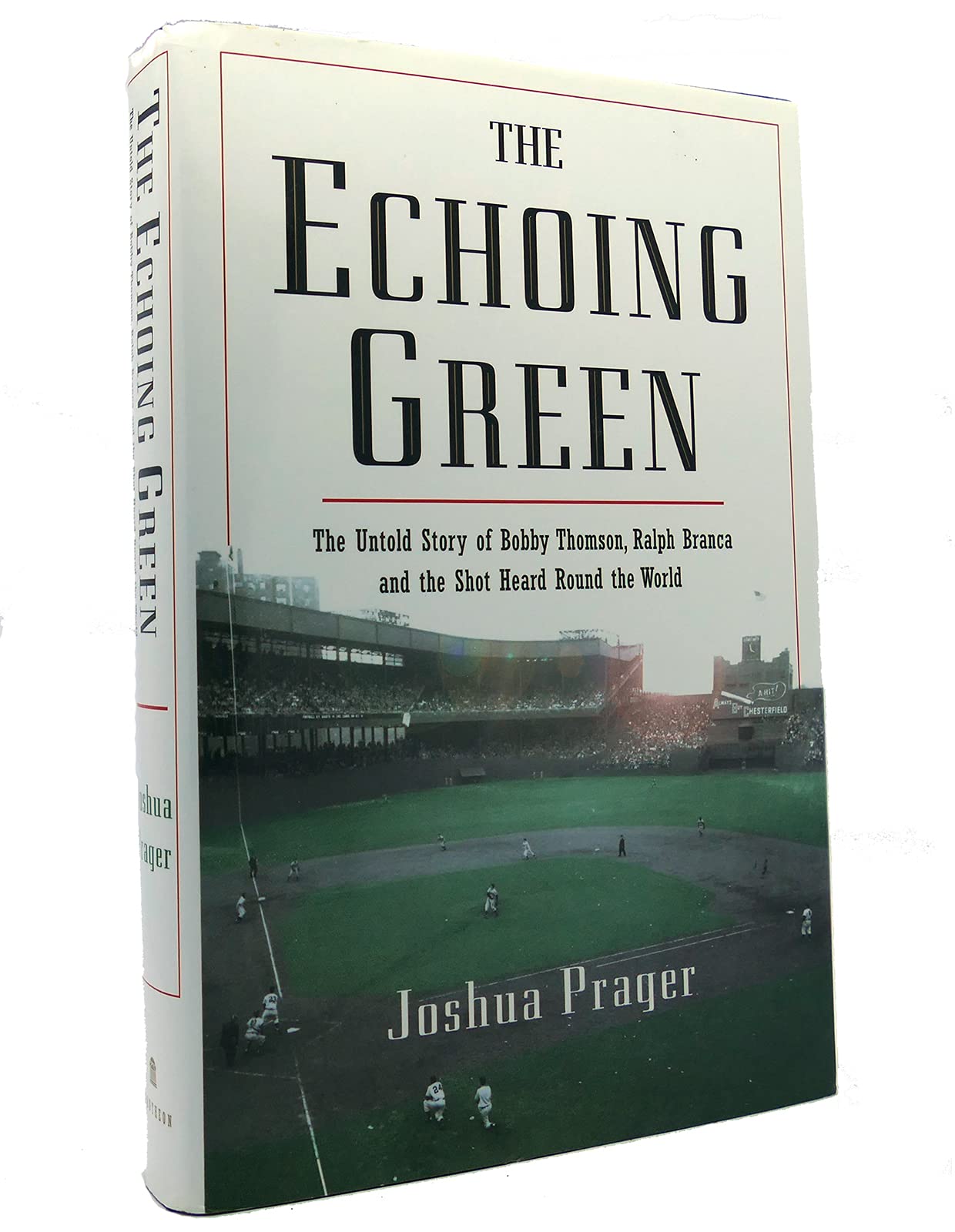
The Echoing Green: The Untold Story of Bobby Thomson, Ralph Branca and the Shot Heard Round the World
$18.71
by Joshua Prager



The 1951 regular season was as good as over. The Brooklyn Dodgers led the New York Giants by three runs with just three outs to go in their third and final playoff game. And not once in major league baseball’s 278 preceding playoff and World Series games had a team overcome a three-run deficit in the ninth inning. But New York rallied, and at 3:58 p.m. on October 3, 1951, Bobby Thomson hit a home run off Ralph Branca. The Giants won the pennant. The Echoing Green follows the reverberations of that one moment–the Shot Heard Round the World–from the West Wing of the White House to the Sing Sing death house to the Polo Grounds clubhouse, where a home run forever turned hitter and pitcher into hero and goat. It was also in that centerfield block of concrete that, after the home run, a Giant coach tucked away a Wollensak telescope. The spyglass would remain undiscovered until 2001, when, in the jubilee of that home run, Joshua Prager laid bare on the front page of the Wall Street Journal a Giant secret: from July 20, 1951, through the very day of that legendary game, the orange and black stole the finger signals of opposing catchers. The Echoing Green places that revelation at the heart of a larger story, re-creating in extravagant detail the 1951 pennant race and illuminating as never before the impact of both a moment and a long-guarded secret on the lives of Bobby Thomson and Ralph Branca. A wonderfully evocative portrait of the great American pastime, The Echoing Green is baseball history, social history and biography–irresistible reading from any angle. *Starred Review* Don DeLillo wrote a novel about it ( Underworld 1997); public figures of every stripe, from Frank Sinatra to Harold Bloom, have shared their memories of it; and an entire borough never recovered from it: Bobby Thomson's home run, the "shot heard round the world," won the 1951 National League pennant for the New York Giants, besting their crosstown rivals, the Brooklyn Dodgers, in a three-game playoff, but in the end the home run became not only baseball's most-remembered moment but also the ultimate expression of the thrill of victory and the agony of defeat (Thomson's triumph was paralleled by the dejection of Dodger pitcher Ralph Branca, immortalized by a photographer after the game, hands on head, moaning, "Why me? Why me?"). The story of the 1951 Giants has been told many times before, of course, but Wall Street Journal reporter Prager brings to the tale both a revealing focus on the entwined lives of Thomson and Branca and the first in-depth examination of the scandal that lurked beneath the surface of the Giants' victory: throughout their remarkable comeback, the team had been using a centerfield telescope to steal the opposing catchers' signs. Did Thomson know beforehand that Branca's second pitch would be a fastball? He says no--his mind was on the moment, not the sign--but the widespread disclosure of the telescope gambit in the 1990s did much to tarnish a nation's near-sacred memories of the event. Prager rides the sign-stealing hobbyhorse a bit too hard here--ladling on heavy-handed foreshadowing--but he does expose multiple layers of fascinating backstory to the drama within a drama, and his psychobiographies of Thomson and especially Branca are unfailingly compelling. Only his convoluted and overblown prose style ("the sportswriter had mined for gold dust the tedium of spring training") keeps this from being one of the best baseball books in decades. But content finally trumps form in what is still the biggest sports story of the last century. Bill Ott Copyright © American Library Association. All rights reserved From Kirkus Reviews Starred Review. Say it ain't so, Leo: an iconoclastic, most penetrating look at a famed 1951 clash between the New York Giants and the Brooklyn Dodgers. Both teams long ago "deserted New York together," remarks Wall Street Journal writer Prager, yielding existential trauma yet unhealed. Well before leaving, on Oct. 3, 1951, their storied rivalry played itself to perfection in a pennant race to end all pennant races, "deadlocked after 156 games, seven innings and six months." It was, Prager writes, something that adults of a certain age would remember as surely as they did the death of JFK or FDR: Dodger Ralph Branca fires a fastball, Giant Bobby Thomson steps forward to swat it out of the park halfway to the moon, the Giants win. The moment is instantly celebrated as the greatest moment in baseball history, immortalized in novels by Philip Roth and Don DeLillo, in The Godfather and The Simpsons. Problem was, as Prager revealed on the 50th anniversary of the grand smack, Giants manager Leo Durocher, of fabulously foul mouth ("I never saw a fucking ball get out of a fucking ball park as fucking fast in my fucking life," he said of one Willie Mays homer), had stolen signals, employing spies with a telescope to suss out what the opposition was planning next. Durocher wasn't even the