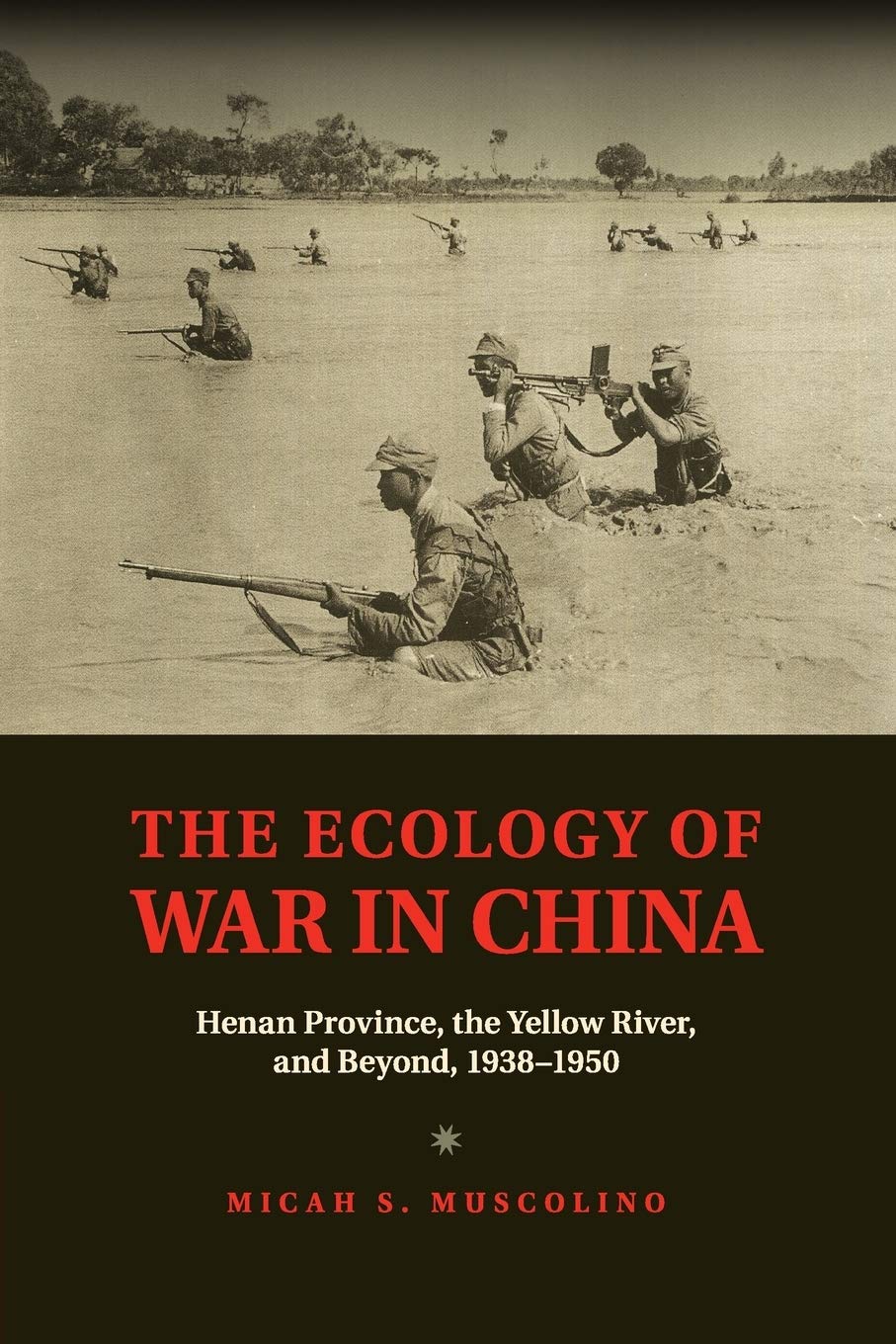
The Ecology of War in China: Henan Province, the Yellow River, and Beyond, 1938–1950 (Studies in Environment and History)
$35.00
by Micah S. Muscolino



This book explores the interplay between war and the environment in Henan Province, a hotly contested frontline territory that endured massive environmental destruction and human disruption during the conflict between China and Japan that raged during World War II. In a desperate attempt to block Japan's military advance, Chinese Nationalist armies under Chiang Kai-shek broke the Yellow River's dikes in Henan in June 1938, resulting in devastating floods that persisted until after the war's end. Greater catastrophe struck Henan in 1942–1943, when famine took some two million lives and displaced millions more. Focusing on these war-induced disasters and their aftermath, this book conceptualizes the ecology of war in terms of energy flows through and between militaries, societies, and environments. Ultimately, Micah Muscolino argues that efforts to procure and exploit nature's energy in various forms shaped the choices of generals, the fates of communities, and the trajectory of environmental change in North China. "This is a riveting study of one of modern history’s worst war-induced disasters. In 1938 the Yellow River was turned into a weapon of strategic defense, its waters let loose on the North China plain by Chinese forces resisting the Japanese invasion. This consummate work shows the evolution of the disaster and lays out its ghastly human and ecological effects. It is a pioneering combination of environmental history and Chinese history." Diana Lary, University of British Columbia "In this brilliantly conceptualized work Muscolino draws on the memories of the displaced as well as the records of the river to tell an environmental history of the Yellow River, granting the latter its full agency in the shaping of modern Chinese history." Wen-hsin Yeh, Richard H. and Laurie C. Morrison Chair Professor in History, University of California, Berkeley "Conceptualizing the relationship between armies and environment in terms of energy flows, Micah Muscolino provides us with a startlingly new and rich way to think about the relationship between war and environment." Hans van de Ven, Director in Oriental Studies, St Catharine’s College, University of Cambridge "The Ecology of War in China is an ambitious book that delivers an intense vision of the tremendous hardships faced by the people and environment of the central Chinese province of Henan throughout a dozen years of Anti-Japanese Resistance, widespread famine, civil war, and, finally, recovery … Muscolino does a masterful job of demonstrating the pivotal role that the Yellow River and the larger environment played in Chinese history." Norman Smith, The Journal of Interdisciplinary History 'Micah Muscolino already has a strong reputation as a pioneering scholar in the field of China’s Republican-era environmental history. His new book makes another major contribution to that field. … The Ecology of War in China is a valuable addition to the literature on the environmental destructiveness of warfare. It must count as one of the most rigorously researched, analytically sophisticated, and strongest studies we have of the causes and consequences of an environmental disaster in twentieth-century China. It deserves to be widely read.' Pauline Keating, The China Journal '… in an age in which human decisions - often based on the short-term pursuit of power - may shape even the broadest long-standing background conditions of human societies, Muscolino's account of unintended consequences, incomplete reversibility, and destabilized environments is also a story of more than just historical interest.' Kenneth Pomeranz, Cross-Currents: East Asian History and Culture Review 'This is a work of painstaking local history, illustrated with numerous detailed maps of the shifting Yellow River flood, and gripping photographs from the time. Archival sources and local observers provide telling details and useful statistics. … Muscolino is an environmental historian, a path-breaker in this discipline in the China field. He forces old-fashioned historians like me to think in new ways, which is certainly both necessary and useful.' Joseph Esherick, Journal of Chinese History 'The Yellow River, China’s second-longest waterway and Asia’s third-longest, is not exactly a typical veteran of the Second World War (or, if you are Chinese, of the 'War of Resistance against Japan'). As Micah S. Muscolino ably demonstrates, the Yellow River nevertheless did literally play a central role as 'an actor' in the second Sino-Japanese War (1937–1945). In its attention to postwar policies and legacies, the book begins to fill a gap in the growing literature on 'war and the environment' by looking beyond the immediate effects of military operations. Overall, The Ecology of War in China is a powerful demonstration of the synergy between people and nature that both destroys and restores.' David Bello, The American Historical Review 'The Ecology of War in China is a superbly researched and tig