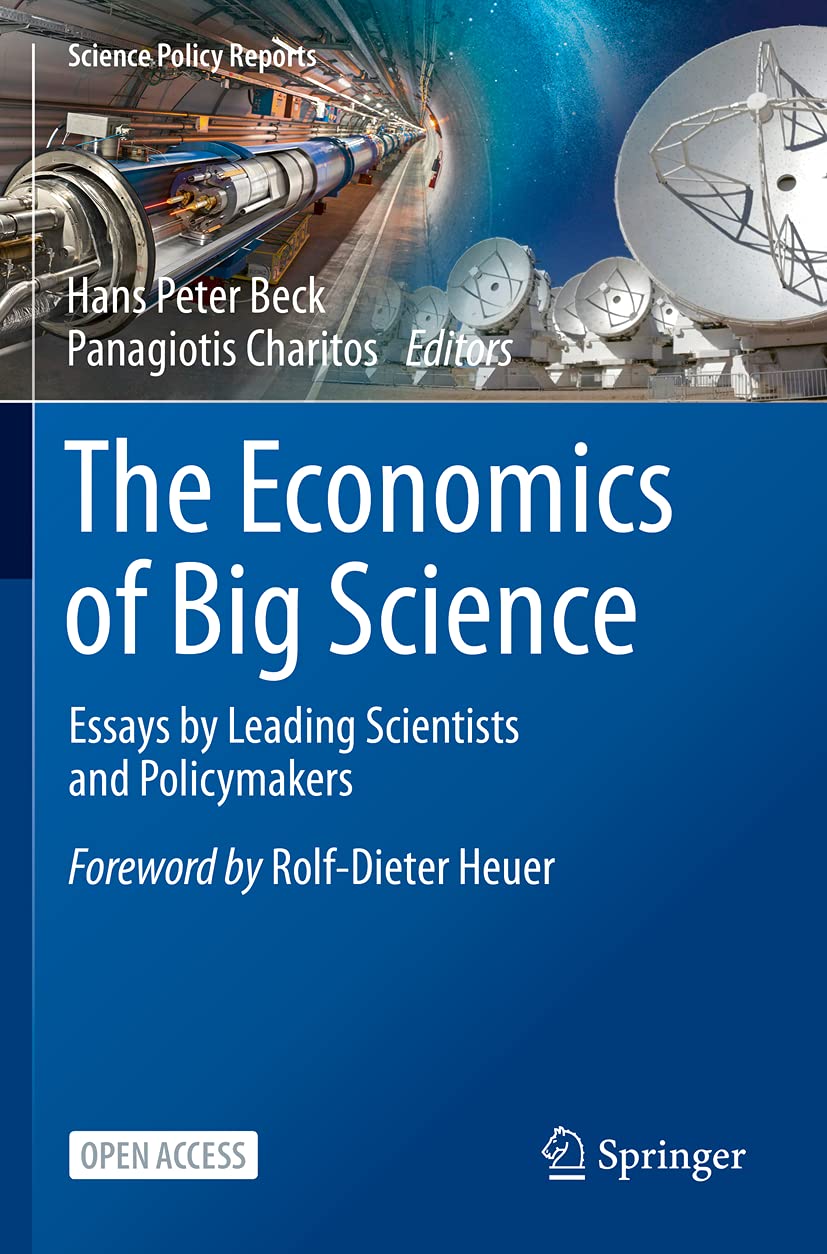
The Economics of Big Science: Essays by Leading Scientists and Policymakers (Science Policy Reports)
$91.35
by Hans Peter Beck



The essays in this open access volume identify the key ingredients for success in capitalizing on public investments in scientific projects and the development of large-scale research infrastructures. Investment in science – whether in education and training or through public funding for developing new research tools and technologies – is a crucial priority. Authors from big research laboratories/organizations, funding agencies and academia discuss how investing in science can produce societal benefits as well as identifying future challenges for scientists and policy makers. The volume cites different ways to assess the socio-economic impact of Research Infrastructures and their role as hubs of global collaboration, creativity and innovation. It highlights the different benefits stemming from fundamental research at the local, national and global level, while also inviting us to rethink the notion of “benefit” in the 21st century. Public investment is required to maintain the pace of technological and scientific advancements over the next decades. Far from advocating a radical transformation and massive expansion in funding, the authors suggest ways for maintaining a strong foundation of science and research to ensure that we continue to benefit from the outputs. The volume draws inspiration from the first “Economics of Big Science” workshop, held in Brussels in 2019 with the aim of creating a new space for dialogue and interaction between representatives of Big Science organizations, policy makers and academia. It aspires to provide useful reading for policy makers, scientists and students of science, who are increasingly called upon to explain the value of fundamental research and adopt the language and logic of economics when engaging in policy discussions. The essays in this open access volume identify the key ingredients for success in capitalizing on public investments in scientific projects and the development of large-scale research infrastructures. Investment in science – whether in education and training or through public funding for developing new research tools and technologies – is a crucial priority. Authors from big research laboratories/organizations, funding agencies and academia discuss how investing in science can produce societal benefits as well as identifying future challenges for scientists and policy makers. The volume cites different ways to assess the socio-economic impact of Research Infrastructures and their role as hubs of global collaboration, creativity and innovation. It highlights the different benefits stemming from fundamental research at the local, national and global level, while also inviting us to rethink the notion of “benefit” in the 21st century. Public investment is required tomaintain the pace of technological and scientific advancements over the next decades. Far from advocating a radical transformation and massive expansion in funding, the authors suggest ways for maintaining a strong foundation of science and research to ensure that we continue to benefit from the outputs. The volume draws inspiration from the first “Economics of Big Science” workshop, held in Brussels in 2019 with the aim of creating a new space for dialogue and interaction between representatives of Big Science organizations, policy makers and academia. It aspires to provide useful reading for policy makers, scientists and students of science, who are increasingly called upon to explain the value of fundamental research and adopt the language and logic of economics when engaging in policy discussions. Hans Peter Beck is a reader at the Physics Department of University of Bern, visiting professor at University Fribourg, and president of the Swiss Physical Society. He teaches particle physics courses to undergrad and graduate students and basic physics courses to medical students. He received his PhD from the University of Zurich on electron-proton collisions with the H1 experiment at the HERA accelerator at DESY in Hamburg, Germany. Hans Peter joined University of Bern and the ATLAS collaboration at CERN's LHC in 1997, where he became involved in the architectural design of and prototyping of the trigger and data acquisition system for the ATLAS experiment. He was editor of the Technical Proposal and was elected chair of the ATLAS Trigger and Data acquisition institutes board. His main interest is in the physics of the Standard Model at highest energies, with a focus on Higgs and multi-boson production at the LHC. In the intense years before and after the Higgs discovery, he was deeply involved in the Higgs to four leptons analysis and chair of its editorial board. In parallel, Hans Peter is known for the International Particle Physics Outreach Group (IPPOG), an international collaboration engaging in informal science education and outreaching for particle physics world wide. During his chairmanship (2013-19), Hans Peter transformed IPPOG into a scientific collaboration, following t