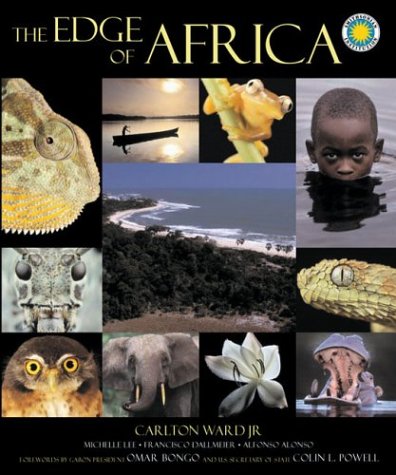



There is a magical place at the edge of Africa where rainforest meets ocean, where elephants and buffalos walk white sand beaches, and hippos, crocs, and sea turtles share the surf. The forest rises a hundred feet tall, full of life and a layered complexity stretching far beyond the horizon. Forests, grasslands, rivers, and lagoons form a unique landscape mosaic. There is no place like it on Earth. Gabon has a story to tell. Its landscapes inspire explorers and scientists with a forest-to-ocean fabric rich in biological diversity. Expeditions are unlocking a treasure chest of knowledge on biology and ecology - the science behind conservation. Unprecedented biodiversity studies are discovering a wealth of species, including several new to science. The Edge of Africa brings light to the unseen wonders of Gabon - from its smallest creatures to its broadest landscapes to the people who call it home. Photographs by Carlton Ward Jr. and text by Michelle Lee capture its stunning essence. The world is grateful to Gabon for conserving its precious wilderness heritage. May Gabon's inspiring story speak to you. There is a magical place at the edge of Africa where rainforest meets ocean, where elephants and buffalos walk white sand beaches, and hippos, crocs, and sea turtles share the surf. The forest rises a hundred feet tall, full of life and a layered complexity stretching far beyond the horizon. Forests, grasslands, rivers, and lagoons form a unique landscape mosaic. There is no place like it on Earth. Gabon has a story to tell. Its landscapes inspire explorers and scientists with a forest-to-ocean fabric rich in biological diversity. Expeditions are unlocking a treasure chest of knowledge on biology and ecology - the science behind conservation. Unprecedented biodiversity studies are discovering a wealth of species, including several new to science. The Edge of Africa brings light to the unseen wonders of Gabon - from its smallest creatures to its broadest landscapes to the people who call it home. Photographs by Carlton Ward Jr. and text by Michelle Lee capture its stunning essence. The world is grateful to Gabon for conserving its precious wilderness heritage. May Gabon's inspiring story speak to you. Gabon, on the west coast of Africa, has a relatively small human population and an almost intact tropical rain forest, which gives the area an extremely high level of biodiversity. In 1996 the Shell Oil Company entered into a partnership with the Smithsonian Institution to assess the region's biodiversity and to help mitigate the effects of petroleum extraction. Photographer Ward spent six months based at the research complex and has produced an astonishing array of images. Using a variety of techniques--animals photographed against a black background; camera "traps" that allow animals to photograph themselves by breaking an infrared beam; and more traditional imaging--Ward has presented the reader with a marvelous series of photos of animals both well known (elephants, hippos) and rare (certain insects, shrews, lizards). An interesting series of photos shows the wildlife and forest surrounding an oil field, with a particularly arresting picture of a bongo antelope daintily stepping over a series of pipes. This beautiful book will fill a need for West African natural history and is highly recommended. Nancy Bent Copyright © American Library Association. All rights reserved Carlton Ward Jr. is an environmental photojournalist from Clearwater, Florida, with graduate training in ecology and anthropology. Through his photographs, he aims to promote conservation of natural environments and cultural legacies. He spent seven months in the field to make the photos in The Edge of Africa . Michelle Lee is an ecologist and field program manager for the Smithsonian in Gabon. Native to southern Ohio, she has lived in Gamba since 2001, running research expeditions and gathering the knowledge needed to compose the text for this book. Francisco Dallmeier, Ph.D. , has directed the Smithsonian Institution's Monitoring and Assessment of Biodiversity Program (SI/MAB) since its inception in 1986, establishing the program's global reach in the field of biodiversity science. Born in Venezuela, he has consistently pursued throughout his career a passion for the conservation of wildlife species and their habitats. Alfonso Alonso, Ph.D. , is a biologist with SI/MAB who orchestrates the research agenda for the Gabon Biodiversity Program. Originally from Mexico, he has extensive professional experience in the Americas, Africa, and Asia. The Smithsonian Institution is an international leader in research and exploration and the world's largest provider of museum experiences supported by authoritative scholarship in science, history, and the arts. The Monitoring and Assessment of Biodiversity Program (SI/MAB) is part of the Smithsonian National Zoological Park's Conservation and Research Center. SI/MAB emphasizes sci