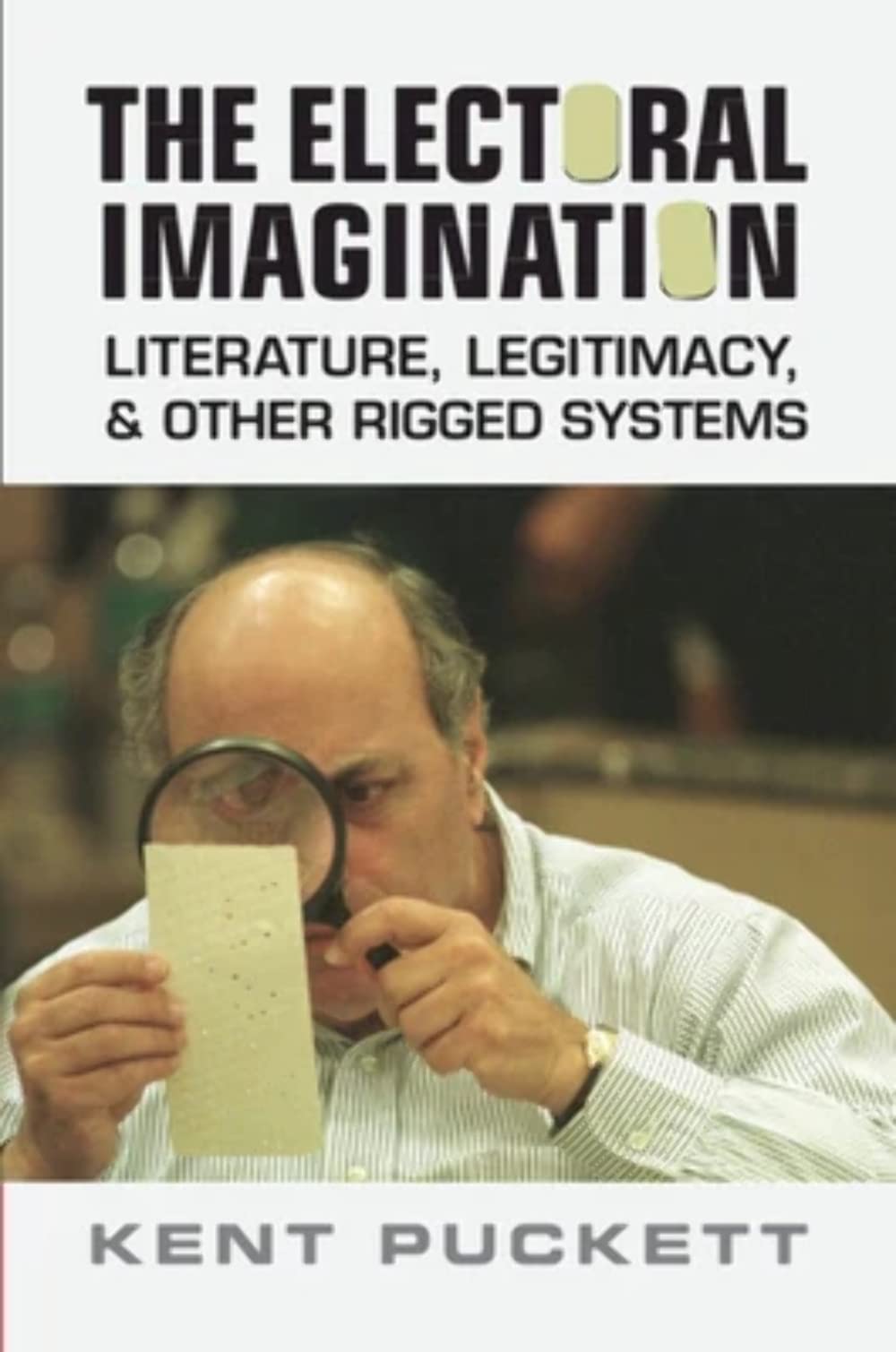
The Electoral Imagination: Literature, Legitimacy, and Other Rigged Systems
$28.45
by Kent Puckett



What happens when we vote? What are we counting when we count ballots? Who decides what an election should look like and what it should mean? And why do so many people believe that some or all elections are rigged? Moving between intellectual history, literary criticism, and political theory, The Electoral Imagination offers a critical account of the decisions before the decision, of the aesthetic and imaginative choices that inform and, in some cases, determine the nature and course of democratic elections. Drawing on original interpretations of George Eliot and Ralph Ellison, Lewis Carroll and Kenneth Arrow, Anthony Trollope and Arthur Koestler, Richard Nixon and Jean-Jacques Rousseau, the Palm Beach Butterfly Ballot and the Single Transferable Vote, The Electoral Imagination works both to understand the systems we use to move between the one and the many and to offer an alternative to the 'myth of rigging.' ‘Recommended.' S. A. Parker, Choice ‘Kent Puckett’s scintillating study of the electoral imagination illuminates both the history of the novel and political theory. … To call this book timely would be an understatement. … it offers a fresh perspective on the relation between the novel and democracy. At the same time, it shows us why the fiction of electoral representation is an urgent necessity.’ Carolyn Vellenga Berman, NOVEL ‘The Electoral Imagination offers a brilliant account of how Anthony Trollope, George Eliot, Lewis Carroll, William Morris, and Ralph Ellison came up with imaginary reversals of electoral protocols, both practical and theoretical, to put the lie to the reigning political theories of the day. Calling attention to these and other writers who used fiction to picture truly democratic elections, Puckett’s compelling new book shows how the discontinuities, exclusions, biases, and contradictions built into the very idea of a fair election might be used to sustain a better fiction of a better democracy.’ Nancy Armstrong, Duke University ‘An expansive, brilliantly original study of the imaginative forms that sustain democracy. From Alice in Wonderland to Richard Nixon, Puckett shows us all the intricate fictions needed in order to make voting mean what it’s supposed to mean.’ Yoon Sun Lee, Wellesley College ‘The relationship between the work of literature and the rickety, unpredictable machinery of representative democracy is laid bare in this delightfully complex and accretive new book. Puckett helps readers imagine Lewis Carroll, William Morris, and Ralph Ellison joining forces to defeat the corrosive hermeneutics of suspicion that make present-day cries of ‘rigged elections’ so terrifyingly potent.’ John Plotz, Brandeis University, author of The Crowd, Portable Property, Semi-Detached An intellectual history and aesthetic theory of democratic elections, this book offers a critical alternative to the 'myth of rigging.' Kent Puckett is author of Bad Form: Social Mistakes and the Nineteenth-Century Novel (2008), War Pictures: Cinema, Violence, and Style in Britain, 1939–1945 (2017), and Narrative Theory: A Critical Introduction (2016), winner of the 2018 Barbara Perkins and George Perkins Prize of the International Society for the Study of Narrative. His essays have appeared in Critical Inquiry, Representations, MLQ, Novel, Victorian Literature and Culture, Public Books, and other journals.