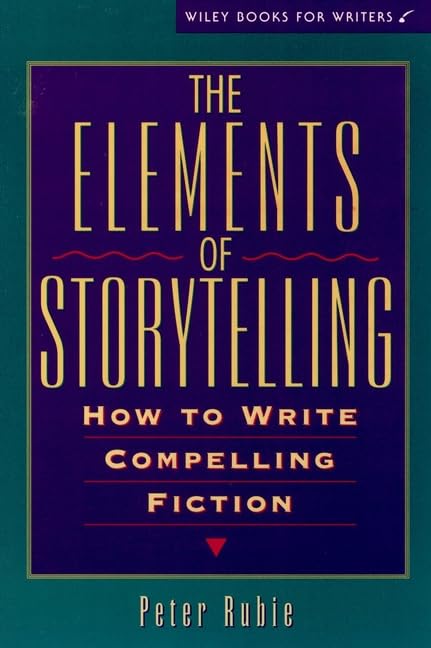
The Elements of Storytelling: How to Write Compelling Fiction (Wiley Books for Writers Series)
$15.99
by Peter Rubie



"I recommend this book to all aspiring novelists." --Kent Carroll, Publisher and Executive Editor Carroll & Graf "I would not hesitate to recommend The Elements of Storytelling to aspiring writers, or to better published ones who need to be reminded of the essentials of the craft. (That's all of us, by the way!)" --Robert Goddard Author of In Pale Battalions and Full Circle "Should be on every writer's bookshelf right between The Elements of Style and the thesaurus." --Tom Colgan, Senior Editor Avon Books "A wonderful book that every aspiring professional writer should own." --Matthew Bialer, literary agent William Morris Agency Telling a story is one of the most basic--and difficult--challenges a fiction writer must face. Acclaimed author, editor, and literary agent Peter Rubie knows that challenge firsthand. By sharing his creative and critical expertise, he gives you the helpful advice you need to master the art of storytelling, including how to: * Create compelling characters and strong plotlines * Pace a story and develop a coherent structure and style * Refine your technique with thought-provoking exercises that hone your storytelling skills * Anticipate the realities of getting your work published--how to make it happen while maintaining confidence and motivation Peter Rubie's "holistic" approach to fiction writing is simple without being simplistic. Rubie addresses issues of character, viewpoint, dialogue, pacing, etc., but his emphasis is on their contribution to the big picture. "The art of the storyteller," he says, "is figuring out a story. The craft of the storyteller is working out the best way to tell that story." The Elements of Storytelling addresses both art and craft. For the former, Rubie presents exercises throughout the book aimed at developing story ideas, creating characters, and the like. For the latter, he offers up a generous helping of common sense. "Start the scene as near the action as possible," he recommends. "Ideally, everything in the story should have more than one function." And, "When writing dialogue, keep in mind that people rarely explain themselves." One of Rubie's most interesting pieces of advice involves the use of the theories behind method acting to get inside one's characters and bring them to life. "Without admitting to and exploring your own dark nature," he says, "you will never successfully understand it in others. I am not suggesting you must become a Nazi or a cannibalistic serial killer in order to successfully create them as fictional characters. I am suggesting that you try to find that part of yourself that, under certain circumstances, you could imagine going berserk and committing singularly antisocial acts." --Jane Steinberg Peter Rubie lends his extensive experience as an author, book doctor, editor, and agent to this thorough and thought-provoking examination of the craft -- and art-- of writing. Rarely has such a wide perspective been brought to that hoary subject. The result is a refreshing and inspired book of insight and advice. The ELEMENTS OF STORYTELLING delivers what it promises and is a book I wish I'd read before taking up fiction-writing, because it would have taught me lots of things -- entertainingly and economically -- that I learnt by hard trial and frequent error instead. I would not hesitate to recommend it to aspiring writers, or to better established ones who need reminding of the essentials of the craft. (That's all of us, by the way!) As an editor, literary agent and published novelist, Peter Rubie has an intimate and practical understanding of fiction writing. Reading THE ELEMENTS OF STORYTELLING is akin to having a perceptive teacher peer over your shoulder as you work and provide thoughtful guidance. Entertaining, opinionated and thorough, with many useful examples, this book is an excellent guide for the aspiring writer... -- Kate Stine, Editor-in-Chief, Otto Penzler Books and The Armchair Detective. From creating strong plots and characters to pacing the story and refining techniques, this provides the aspiring writer with advice on how to master storytelling for all ages. Using viewpoint effectively, analyzing character actions, and gaining initial ideas for plot are all covered. -- Midwest Book Review Like the best guides to writing, THE ELEMENTS OF STORYTELLING is brief and to the point. Whether you're a novelist or a short story writer, if you aren't familiar with the basic principles Peter Rubie makes clear, you're bound for disaster. Every fiction writer needs this book, either to learn the essential principles of effective writing or to remind oneself of what it is that makes fiction compelling." -- J. Madison Davis, novelist, North American president of the International Association of Crime Writers, Edgar Allan Poe and Oklahoma book award nominee, and Senior Professor of the Professional Writing Program of the University of Oklahoma. -- J. Madison Davis, novelist, North American