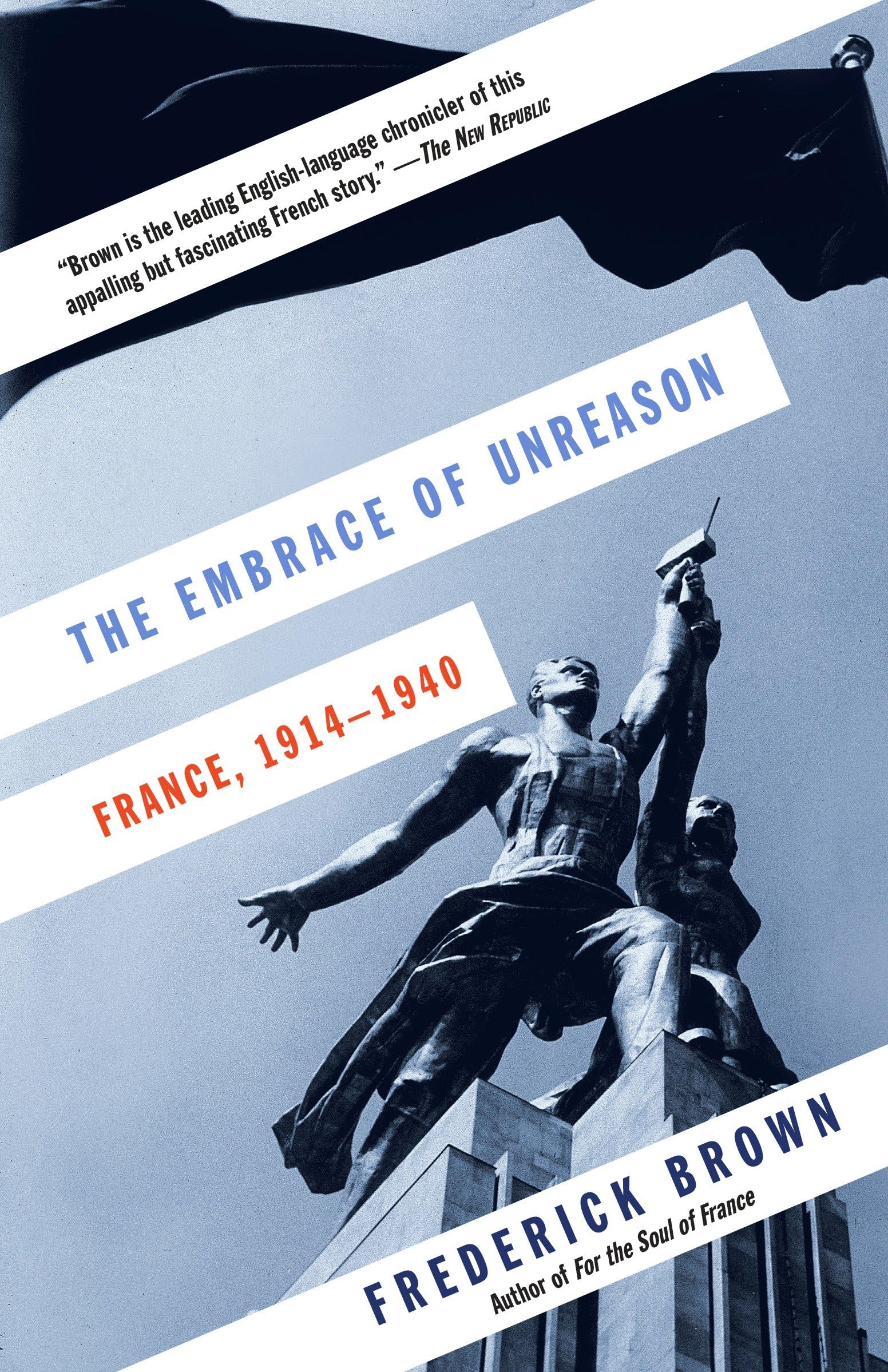



Spanning the turbulent decades between the World Wars, The Embrace of Unreason casts new light on the darkest years in modern French history. It is a fascinating reconsideration of the political, social, and religious movements that led to France’s move away from the humanistic traditions and rationalistic ideals of the Enlightenment and towards submission to authority—and the dramatic rise of Fascism and anti-Semitism. Drawing on newspaper articles, journals, and literary works of the time, acclaimed biographer and cultural historian Frederick Brown explores the forces unleashed by the Dreyfus Affair and how clashing ideologies and new artistic movements led France to an era of violence and nationalistic fervor. “Brown [is] the leading English-language chronicler of this appalling but fascinating French story.” — New Republic “Brilliant. . . . At once social history, cultural history, and a series of biographical sketches, Frederick Brown’s book is both illuminating and a warning. . . . This is terrific history—Brown is an incisive biographer, very good on politics, still better on culture, and anybody who is interested in France . . . should read this book.” — The Daily Beast “A stimulating portrayal. . . . Brown deftly and economically analyzes [his subjects]. . . . He succeeds as usual in joining accurate scholarship to elegant and often pithy style.” — The New York Review of Books “[Brown] is a historian who eschews jargon and knows how to make complicated questions clear to the common reader.” — The Wall Street Journal Frederick Brown is the author of several award-winning books, including For the Soul of France; Flaubert, a National Book Critics Circle Award finalist; and Zola, one of The New York Times best books of the year. Brown has twice been the recipient of both Guggenheim and National Endowment for the Humanities fellowships. He lives in New York City. Excerpted from the Hardcover Edition Prologue Until recent times, the French political imagination was disposed to associate its dogmas and enthusiasms with the symbol of the tree. In 1792, revolutionaries at war with monarchical Europe planted “ arbres de la liberté ” in towns and villages throughout the country, taking their cue from the American patriots who had rallied for independence at a famous elm near the Boston Common. Among the hundreds that dotted Paris (mostly poplars, which grew quickly and had the further advantage of deriving etymologically from the Latin populus), one was planted within view of the royal palace in a ceremony over which the king himself presided, under duress. It was cut down several years later, not long after Louis XVI had been guillotined, despite the chief judge’s pronouncement at Louis’s trial that “the tree of liberty grows only when watered by the blood of tyrants.” Otherwise, cutting down a liberty tree under the new dispensation was tantamount to profaning the host under the old regime and punished accordingly. When a villager felled one in the Vaucluse, sixty-three neighbors who concealed his identity paid the forfeit, exemplifying Robespierre’s notorious oxymoron, “the despotism of liberty.” They were killed, their houses were burned, and their fields were salted. As the Revolution understood freedom to be a universal birthright, liberty trees did not require native soil. They grew in land conquered by the Republic beyond the Rhine and, abroad, in the Caribbean colonies, where their proximity to slave markets before the abolition of slavery, in 1794, was noted by one derisive observer.* Far from preserving the original character of trees planted under revolutionary auspices, Napoleon, who came out of the Revolution, allowed them to survive as “arbres Napoléon” while discouraging cer- emonies that glorified the advent of liberty. They numbered at least sixty thousand when Louis XVIII mounted the throne of a restored monarchy. Seen thenceforth as culpable mementos of a hiatus in the the Bourbon succession, liberty trees were harvested for firewood or furniture. With the overthrow of Louis-Philippe in 1848 and the establishment of the Second Republic, maypoles reappeared in plantings that sur- passed the exuberance of eighteenth-century celebrations. “The plantings had multiplied a hundredfold,” wrote a chronicler. “They were to be seen at all the markets, squares, quays, gardens, intersections, and even in the courtyards of public institutions, at the Prefecture of Police, at the Opéra, etc. Patriotic songs, religious ceremonies, speeches, music, the national guard, acclamations, flowers, ribbons, the discharge of weapons, the curious crowd made for a lively spectacle.” As Louis XVI had been pressed into service in the early 1790s, so now Victor Hugo, deputy mayor of the 9th arrondissement, presided over the planting of a poplar on the Place des Vosges, where he resided. Priests were invited to water saplings with their silver aspergillums. Those thousands of well-wa