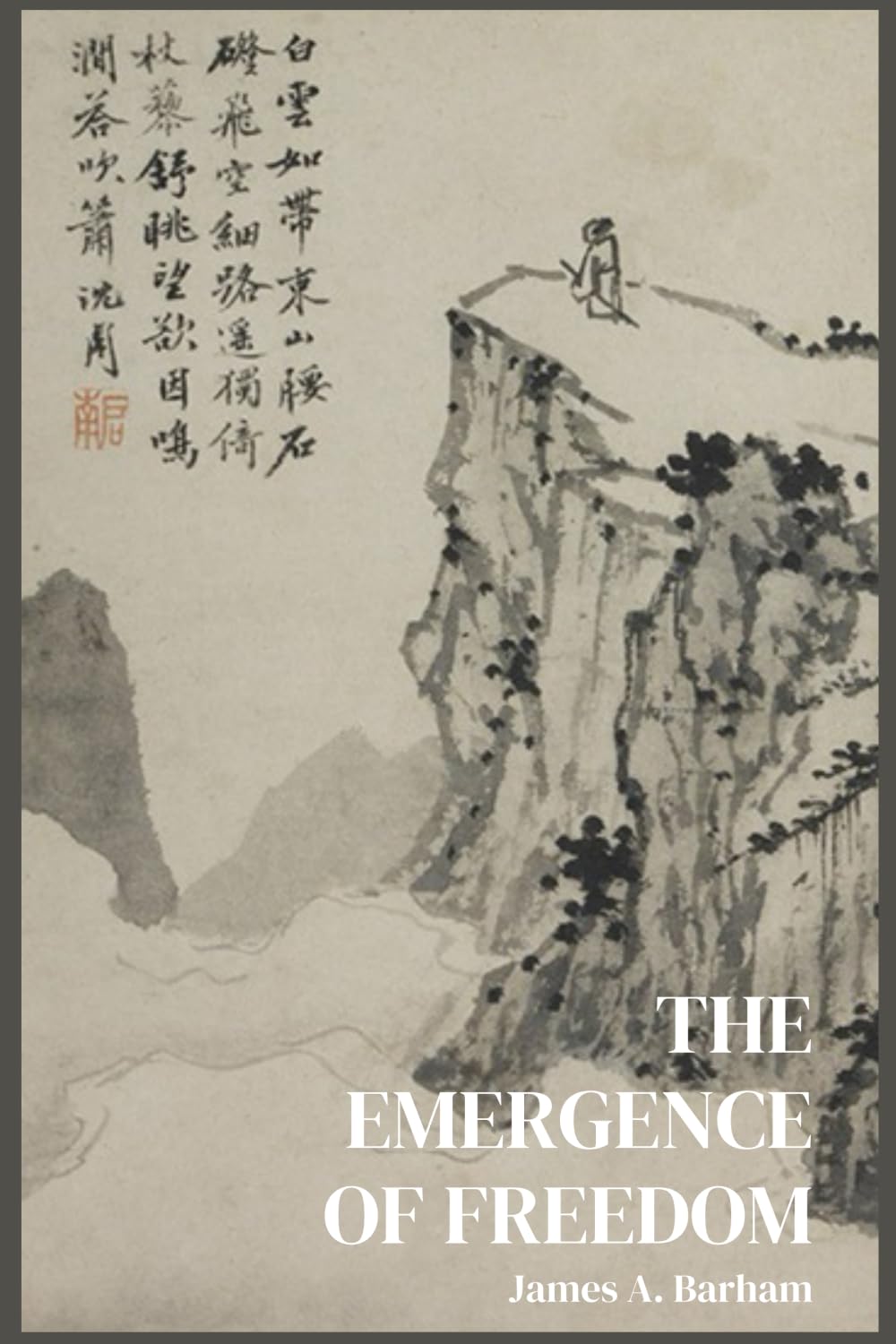
The Emergence of Freedom: The Sciences and the Human Spirit After Darwin
$14.95
by James A. Barham



The Emergence of Freedom Scientism is the reigning belief system of our time. It is the worldview that the natural sciences, as they exist today, give us a complete and sufficient understanding of all of nature, including ourselves. This book has two main aims. The first is to challenge eight ideas commonly held by supporters of scientism: eternalism in the philosophy of time, physicalist reductionism, (hard) determinism, mechanism in biology, neural reductionism, psychologism, moral relativism, and technocratic statism. The second, and perhaps more important, aim is to provide a new, positive narrative that explains humanity’s place in nature in contrast to the dominant scientistic narrative. The key concepts explored throughout the book are emergence, freedom, and spirit. “Emergence” denotes the universal tendency in nature for increasing quantity to lead to novel qualities (the “more is different” principle). “Freedom” denotes nature’s broad disposition towards an ever-increasing autonomy that transcends strict, linear causality, from various forms of complex and nonequilibrium structures, to the advent of life understood as natural agency, to animal sentience, and finally to the arrival of free will in the fullest, human sense. The chapter on life and its objective teleology is the linchpin of the book. Lastly, “spirit” denotes the domain of reality (Gottlob Frege’s “third realm”) created by human social interaction, language, reason, and cultural development over the course of history. Advanced praise for The Emergence of Freedom : James Barham indicates what the next steps beyond what Nagel achieved in Mind and Cosmos might be. It is high time to admit that a reductionist account of life, consciousness, and freedom is a tired-out trope left over from the nineteenth century. In the twenty-first, we must bestir ourselves to wonder why more is different and what it is about the physical universe that enables it to give rise to the realm of the spirit. With The Emergence of Freedom, Barham has shown us how to go about asking these questions and where to look for the initial answers. Christopher O. Blum, Professor of Philosophy, Augustine Institute The emperor has power; the emperor has funding; the emperor has celebrity endorsements. Today, the emperor is scientism: the self-assured and self-confirmed philosophy that dominates western media, academia, and even venture capital. However, it takes a courageous individual such as James Barham to carefully defend the obvious: the emperor has no clothes. Keith Buhler, PhD, Headmaster, Saint Andrew Academy It takes originality and courage to break down the false modern conception of man and the universe, but then erudition and an in-depth understanding of science and philosophy to build a convincing alternative... Barham combines the latest insights from science and the rich philosophical traditions from both East and West in a provocative work that seeks to restore man's rightful place in the universe - an attempt that is more urgent than ever in these times of turmoil, confusion, and uncertainty. J.P. van Rossum, PhD, author of Dialogues on Schopenhauer JAMES A. BARHAM was born in Dallas, Texas, in 1952. He holds a BA (1972) in classics from the University of Texas at Austin, an MA (1976) in the history of science from Harvard University, and a PhD (2011) in the history and philosophy of science from the University of Notre Dame (Indiana). James Barham indicates what the next steps beyond what Nagel achieved in Mind and Cosmos might be. It is high time to admit that a reductionist account of life, consciousness, and freedom is a tired-out trope left over from the nineteenth century. In the twenty-first, we must bestir ourselves to wonder why more is different and what it is about the physical universe that enables it to give rise to the realm of the spirit. With The Emergence of Freedom, Barham has shown us how to go about asking these questions and where to look for the initial answers. Christopher O. Blum, Professor of Philosophy, Augustine Institute The emperor has power; the emperor has funding; the emperor has celebrity endorsements. Today, the emperor is scientism: the self-assured and self-confirmed philosophy that dominates western media, academia, and even venture capital. However, it takes a courageous individual such as James Barham to carefully defend the obvious: the emperor has no clothes. Keith Buhler, PhD, Headmaster, Saint Andrew Academy It takes originality and courage to break down the false modern conception of man and the universe, but then erudition and an in-depth understanding of science and philosophy to build a convincing alternative... Barham combines the latest insights from science and the rich philosophical traditions from both East and West in a provocative work that seeks to restore man's rightful place in the universe - an attempt that is more urgent than ever in these times of turmoil, confusion, and uncertai