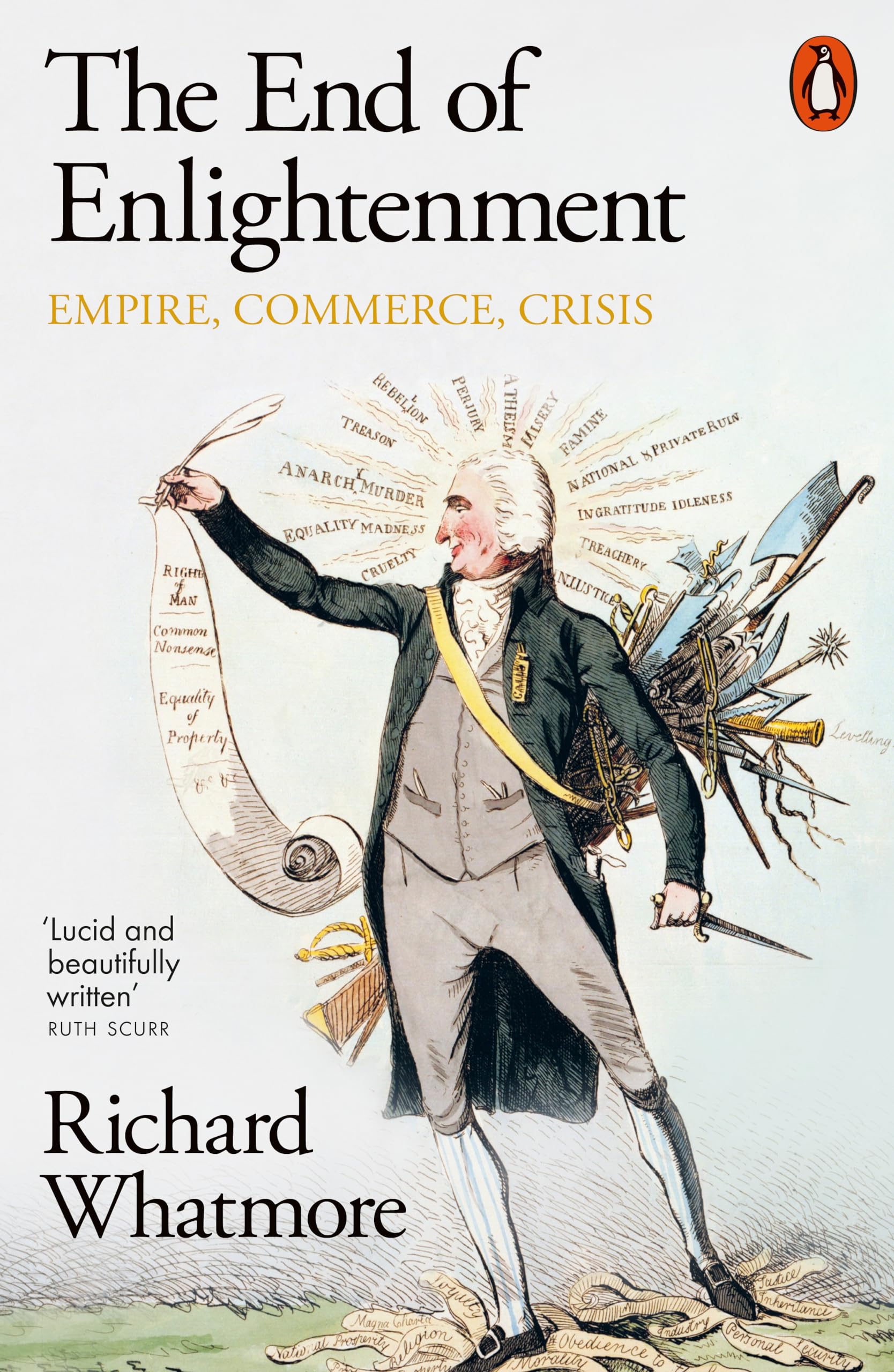



A landmark study of of one of the most controversial periods in history, from an eminent historian The Enlightenment is popularly seen as the Age of Reason, a key moment in human history when ideals such as freedom, progress, natural rights and constitutional government prevailed. In this radical re-evaluation, historian Richard Whatmore shows why, for many at its center, the Enlightenment was a profound failure. By the early eighteenth century, hope was widespread that Enlightenment could be coupled with toleration, the progress of commerce and the end of the fanatic wars of religion that were destroying Europe. At its heart was the battle to establish and maintain liberty in free states – and the hope that absolute monarchies such as France and free states like Britain might even subsist together, equally respectful of civil liberties. Yet all of this collapsed when states pursued wealth and empire by means of war. Xenophobia was rife and liberty itself turned fanatic. The End of Enlightenment traces the changing perspectives of economists, philosophers, politicians and polemicists around the world, including figures as diverse as David Hume, Adam Smith, Edmund Burke and Mary Wollstonecraft. They had strived to replace superstition with reason, but witnessed instead terror and revolution, corruption, gross commercial excess and the continued growth of violent colonialism. Returning us to these tumultuous events and ideas, and digging deep into the thought of the men and women who defined their age, Whatmore offers a lucid exploration of disillusion and intellectual transformation, a brilliant meditation on our continued assumptions about the past, and a glimpse of the different ways our world might be structured - especially as the problems addressed at the end of Enlightenment are still with us today. "In this lucid and beautifully written book, Richard Whatmore evokes the darkening vision of the 18th century thinkers forced to confront the failure of Enlightenment. Instead of achieving perpetual peace and progress, they saw Europe fragment into a collection of warmongering states teetering on the brink of bankruptcy and global turmoil. Whatmore carefully reconstructs the historical context for the failure of Enlightenment and presents it as a powerful echo chamber for our own troubled times. This is a fascinating and important book. " —Ruth Scurr, author, Napoleon: A Life Told in Gardens and Shadows " This intellectually exhilarating book is particularly relevant today , when liberal democracy is facing new dangers which threaten to drag us back into the darkness once more." —Adam Sisman, author, The Secret Life of John Le Carré "A brilliant work of intellectual interpretation by our foremost historian of Enlightenment ideas . Whatmore rescues the Enlightenment from today's circular debates and places it where it belongs: in the pulsing, chaotic era of its genesis and demise." —Christopher de Bellaigue, author, The Lion House " Panoramic in scope, always fresh and deep in its analysis , but with a polemical edge for today’s readers fearful again for our global future." —Jesse Norman, author, Adam Smith: Father of Economics "Shows brilliantly how an idea, though it may travel across the centuries, can still be historically located, just like the people who invented it. Invigorating. . . the Enlightenment in Whatmore’s telling is not a staid, steady procession of pompous ideas, but a vital intellectual exercise in making the best of a bad hand. And that’s a lesson for the 21st century too." — Evening Standard "In a study with chilling modern resonance, the history don contends that the age of reason was betrayed by the greed, corruption and barbarism of Britain’s ruling elite. . . A nuanced history. . . Enlightenment, for Whatmore and the thinkers he so engagingly profiles, had an objective, namely to overcome superstition that had soaked 17th-century Europe in blood." — Observer " Highly intelligent and sensitively written ." — Financial Times "Whatmore approaches the Enlightenment on its own terms. . . There is buried treasure in his account of how figures from different intellectual backgrounds negotiated the Enlightenment crisis. . . Whatmore is to be applauded ."— History Today "Whatmore serves up eight scintillating portraits of disillusioned thinkers who gave up on the hope of a lasting peace... an ambitious exposition of the British thought-world in the years bookended by the American and French Revolutions." — Times Richard Whatmore is Professor of Modern History at the University of St Andrews and Co-Director of the Institute of Intellectual History. He is the author of several acclaimed contributions to intellectual history and eighteenth-century scholarship, including The History of Political Thought , Terrorists, Anarchists and Republicans and Against War and Empire .