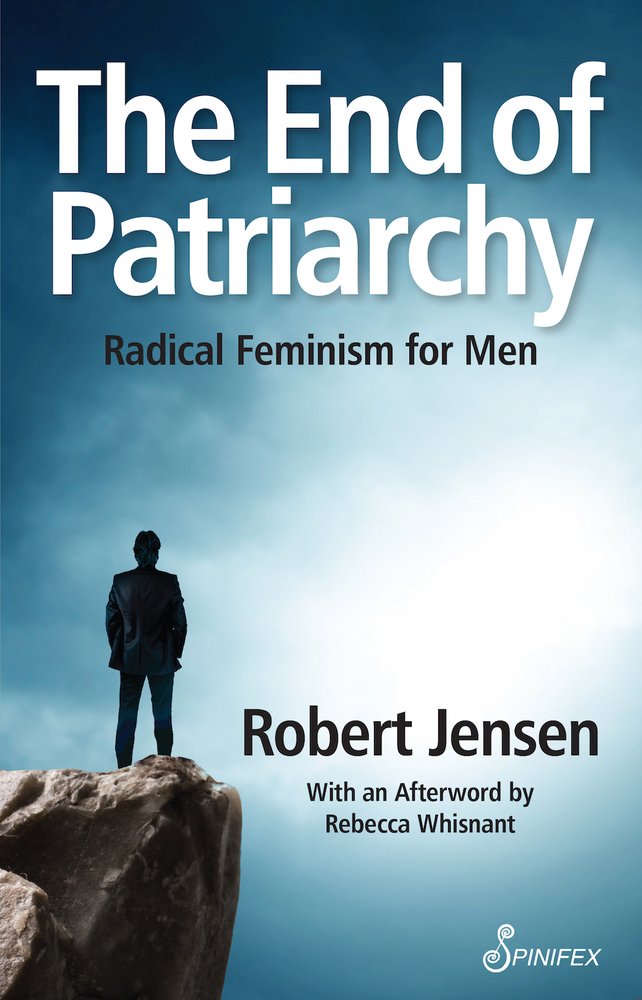



A radical feminist manifesto for men, challenging patriarchy and advocating for a more just and sustainable world. The End of Patriarchy asks a crucial question: What do we need to create stable, decent human communities that can thrive in a sustainable relationship with the larger living world? Robert Jensen answers with feminism and a critique of patriarchy, calling for a radical feminist challenge to male dominance and an end to violence and coercion. This book offers a powerful argument that a socially just society requires a radical feminist overhaul of patriarchal structures. It is for men seeking a deeper understanding of feminism, students and scholars of gender studies, and activists committed to social justice. Discover how to challenge male dominance, promote gender equality, and contribute to a more equitable world. "At a time when much of what passes for feminism is actually a neo-liberal approach that privileges individual empowerment over revolutionary social change, Robert Jensen comes out with a much-needed book that is bound to put the radical back in feminism. His insightful analysis, unflinching commitment to radical feminism, and his courageous call to eradicate patriarchy makes The End of Patriarchy: Radical Feminism for Men a refreshing and bold text." —Gail Dines, Professor of Sociology and Women's Studies, Wheelock College, and author of Pornland: How Porn has Hijacked our Sexuality "This is a terrific, powerful, informative book. There is not one page without an idea worth discussing and exploring. Jensen emerges as a wise and humble man willing to listen to women and to question men. Such men are rare. He does the opposite of mansplaining: man-listening-to-women! I love it!" —Jeffrey Masson, author of Beasts: What Animals Can Teach Us About the Origins of Good and Evil "Jensen presents a brilliant and brave analysis of patriarchy and its costs. His thoughts concerning rape, pornography, and transgenderism are deeply insightful and important — and especially compelling in their clarity and honesty. This book is a must-read for men and women who, like Jensen, care passionately about imagining and creating a sustainable, humane, and socially just world." —Rebecca Bigler, Professor of Psychology and Women's and Gender Studies, University of Texas Robert Jensen is a professor in the School of Journalism at the University of Texas at Austin, where he teaches courses in media law, ethics, and politics and is a Regents’ Outstanding Teaching Award winner. Jensen is a board member of Culture Reframed and the Third Coast Activist Resource Center. He is the author of ten previous books and two more in Spanish. The End of Patriarchy Radical Feminism for Men By Robert Jensen, Renate Klein, Pauline Hopkins, Susan Hawthorne Spinifex Press Pty Ltd Copyright © 2017 Robert Jensen All rights reserved. ISBN: 978-1-74219-992-4 Contents Acknowledgements, Preface: Begin in the Body, Introduction: Follow Your Fear, Sex and Gender, Patriarchy and Feminism, Pressing Arguments, Rape and Rape Culture: 'Normal' Violence, Prostitution and Pornography: Sex Work or Sexual Exploitation?, Transgenderism: Biology, Politics, Ecology, Conclusion, Afterword: On Fear and Resistance by Rebecca Whisnant, Further Reading, Index, CHAPTER 1 SEX AND GENDER As much as any political discussion and debate, inquiries into patriarchy require considerable attention to definitions of terms and explication of concepts — the sociological and scientific, the cultural and biological. Some disagreements may result from using terms in different ways, or not coming to agreement about competing definitions of a term before proceeding. So, I begin with basics. The most basic: Human beings are organisms living in ecosystems, part of a larger living world we call the ecosphere, our home planet. Although human cognitive and linguistic capacities are — to the best of our knowledge — far more advanced than those of any other species, those capacities do not allow us to transcend the biophysical limits of the eco-sphere. While there is much debate (and no plausible resolution anytime soon) about the existence of a non-material soul or mind, we should be able to agree that we are material beings and that our everyday activities are proscribed by those limits. We can use our creative capacities to imagine many alternative realities, but we live in the material reality of this world. I take one corollary of this acceptance of our place in the ecosphere to be that there exists something we could call 'human nature', just as there is pigeon nature or barley nature or algae nature. That simply means that every organism has a genetic endowment that makes some things possible and some things impossible — there are parameters within which any organism, including the human, operates. Everyday experience demonstrates that human nature is widely variable, that any two humans who seem pretty much the s