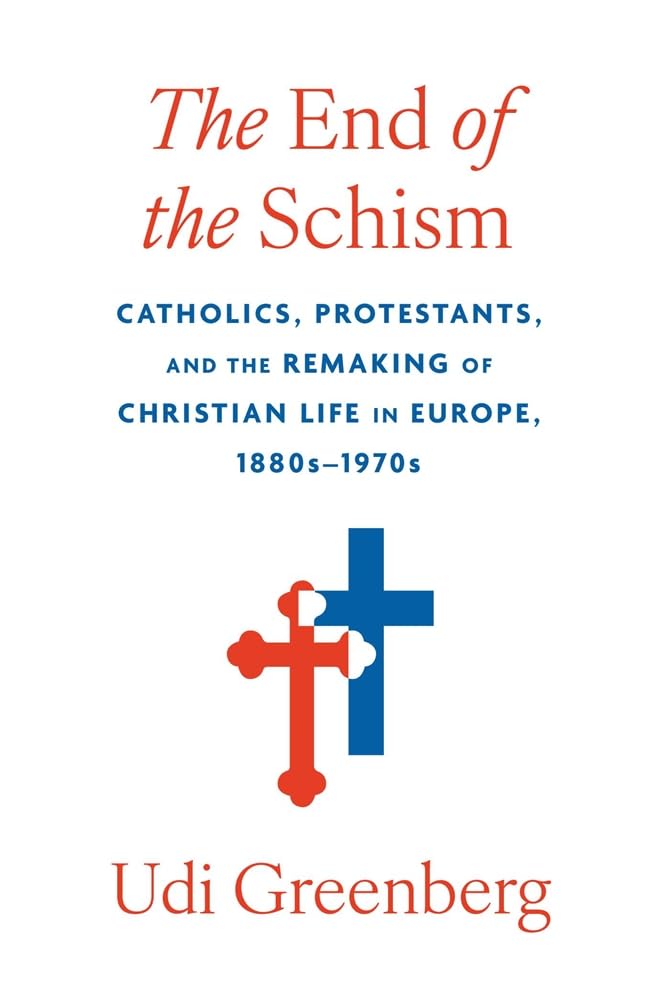
The End of the Schism: Catholics, Protestants, and the Remaking of Christian Life in Europe, 1880s–1970s
$30.85
by Udi Greenberg



The dramatic story behind an extraordinary transformation: the reconciliation between Europe’s Protestants and Catholics, and the emergence of a new era of Christian collaboration. For centuries, Europe’s Catholics and Protestants were bitter rivals, each group blaming the other for violence and alleged moral decline. Yet starting in the 1930s, they swiftly made peace, abandoning old stereotypes and even forming joint political parties and social organizations. Why did these erstwhile adversaries suddenly start cooperating, and what were the consequences? A groundbreaking study, The End of the Schism overturns conventional wisdom about this revolutionary change. Udi Greenberg shows that ecumenism did not grow out of mutual tolerance. Rather, Christian thinkers and politicians on both sides of the Catholic-Protestant divide came together to contain what they considered growing threats to Christian life: socialism, feminism, and Afro-Asian liberation movements. This project of interconfessional peacemaking accelerated with the rise of the Nazis, whose call for religious unity sparked intense debates among Christian denominations about their relationships with one another. Their rapprochement culminated in the unfolding of the Cold War and decolonization, when Catholic and Protestant authorities formally declared each other “brethren in faith.” The End of the Schism makes clear the enormous consequences of the ecumenical revolution. By working together, Catholics and Protestants were able to design Europe’s economic policies, regulate its sexual practices, and deeply shape its postwar relationship with the Global South. As confessional attachments in Europe have weakened, this coalition of Christians has only grown more cohesive, leveraging their alliance to maintain influence across a politically fractured continent. “Greenberg provides a historical tour of the ecumenical movement in Europe, focusing on four distinct periods…In a time when the United States and Europe are once again facing crises of democracy and versions of Christian nationalism are finding broad appeal, Greenberg’s book highlights an essential history.” ― Daniel Rober , Christian Century “Greenberg has done genuinely impressive research, mining many often-obscure French- and German-language sources seldom consulted by Anglo-American scholars.” ― Thomas Albert Howard , Commonweal “The crisis and decline of European Christianity lately have obscured just how revolutionary and shocking the ecumenical healing of confessional rifts among Christians in the middle of the twentieth century really was. In his bold, fair-minded, and original interpretation, Udi Greenberg goes far beyond restoring to view the end of five hundred years of strife; he uncovers its dark roots on the political right and its underlying motivations in a decolonizing and secularizing world. This book is a masterpiece.” ― Samuel Moyn, author of Liberalism against Itself: Cold War Intellectuals and the Making of Our Times “Extraordinarily attuned to detail in ideas and practices, The End of the Schism is equally successful in chronicling one of the most monumental changes of twentieth-century history: the rapprochement between Protestantism and Catholicism. Brilliantly, Greenberg not only explains how Christians came together but also highlights the costs of that togetherness―costs that were not equally shared.” ― Stefanos Geroulanos, author of The Invention of Prehistory: Empire, Violence, and Our Obsession with Human Origins “A provocative and beautifully written book. Greenberg convincingly argues that what brought twentieth-century European Catholics and Protestants together under the nebulous banner of ‘Christian Democracy’ was not their disgust with fascism and the Holocaust but rather what they saw as the more pressing issues of their time: the spread of communism, the growing weakness of the patriarchal family, the unstoppable wave of decolonization, and, most significantly, the threat of secularization. As Greenberg shows, European liberal pluralism was thus not teleological or self-evident but rather a conscious attempt to produce and maintain social hierarchies of class, race, and gender.” ― Camille Robcis, author of Disalienation: Politics, Philosophy, and Radical Psychiatry in Postwar France “The surprising turns in the Christian churches’ entanglements in politics throughout Europe’s tumultuous twentieth century―from hostility to working-class demands and complicity with Nazi bloodshed to postwar restoration of family values and eventual embrace of decoloniality abroad and liberationist possibilities at home―are all compellingly explained in Udi Greenberg’s beautiful book. Brilliantly original; every chapter offers revelatory insights.” ― Dagmar Herzog, author of The Question of Unworthy Life: Eugenics and Germany’s Twentieth Century “The triumph of ecumenism is one of the great untold stories of modern European history. In this pathbre