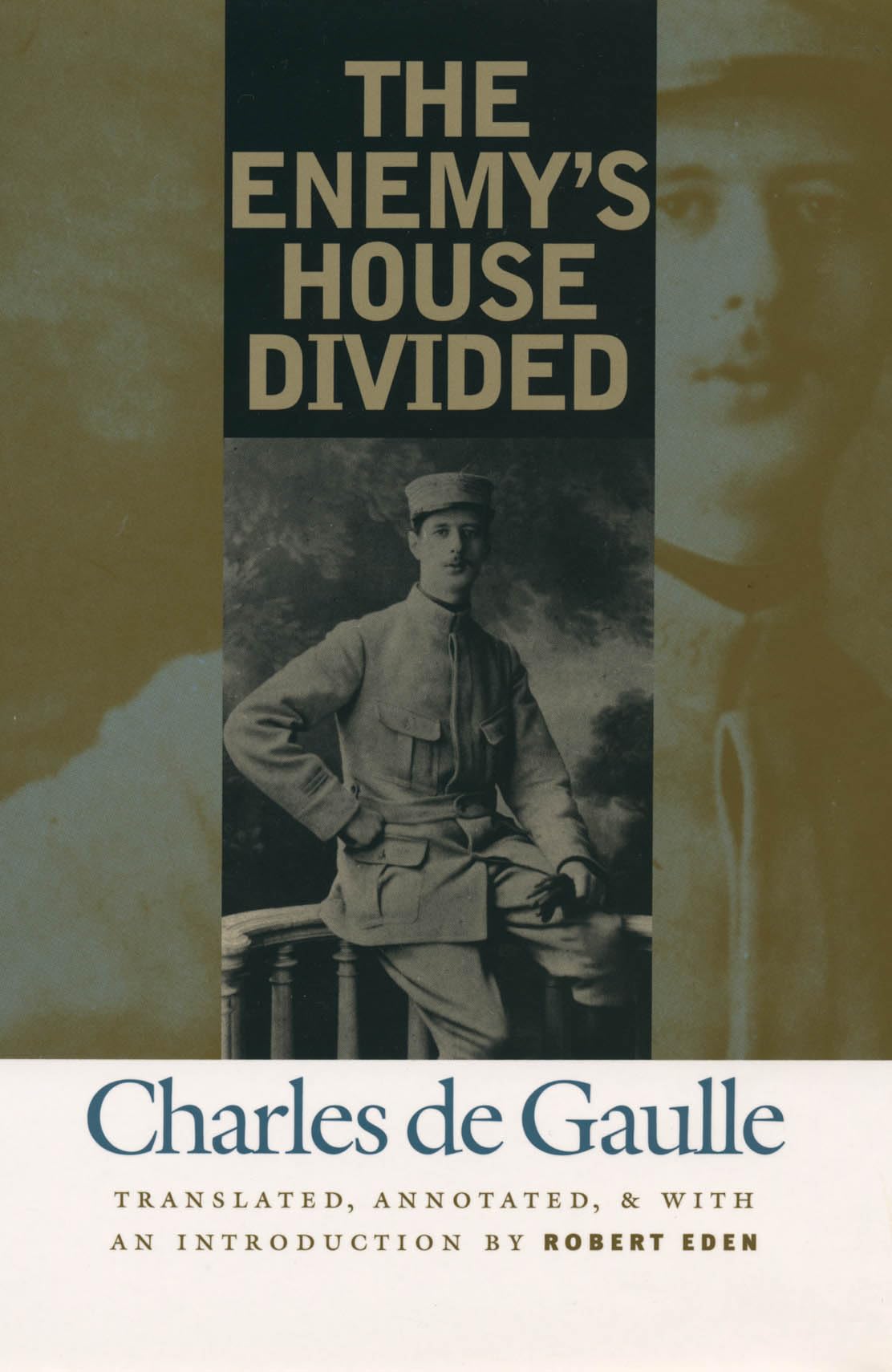



Originally published in 1924 and available here in English for the first time, The Enemy’s House Divided is Charles de Gaulle’s analysis of the major errors that led the Germans to disaster in World War I. Based partly on observations made during his internment as a prisoner of war from 1916 to 1918, it can be seen as the foundation for everything he wrote in the 1920s and 1930s in the shadow of German resurgence and for much of what he said and did after the Nazi victory in June of 1940. To de Gaulle, the German conduct of the Great War and the debacle of 1918 was the greatest moral disaster ever to befall a modern civilized political community. He seeks to identify the internecine causes of the collapse of the German war effort in 1918 and of the subsequent dissolution of the German Empire. His diagnosis of the profound moral crisis that unfolded in Germany during World War I points forward to 1940, for de Gaulle understood the fall of France, above all, as a moral catastrophe for the French. His first book, it is also a key document of de Gaulle’s “philosophy of action,” introducing his statesmanship to the world with its deliberate and studied critique of the perils of Nietzsche’s philosophical initiative. “A fascinating study of the relationship between high command and social cohesion, strategic choice and political intrigue. The editor’s excellent translation and even better introduction and notes make this lucid and penetrating book particularly worthwhile — a gift to those interested in one of the most intriguing soldier-statesmen of the past century.” — Foreign Affairs “Highly recommended. This first English translation will be of great interest to all levels of readership.” — CHOICE “Those interested in World War I and Charles de Gaulle should be grateful to Professor Robert Eden for his fine translation of de Gaulle’s first book. . . . Deserves careful reading by those who want a fascinating look into the 'house of the enemy.'” — Journal of Military History “De Gaulle was a talented writer and historian, so his first book — clearly translated by Robert Eden — makes enjoyable reading.” — International History Review “An indispensable document for studying the question of how a great leader comes into existence. . . . Thanks to the patient work of Robert Eden, the very beginning of de Gaulle’s career as a moralist and a politician is now available to the English-reading public. . . . Also very valuable for the French scholar because of the detailed and thoughtful introduction.” — Society “De Gaulle’s early masterpiece: a brilliant account of the internal divisions in Germany that led to its defeat in 1918, focusing on the flawed character of its leaders, on the civilian-military conflicts, and on morale. A book that informs about its subject and author, who had come to assess German affairs as a prisoner of war. A first translation of a work written nearly 80 years ago and still of profound interest.” ― Fritz Stern, Columbia University “De Gaulle viewed World War I as a crisis of European civilization, and Berlin’s defeat in that war as an event brought on by the moral failures of Germany’s leadership. Robert Eden’s excellent translation of The Enemy’s House Divided offers English-speaking readers a window into the philosophical mindset of France’s greatest twentieth-century leader, one whose task it was to rehabilitate his nation after a similar catastrophe in 1940.” — Douglas Porch, Naval Postgraduate School “We owe an immense debt to Robert Eden for recovering and making available to the English-speaking world this forgotten classic: the young Charles de Gaulle’s meditation on the role played by the German officer corps in engendering Wilhelmine Germany’s collapse and his attribution of their blunders to the malign influence exercised on German military culture by the thinking of Friedrich Nietzsche.” ― Paul A. Rahe, University of Tulsa “The publication of this volume is an event in English-language de Gaulle scholarship, making available an excellent edition of a book that is both absolutely indispensable for understanding the great French statesman and a serious work of political history in its own right. Robert Eden’s introductory essay is an elegant and authoritative guide to things Gaullist.” — Daniel J. Mahoney, author of De Gaulle: Statesmanship, Grandeur, and Modern Democracy “The publication of this volume is an event in English-language de Gaulle scholarship, making available an excellent edition of a book that is both absolutely indispensable for understanding the great French statesman and a serious work of political history in its own right. Robert Eden’s introductory essay is an elegant and authoritative guide to things Gaullist.” — Daniel J. Mahoney, author of De Gaulle: Statesmanship, Grandeur, and Modern Democracy The young de Gaulle’s analysis of German defeat in World War I Robert Eden is professor of political science at Hillsdale College in H