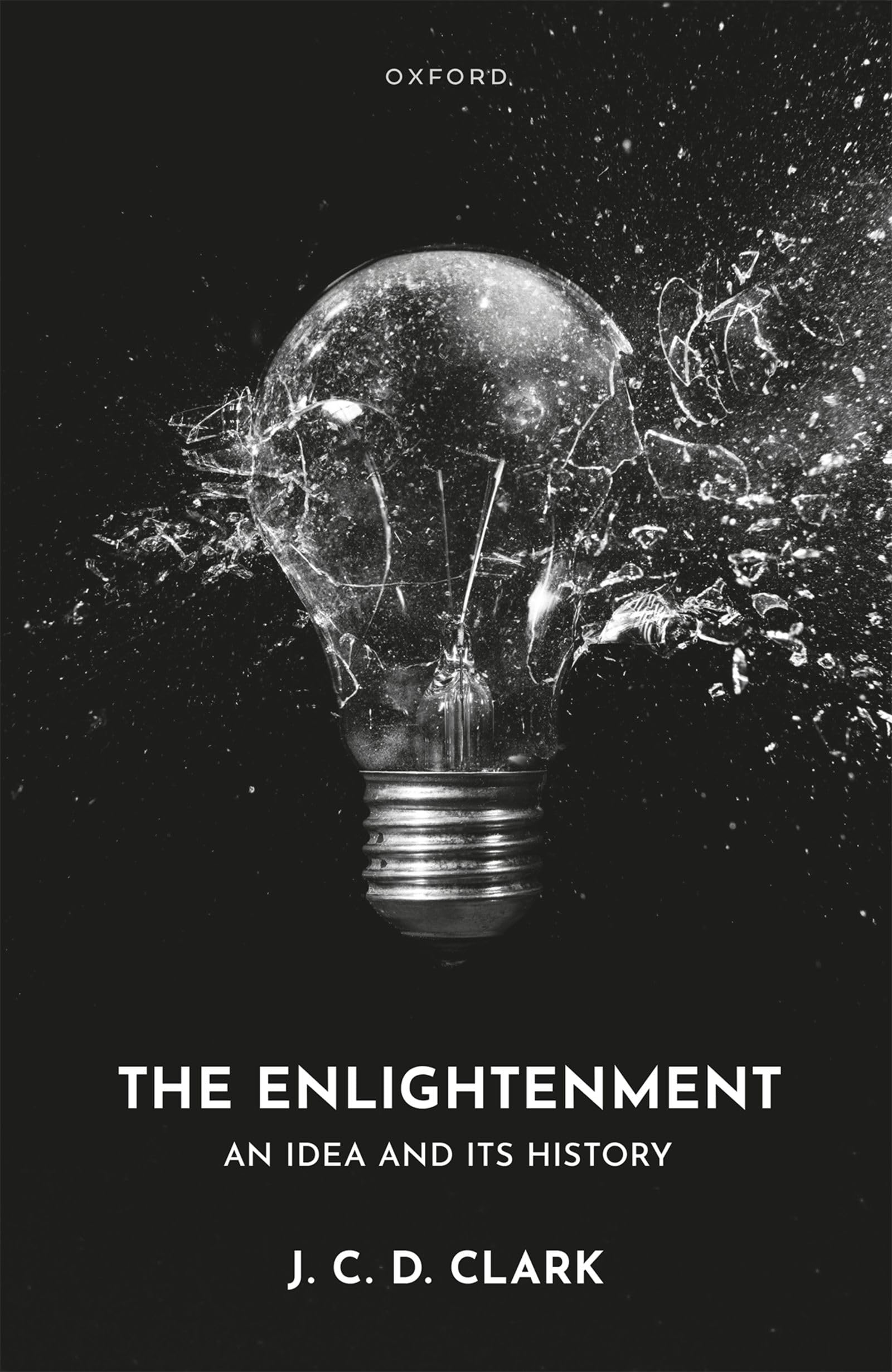



Enlightenment studies are currently in a state of flux, with unresolved arguments among its adherents about its dates, its locations, and the contents of the 'movement'. This book cuts the Gordian knot. There are many books claiming to explain the Enlightenment, but most assume that it was a thing . J. C. D. Clark shows what it actually was, namely a historiographical concept . Currently 'the Enlightenment' is a term widely accepted across popular culture and in a variety of academic disciplines, notably history, philosophy, political theory, political science, literary studies, and theology; Clark calls for a fundamental reconsideration in each. The Enlightenment: An Idea and Its History provides a critical historical analysis of the Enlightenment in England, Scotland, France, Germany, and the United States from c. 1650 to the present. It argues that the degree of commonality between social and intellectual movements in each--and, more broadly, between the five societies--has been overstated for polemical purposes. Clark shows that the concept of 'the Enlightenment' was not widely adopted in those societies until the mid-twentieth century; indeed, that it was unknown in the eighteenth. Without the concept, people at the time were unable to act in ways that would have created the Enlightenment as a coherent movement. Since the conventional account has held that the Enlightenment was a phenomenon, the idea could be used as a component of what has been called a 'civil religion': a summing up of the myths of origin, aims, and essential values of a society from which dissent is not permitted. An appreciation that it was instead a historiographical concept undermines, in turn, the idea that there was any great transition to what came to be called 'modernity'. "A magnificent sweep of intellectual history over the long eighteenth century 1660 to 1832 and into the modern era." -- John Redwood, John Redwood's Diary "Clark's erudition is truly impressive." -- D. A. Harvey, CHOICE "Especially impressive is Clark's fine grained comparison of translations of original works by Enlightenment writers, from those authors' original languages into other European tongues." -- Kevin Schmiesin, Law & Liberty "Clark's survey extends beyond the beliefs of French intellectuals to cover the so-called Enlightenment in England, Scotland, Germany, America and elsewhere. Thereafter, all the major writers on the Enlightenment are covered, if sometimes briefly - Cassirer gets his due but Jonathan Israel is demoted to a footnote. Still, the book is a triumph of scholarship and of clarity." -- Alan Sked, The Salisbury Review "It is an example of rich and powerful scholarship in which a leading historian of ideas and intellectual history engages with wider politics and society. It is therefore as much an event as it is an important and stimulating book." -- William Gibson, The Journal of Religious History, Literature and Culture "[...] full of daring originality and memorable insights. It will jolt the scholarly debate...J.C.D. Clark excels in scholarly demolition. His book promotes an "emancipation" from the Enlightenment label. Mr. Clark's scholarship tends to age well and reshape the terms of debate even for his critics. [He] promotes a history respectful of the past, one that is not written in the thrall of our present political priorities. That is a cause worth fighting for." -- Jeffrey Collins, Wall Street Journal "The "argument is simple, decisive, and demands to be faced squarely by anyone who writes about the Enlightenment in the future ... massive and marvellous ... a great valiant and lordly work of negative judgement: and I recommend everyone read it." -- James Alexander, Cosmos and Taxis "Writing with patient lucidity and ample quotation, Clark, with no overt polemical intention, exposes the weak points of some Enlightenment thinkers." -- Ritchie Robertson, Society "Writing with patient lucidity and ample quotation, Clark, with no overt polemical intention, exposes the weak points of some Enlightenment thinkers." -- Ritchie Robertson, Society J. C. D. Clark J. C. D. Clark was educated at Cambridge, where he was a Fellow of Peterhouse. At Oxford, he was a Fellow of All Souls College; at Chicago, he held a Visiting Professorship at the Committee on Social Thought; he has held visiting posts elsewhere. Latterly he was Hall Distinguished Professor of British History at the University of Kansas. He lives now in Northumberland. His interests are primarily in intellectual history, philosophy, social history, literature, and historiography, especially in the 'long eighteenth century', 1660-1832.