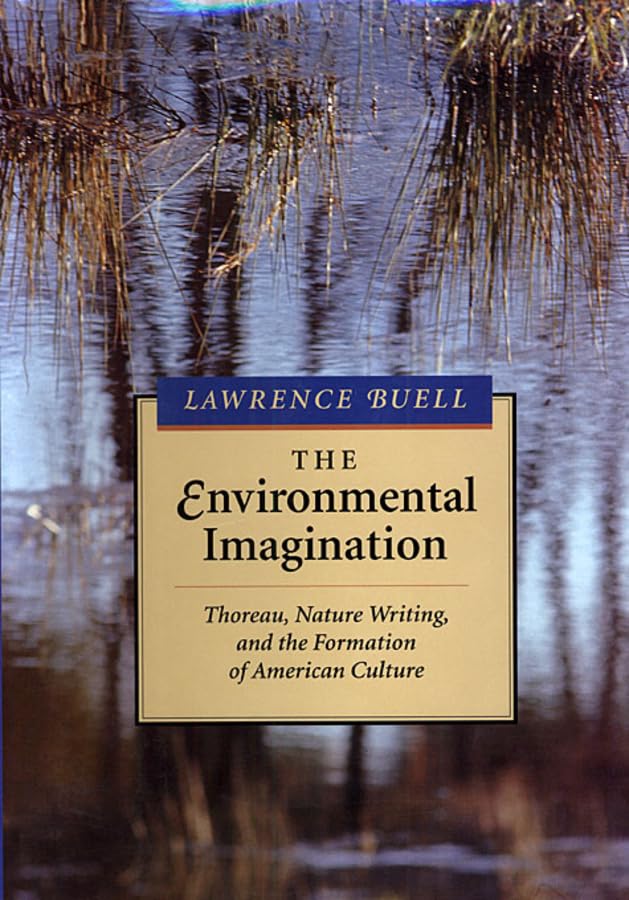
The Environmental Imagination: Thoreau, Nature Writing, and the Formation of American Culture
$28.40
by Lawrence Buell



With the environmental crisis comes a crisis of the imagination, a need to find new ways to understand nature and humanity's relation to it. This is the challenge Lawrence Buell takes up in The Environmental Imagination , the most ambitious study to date of how literature represents the natural environment. With Thoreau's Walden as a touchstone, Buell gives us a far-reaching account of environmental perception, the place of nature in the history of western thought, and the consequences for literary scholarship of attempting to imagine a more "ecocentric" way of being. In doing so, he provides a major new understanding of Thoreau's achievement and, at the same time, a profound rethinking of our literary and cultural reflections on nature. The green tradition in American writing commands Buell's special attention, particularly environmental nonfiction from colonial times to the present. In works by writers from Crevecoeur to Wendell Berry, John Muir to Aldo Leopold, Rachel Carson to Leslie Silko, Mary Austin to Edward Abbey, he examines enduring environmental themes such as the dream of relinquishment, the personification of the nonhuman, an attentiveness to environmental cycles, a devotion to place, and a prophetic awareness of possible ecocatastrophe. At the center of this study we find an image of Walden as a quest for greater environmental awareness, an impetus and guide for Buell as he develops a new vision of environmental writing and seeks a new way of conceiving the relation between human imagination and environmental actuality in the age of industrialization. Intricate and challenging in its arguments, yet engagingly and elegantly written, The Environmental Imagination is a major work of scholarship, one that establishes a new basis for reading American nature writing. The best writing about nature, literary scholar Lawrence Buell suggests, has at its root an argument that humans are accountable to the environment. In the American literary canon, the work that best demonstrates this thesis is Henry David Thoreau's classic Walden , a memoir celebrating at once the virtues of voluntary simplicity and the quest for political liberty. It is from Walden that much contemporary writing about nature derives, from the poems of the Kentucky farmer Wendell Berry to the back-to-the-land exhortations of Edward Abbey and Annie Dillard. In this study, Buell charts the growth of Thoreau's own environmental ethic and his lasting influence on writers of many kinds, among them Theodore Roethke, Gary Snyder, James Lovelock, Rachel Carson, and Aldo Leopold. He also examines Thoreau's life, reminding his readers that although Thoreau will always be identified with that little Massachusetts pond, he was a wide-ranging traveler and thinker who was never quite comfortable at rest. Neither, Buell reminds us, is Thoreau always to be taken as a strictly reliable narrator; parts of Walden are fictionalized and embellished, and the book should not be reduced to "the autobiographical narrative alone," but instead should be seen as something of a parable. Buell's discussions will be of interest to any serious student of Thoreau's writings. --Gregory McNamee “Literature generally defines itself as that realm of higher culture freed from both the sloppy nostalgia of nature lovers and the fact-bound objectivity of science. The resulting paradox gives Lawrence Buell his subject: nature writing survives in American literary and cultural studies as an 'enclave canon,' widely ignored even as the idea of nature is acknowledged to be formative to American culture and central to at least one canonical writer, Henry David Thoreau. In this fine book, Buell uses Thoreau's position at the crux of this paradox to argue for the return of nature to literary criticism and theory...Buell's excellent book is essential reading that for years to come will provide a central point of reference in discussions of Thoreau, environmental writing, and realist aesthetics.” ― Laura Dassow Walls , Isis “ The Environmental Imagination has become a standard work on the subject, and a pioneering example of what is being called 'ecocriticism.'” ― Jay Parini , New York Times Magazine “[A] remarkable book...Building upon and brilliantly extending the new ecocriticism, Buell has made the most of Thoreau as cultural icon as well as major literary and intellectual figure, in the process raising the stakes and broadening the responsibilities of Thoreau scholarship and criticism.” ― William Rossi , ESQ: A Journal of the American Renaissance “Lawrence Buell has undertaken a heroic task: to reorient the understanding of American literature and culture towards 'ecocentrism'; that is, to place the environment (and not simply humans within the environment) at the center of American literary studies. Further, its concern for 'the literal environment as opposed to the environment as a cultural symbol,' The Environmental Imagination is a respectful effort