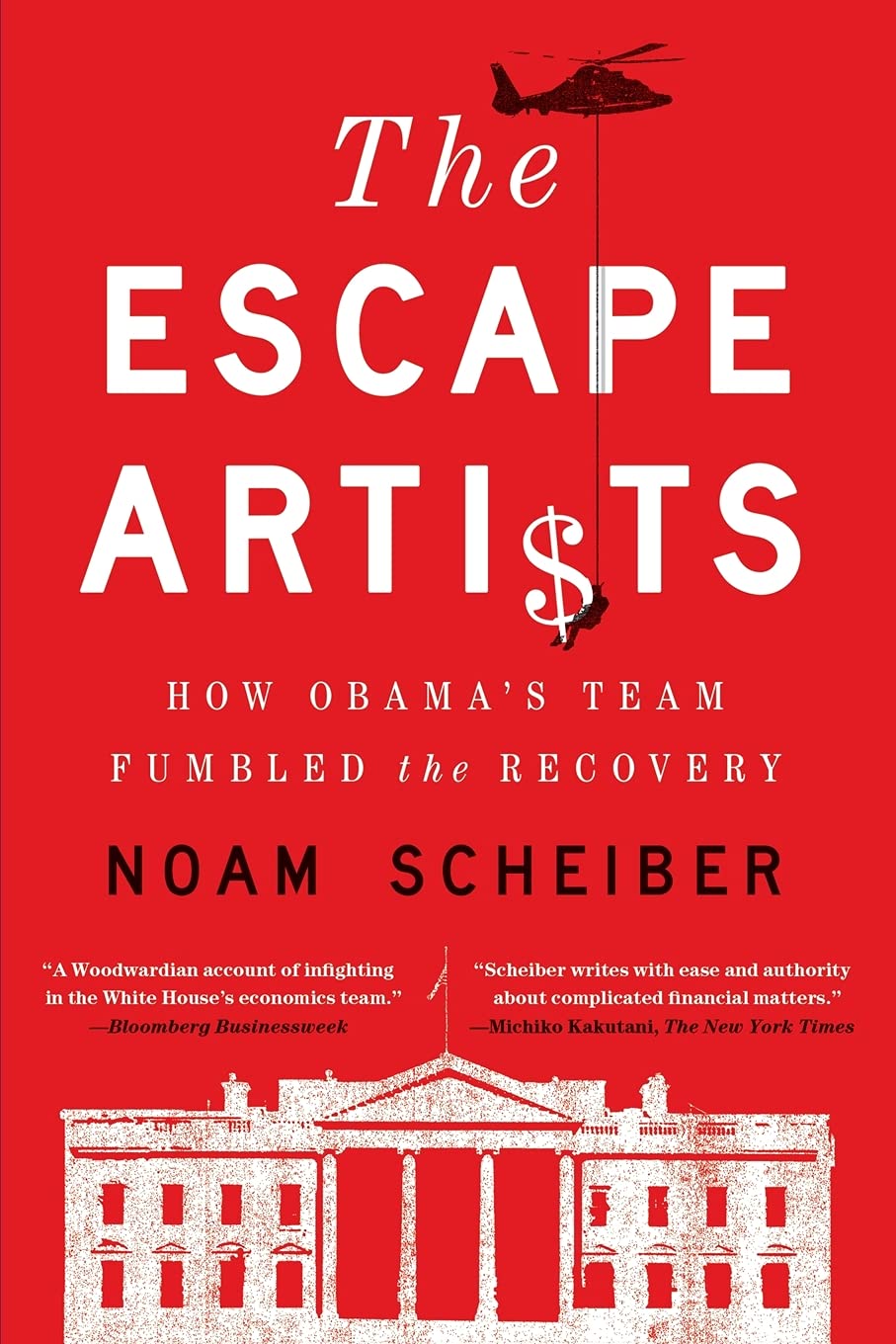



The widely acclaimed and newsbreaking account of President Obama’s campaign to rescue America from its recession: inside the meeting rooms, the inboxes, and the minds of the pedigreed propeller heads who guided America through a worldwide crisis. DEEP INTO THE OBAMA PRESIDENCY, THE UNEMPLOYMENT RATE WAS PAINFULLY HIGH, THE GAP BETWEEN RICH AND POOR HAD WIDENED, AND THE STIMULUS HAD NOT DONE ENOUGH TO BRING JOBS BACK. WHAT WENT WRONG? FACING THE WORST ECONOMY SINCE THE 1930S, President Obama hired a crack team of escape artists: financial wizards who had pulled off numerous whiteknuckle getaways during the Clinton era. But this time, they fell far short. The Escape Artists reveals why. Star White House journalist Noam Scheiber delivers a gripping narrative of the Obama presidency and the mistakes and missed opportunities that kept his pedigreed team from steering the economy in the right direction. With previously undisclosed internal documents and extensive, original reporting from the highest levels of the administration, Scheiber reveals how the very qualities that made these men and women escape artists in the 1990s ultimately failed them. ""The Escape Artists" is a compelling narrative, deeply reported and beautifully written." --Jonathan Chait, "New York" ""The Escape Artists" offers great insight into Obama's self-perception. . . . Scheiber's reporting has naturally sparked a great deal of second-guessing in Democratic circles, and his book will provide plenty of ammunition for the president's liberal critics . . . [and] to those critics on the right who believed that the White House never really earned their trust." --Reihan Salam, "The Daily" ""The Escape Artists" reads like a Bob Woodward book--albeit better written and informed by a more sophisticated understanding of economics and policymaking." --Daniel Gross, Yahoo! Finance "A Woodwardian account of infighting in the White House's economics team . . . Scheiber is a smart, clear-eyed reporter who frames his arguments elegantly." --"Bloomberg Businessweek" "Diligently reported and informative." --John Cassidy, "The New Yorker" "Noam Scheiber offers a persuasive take on administration policymaking . . . [and] provides a template for future administrations--even a future Obama administration--to avoid the trap of thinking too narrowly and too politically in a crisis." --Matthew Yglesias, "Slate" "Scheiber writes with ease and authority about complicated financial matters . . . and proves particularly adept at showing how [the Obama economic team's] personalities, philosophies and previous experiences with one another shaped their interactions and the policy-making process." --Michiko Kakutani, "The New York Times" "What Scheiber offers is a judicious, nuanced and ultimately . . . persuasive chronicle of how contentious experts jockeyed to influence a young president stuck with an almost impossible set of chal-lenges. . . . Such sophisticated analysis of how the nation's most powerful officials think--however one regards the wisdom of that thinking--distinguishes Scheiber's book." --Paul M. Barrett, "The New York Times Book Review" Noam Scheiber is a senior editor at The New Republic , writing about politics and Obama administration economic policy. He has written for the New York Times , The Washington Post , New York magazine, and Slate and has appeared on CNN, CNBC, MSNBC, and NPR. He lives in Washington, D.C. PROLOGUE Shortly after four o’clock on the afternoon of Wednesday, April 13, 2011, U.S. Treasury Secretary Tim Geithner walked down the hall from his office toward a large conference room facing the building’s interior. He was surrounded by a retinue of counselors and aides. When they arrived in the room—known around Treasury simply as “the large”—four people were seated at a long walnut table on the side near the door. Geithner and his entourage greeted them, then walked around to the far side and took their seats. At first glance, Geithner gave the impression of the former Wall Street banker many Americans assumed him to be. He wore elegant suits and alpha-male ties. His spread collars suggested a Savile Row provenance. But, given a moment to focus, the eye noticed hints of something else. His shoes were a bit shabby. On his wrist he wore an old digital watch. The suit, upon closer inspection, was Brooks Brothers—off the rack. It had only seemed nattier because he was well-proportioned and boyishly trim. Geithner wasn’t an ex-banker after all. He was a lifelong bureaucrat. This status gave him a measure of independence of which he was rightly proud. While friends and former co-workers moved seamlessly from government to business and back, Geithner had resisted the easy payday time and time again. “I never worked on Wall Street,” he told a group of congressional Democrats in early 2009. “I’ve worked in public service my whole life.” Where others might be cowed in the presence of bankers, knowing they might soon