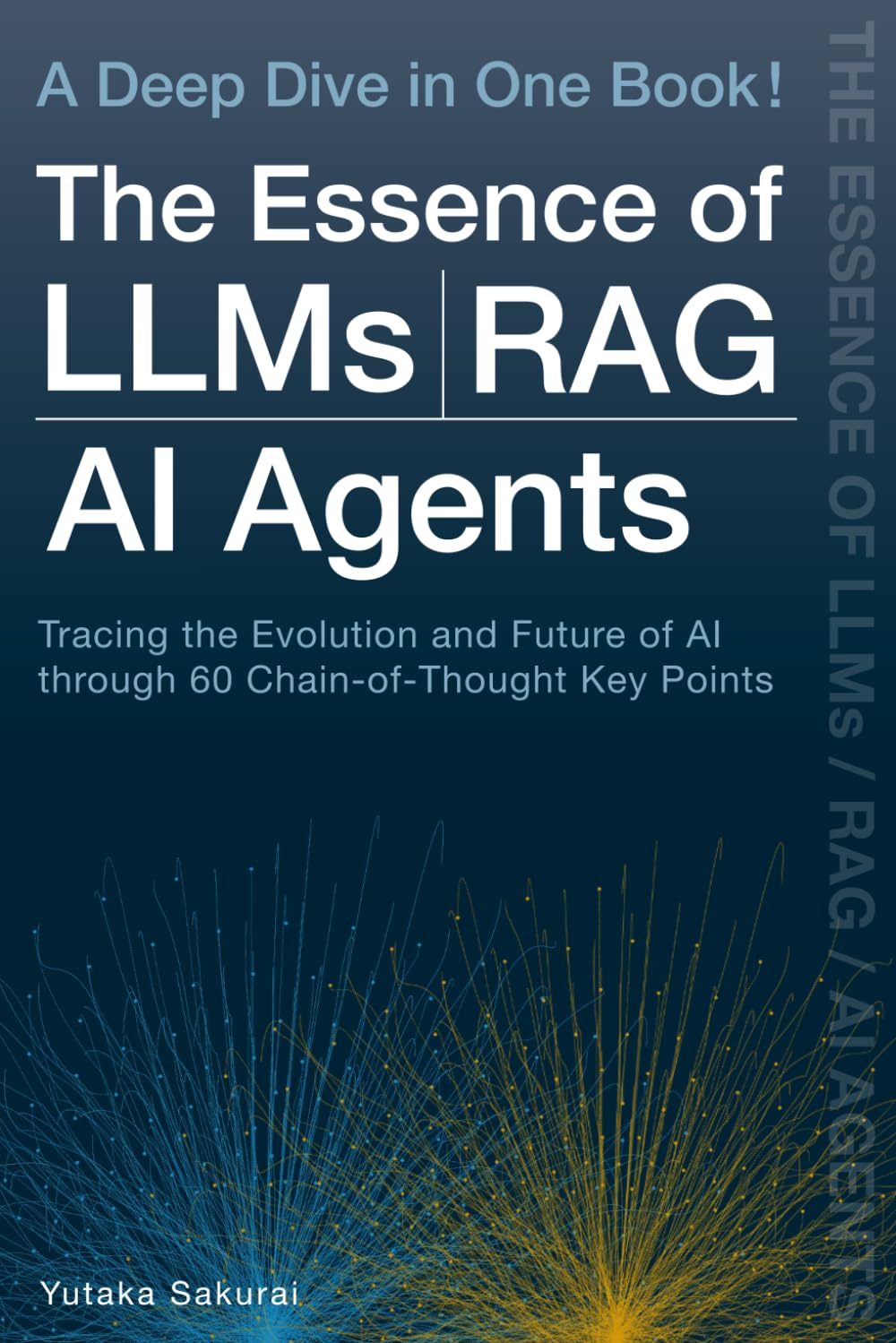
The Essence of LLMs / RAG / AI Agents - A Deep Dive in One Book: Tracing the Evolution and Future of AI through 60 Chain-of-Thought Key Points
$21.99
by Yutaka Sakurai



This book provides a deep exploration of the essence of large language models ( LLMs ), their advanced application in Retrieval-Augmented Generation ( RAG ), and the rapidly emerging paradigm of LLM-based AI agents. It traces their evolution—from the early history of AI to the latest developments represented by GPT-5—through a comprehensive, multi-layered perspective that distills key ideas into a concise and coherent framework. The book's core value lies in presenting, without obfuscation or essential omission, the comprehensive knowledge required to understand and anticipate the future trajectory of AI. Modern AI systems achieve intelligence by compressing vast amounts of data—capturing the underlying structure of the world—and by adopting step-by-step reasoning styles such as Chain of Thought ( CoT ) to dramatically enhance their capabilities. The author believes that the same principle applies to human insight: emergence and understanding arise through the process of abstraction and structured compression. This book is written from that viewpoint. At its core are about sixty key phrases that run throughout the text. Each phrase captures a fundamental idea in a short, intuitive sentence, accompanied by a brief explanatory note that provides context and background. Individually, they offer fresh perspectives—even on topics familiar to experts—and collectively, they form a coherent intellectual progression that mirrors a chain of thought in the reader’s own mind. Rather than presenting fragmented knowledge, the key phrases are arranged in a logical sequence aligned with the evolution of technology. By following them in order, readers will find their understanding naturally deepening—moving beyond surface information toward the underlying principles of intelligence itself. These key phrases allow readers who may not be familiar with technical terminology to grasp the overall essence of the subject. The main chapters that follow—making up the majority of the book—build on these ideas, incorporating the latest research findings to guide readers toward a deeper and more systematic understanding. In this sense, the book offers more than a retrospective summary of past and present technologies. It provides a compact, forward-looking guide to the complex landscape of AI as a whole—its origins, unresolved challenges, and the trajectories that will shape its future. Ultimately, it aims to serve as both a foundation for understanding today’s AI revolution and a map for rationally envisioning the technologies of tomorrow. Table of Contents Chapter 1 From LLMs to RAG and the Age of AI Agents Chapter 2 From the AI Winter to Deep Learning: The Machine Learning Foundations of LLMs Chapter 3 The Core of Natural Language Processing: How Machines "Understand" Language Chapter 4 The Rise of Transformers and Evolution of LLMs: The Architecture and Training Behind ChatGPT Chapter 5 The Success Factors of LLMs: The Emergence of Human-Like Intelligence and Reasoning Chapter 6 The Mechanics of RAG and Domain Knowledge Integration: Expanding Semantic Space and Fusing Expertise Chapter 7 What Are AI Agents?: The Form of "Acting Intelligence" Beyond RAG Chapter 8 Overcoming Challenges and a Look Forward: The Next Stage of AI and Society in 2030 Chapter 9 Mastering AI: The Future of AI Literacy and Organizational Strategy