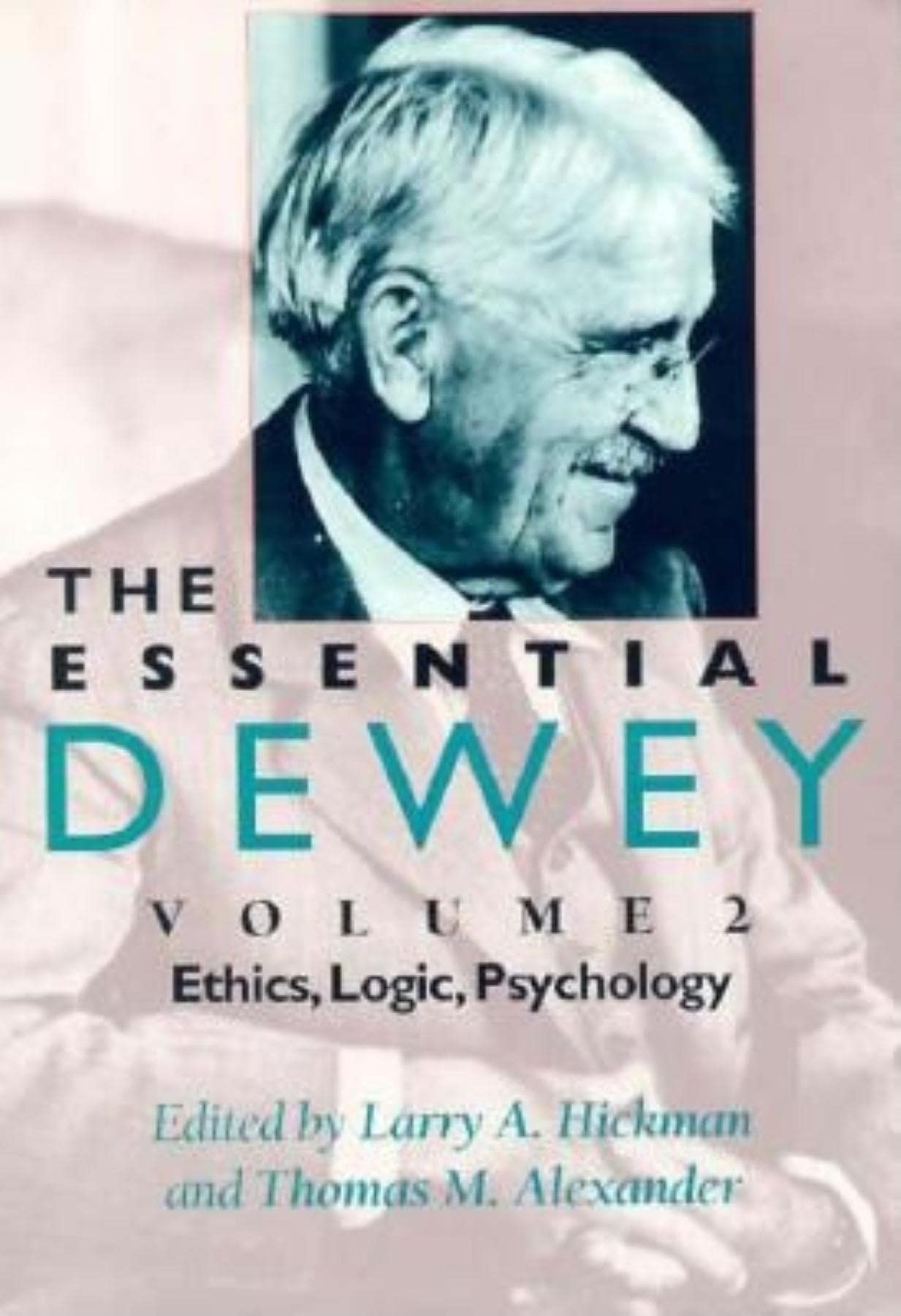



In addition to being one of the greatest technical philosophers of the twentieth century, John Dewey (1859-1952) was an educational innovator, a Progressive Era reformer, and one of America's last great public intellectuals. Dewey's insights into the problems of public education, immigration, the prospects for democratic government, and the relation of religious faith to science are as fresh today as when they were first published. His penetrating treatments of the nature and function of philosophy, the ethical and aesthetic dimensions of life, and the role of inquiry in human experience are of increasing relevance at the turn of the 21st century. Based on the award-winning 37-volume critical edition of Dewey's work, The Essential Dewey presents for the first time a collection of Dewey's writings that is both manageable and comprehensive. The volume includes essays and book chapters that exhibit Dewey's intellectual development over time; the selection represents his mature thinking on every major issue to which he turned his attention. Eleven part divisions cover: Dewey in Context; Reconstructing Philosophy; Evolutionary Naturalism; Pragmatic Metaphysics; Habit, Conduct, and Language; Meaning, Truth, and Inquiry; Valuation and Ethics; The Aims of Education; The Individual, the Community, and Democracy; Pragmatism and Culture: Science and Technology, Art and Religion; and Interpretations and Critiques. Taken as a whole, this collection provides unique access to Dewey's understanding of the problems and prospects of human existence and of the philosophical enterprise. Dewey (1859-1952) is probably best known to the public in general for his philosophy of education. This collection of his writings, covering the entire course of his intellectual development over time, will therefore provide a necessary corrective to this limited view by showing the depth and breadth of his philosophic interests. In the course of his long life, Dewey wrote and published on myriad topics: certainly, and perhaps most importantly to him, on public education, but also?and extensively?on technical philosophy, including metaphysics, epistemology, logic, aesthetics, religion, science, ethics, and social philosophy. And though neglected by academic philosophers for a time, Dewey's pragmatic orientation has recently proved influential in the thought of Quine, Putnam, and Rorty, among others. This two-volume collection of essays and book chapters, culled from an earlier 37-volume critical edition of his works, provides for the first time a publication of his writings that is both manageable and comprehensive. For academic and larger public libraries.?Leon H. Brody, U.S. Office of Personnel Mgt. Lib., Washingon, DC Copyright 1998 Reed Business Information, Inc. "This two―volume collection of Dewey's writings is drawn from the 37―volume Collected Works of John Dewey (1967―91). Volume 1 covers the general themes of pragmatism, education, and democracy; volume 2 covers ethics, logic, and psychology. The editors are two of the best Dewey scholars: Larry Hickman, John Dewey's Pragmatic Technology (CH, Jun'90), and Thomas Alexander, John Dewey's Theory of Art, Experience and Nature, (CH, Dec'87). The only other broad―based collection in print is John McDermott's two―volume work The Philosophy of John Dewey (CH, May'74). These well―produced volumes show the enormous breadth of Dewey's writing over 50 years. Some quibbles: although clear references are given to the location of the selections in the Collected Works and to the original source of publication, chapter numbers would have been helpful. This reviewer would have liked more on Dewey's attack on the human search for certainty and its consequences, instead of commentaries on other philosophers. Nevertheless, this set should be a very high priority for public libraries lacking the complete works and is essential for small college libraries; researchers in libraries with the complete set will still find these two volumes most useful. All levels. ―R. H. Evans, University of Minnesot"―Duluth , Choice , February 1999 ". . . [T]his set should be a very high priority for public libraries lacking the complete works and is essential for small college libraries; researchers in libraries with the complete set will still find these two volumes most useful. All levels. February 1999"― Choice