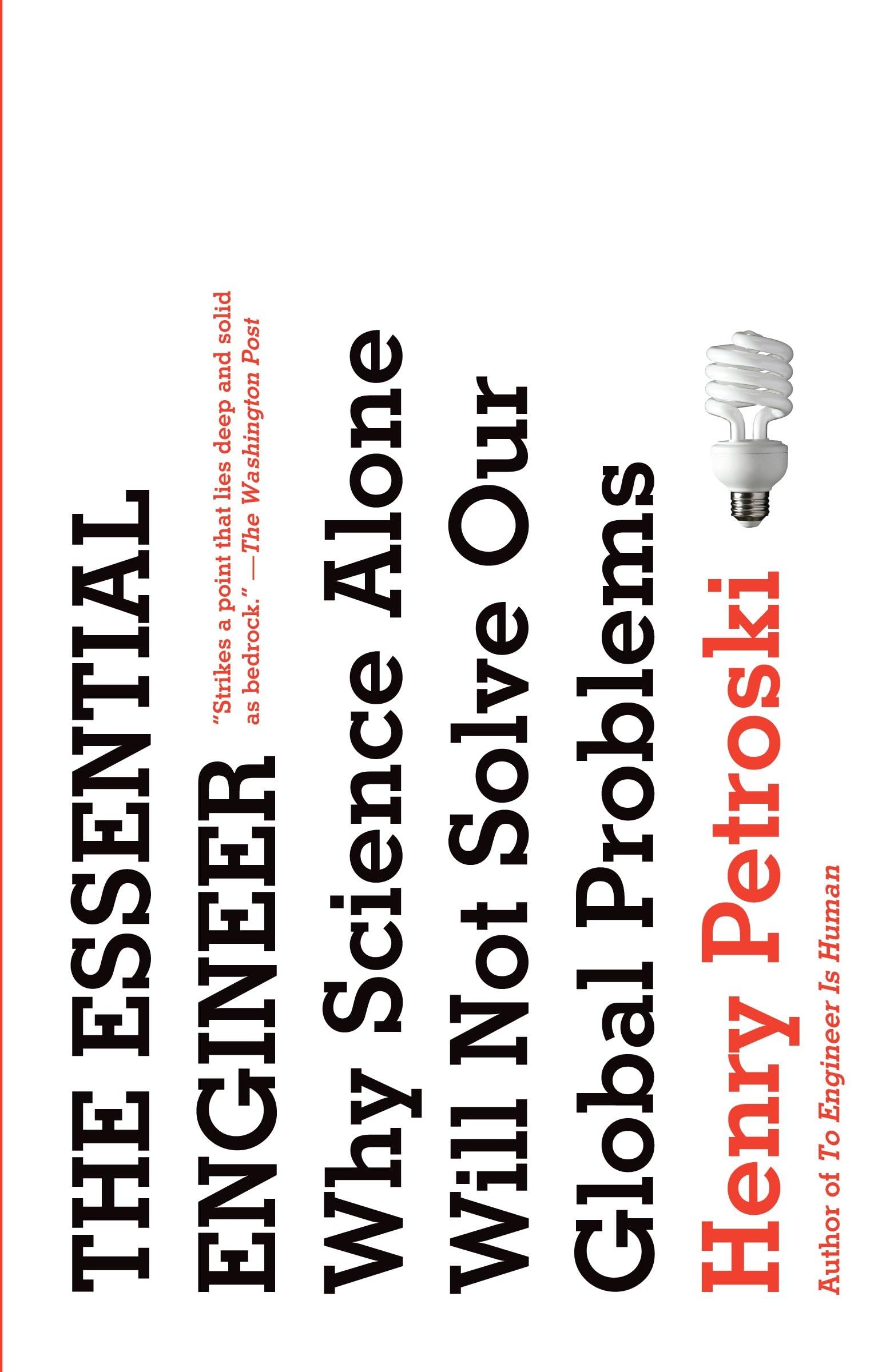
The Essential Engineer: Why Science Alone Will Not Solve Our Global Problems
$16.00
by Henry Petroski



From the acclaimed author of The Pencil and To Engineer Is Human , The Essential Engineer is an eye-opening exploration of the ways in which science and engineering must work together to address our world’s most pressing issues, from dealing with climate change and the prevention of natural disasters to the development of efficient automobiles and the search for renewable energy sources. While the scientist may identify problems, it falls to the engineer to solve them. It is the inherent practicality of engineering, which takes into account structural, economic, environmental, and other factors that science often does not consider, that makes engineering vital to answering our most urgent concerns. Henry Petroski takes us inside the research, development, and debates surrounding the most critical challenges of our time, exploring the feasibility of biofuels, the progress of battery-operated cars, and the question of nuclear power. He gives us an in-depth investigation of the various options for renewable energy—among them solar, wind, tidal, and ethanol—explaining the benefits and risks of each. Will windmills soon populate our landscape the way they did in previous centuries? Will synthetic trees, said to be more efficient at absorbing harmful carbon dioxide than real trees, soon dot our prairies? Will we construct a “sunshade” in outer space to protect ourselves from dangerous rays? In many cases, the technology already exists. What’s needed is not so much invention as engineering. Just as the great achievements of centuries past—the steamship, the airplane, the moon landing—once seemed beyond reach, the solutions to the twenty-first century’s problems await only a similar coordination of science and engineering. Eloquently reasoned and written, The Essential Engineer identifies and illuminates these problems—and, above all, sets out a course for putting ideas into action. "Analyzing both historical and contemporary examples, from climate change to public health, Petroski shows how science often overlooks structural, economic, environmental and aesthetic dimensions that routinely challenge engineers. Moreover, he says, sometimes science trails technology, as when engineers had to design the first moon landing vehicles before scientists learned its surface composition. Far from being hostile toward science, Petroski pleads for continued cooperation between science and engineering. When, as Petroski laments, even President Obama has sometimes omitted engineering in touting science, this book could hardly be more timely."-- Publishers Weekly "With customary acuity and variety, Petroski is sure to please his established readership with these interesting disquisitions on technology." -- Booklist Henry Petroski is the Aleksandar S. Vesic Professor of Civil Engineering and a professor of history at Duke University. The author of more than a dozen previous books, he lives in Durham, North Carolina, and Arrowsic, Maine. 1 Ubiquitous Risk Our lives and those of our children and grandchildren are constantly at risk. Hardly a day passes, it seems, when there is not a story on television or in the newspaper about some new threat to our health and safety. If it is not toys decorated with lead- based paint, then it is drugs—not just pharmaceuticals but something as commonplace as toothpaste—containing adulterated ingredients, or even milk contaminated with industrial chemicals that found its way into candy sold around the globe. Risk and reassurance are two key considerations of the activities of science, engineering, invention, and technology—collectively often referred to simply as “science” or “science and technology.” Whatever they are called, they play a critical role in modern civilization, being essential for the advancement of society and the protection of our quality of life. It is these human disciplines associated with discovery and design that help separate the good from the dangerous on the farm and in the factory, at home and at the office, and on battlefields and frontiers. While science and technology can be misused and become the source of ruin, we would be at even greater risk from tainted products and contagious diseases were it not for the benevolent use of what are among the achievements that make us most distinctly human. If science and technology are two- edged swords, they are also the essential weapons in detecting and managing everyday risk. The bad milk that caused so much consternation a couple of years ago originated in China, which is among the largest exporters of food and food ingredients in the world. In order to increase quantities and thus realize greater profit, unscrupulous participants in the food supply chain misused chemical engineering to water down and adulterate milk. However, diluted milk, being lower in protein, can easily be detected by standardized testing employing well- established technology. But by adding inexpensive melamine, a chemical rich in n