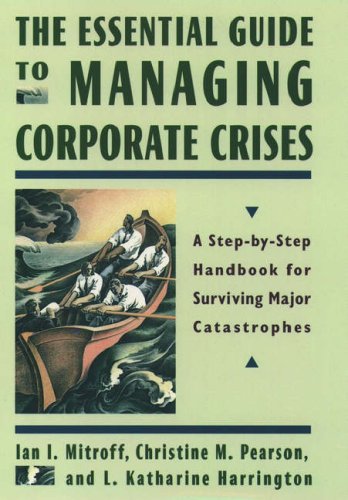
The Essential Guide to Managing Corporate Crises: A Step-by-Step Handbook for Surviving Major Catastrophes
$21.25
by Ian I. Mitroff



Syringes allegedly found in cans of Pepsi, deaths from Jack-in-the-Box hamburgers, kickbacks from Honda dealers to corporate executives, racial discrimination by Dennys employees: a crisis can strike a firm at any time and no company is immune. But now, when disaster hits, managers can turn to The Essential Guide to Managing Corporate Crises . Enhanced with unique interactive software (for Macintosh) that can be used both as part of a training program and as a working guide during the crisis itself, this essential handbook shows executives, including those with no experience in this area, how to assess their company's strengths and vulnerabilities before a crisis ever happens, how to handle a crisis effectively once it hits--including what to do if there has been no pre-crisis planning--and how to learn from a crisis so they can minimize future problems. No other guide provides as much necessary information about crisis management in one convenient volume. Mitroff, Pearson, and Harrington, all highly regarded authorities, provide an overview of the entire crisis management process, cover thoroughly what to do before and after a disaster, and highlight the knowledge and training needed to implement an effective program. They lay out the key management actions and decisions that executives must face to handle a major crisis, and provide a questionnaire that helps managers assess their firms' overall level of crisis preparedness. There are many ways that firms can find themselves in trouble, and the authors cover them all, ranging from disasters that threaten the public image of a company or product line, to financial catastrophes, to industrial problems that endanger consumers, employees, the community, or the environment. Along the way, they are careful to give managers many real-life examples, to make each point crystal clear. In discussing media relations, for instance, they show how Johnson & Johnson, during the Tylenol tampering tragedy, improved its credibility and achieved customer reassurance through candor with the media. And they contrast Johnson & Johnson's successful response with Exxon's arrogant response to the Valdez oil spill, and show how US Air's CEO might have responded more effectively to questions about his airline's safety standards. The book also reveals how some companies' solutions to crises only serve to create new problems. For example, Sears sought to avert financial disaster by offering Auto Repair employees a bonus for bringing in more business, a strategy that not only increased revenue, but also led to employees recommending unnecessary repairs to customers, thus tarnishing Sears' reputation. Similarly, NASA introduced a bonus for workers in key programs who located defects that led to employees discovering non-existent defects to collect the bonus. Based on the authors' years of experience studying crises, teaching courses and conducting seminars in CM, and advising firms during the heat of actual crises, The Essential Guide to Managing Corporate Crises is crucial reading for all key managers and legal personnel in any size private or public organization. The authors, academics and consultants in crisis management, explain how to assess a company's strengths and vulnerabilities before a crisis happens, how to handle a crisis once it hits (including what to do if there has not been any precrisis planning), and how to learn from a crisis so that future problems can be minimized. A crisis can strike any company at any time, and although no company is immune, effective crisis management will enable organizations to recover much faster and learn more from their experiences. One chapter serves as an instruction manual for the crisis management software that is to be included in the finished book. With damage containment, treatment of the problem, and recovery from the crisis as central themes, the authors consider the various stages of a crisis, beginning with the importance of identifying its precise nature and causes. Appropriate dealings with the media are fundamental to proper crisis management, since a company is perceived in the marketplace as a hero, a villain, or a victim, and public perception is shaped by the media. Proper training is recommended to ensure positive reaction and functioning in times of crisis and to prepare managers to face reality when a crisis hits. Mary Whaley "A crisis can strike any company at any time, and although no company is immune, effective crisis management will enable organizations to recover much faster and lean more from their experiences."--Booklist"This is a book that should cause crisis management consultants to shudder because they might lose their jobs. It states what to do, why you should do it, and then provides the information technology to help you either address or avoid your next crisis."--Vincent P. Barabba, General Manager, Knowledge Network, General Motors Corporation"Rarely does a book come along that addresses so com