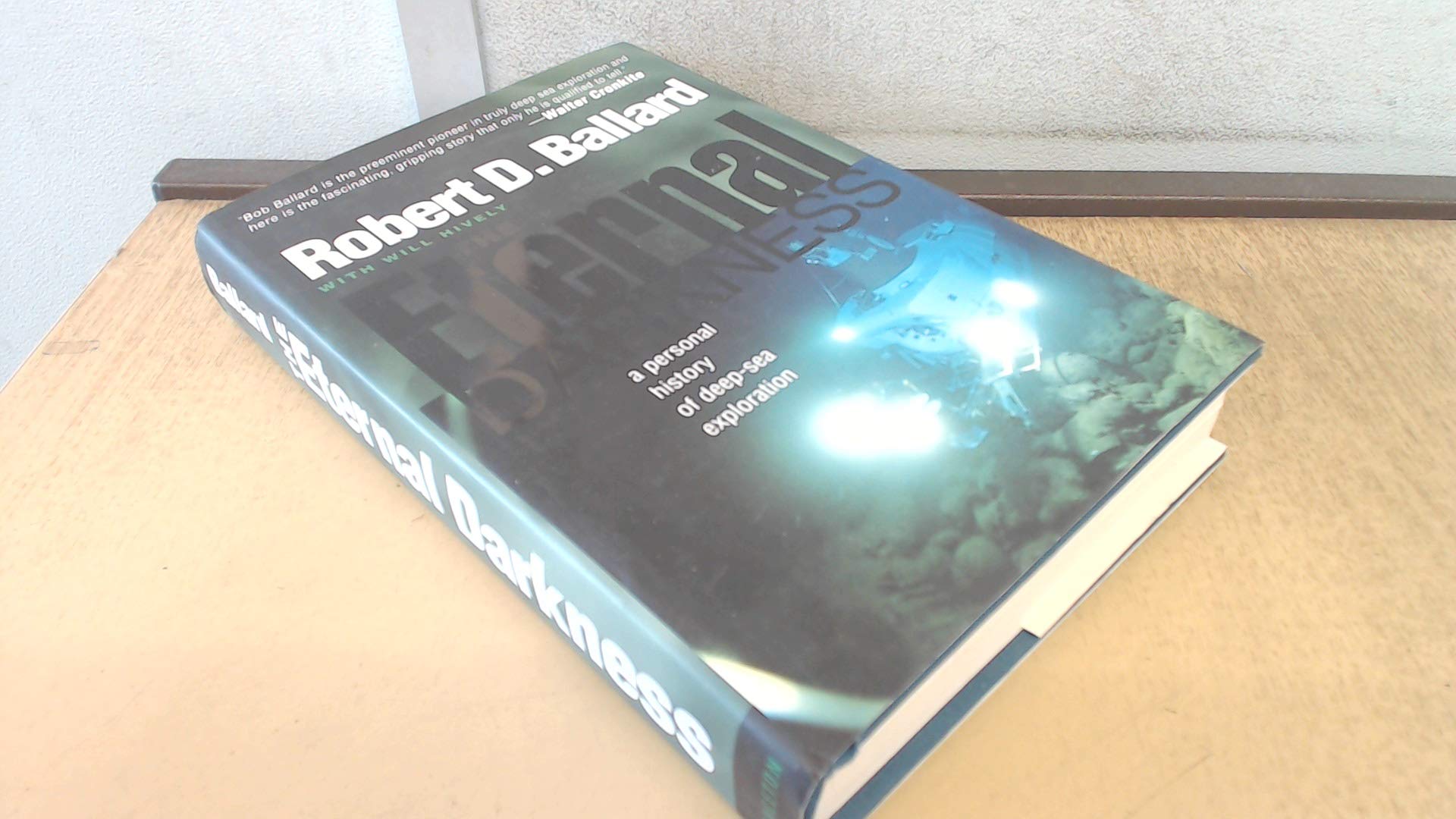



Until a few decades ago, the ocean depths were almost as mysterious and inaccessible as outer space. Oceans cover two-thirds of the earth's surface with an average depth of more than two miles--yet humans had never ventured more than a few hundred feet below the waves. One of the great scientific and archaeological feats of our time has been finally to cast light on the "eternal darkness" of the deep sea. This is the story of that achievement, told by the man who has done more than any other to make it possible: Robert Ballard. Ballard discovered the wreck of the Titanic. He led the teams that discovered hydrothermal vents and "black smokers"--cracks in the ocean floor where springs of superheated water support some of the strangest life-forms on the planet. He was a diver on the team that explored the mid-Atlantic ridge for the first time, confirming the theory of plate tectonics. Today, using a nuclear submarine from the U.S. Navy, he's exploring the ancient trade routes of the Mediterranean and the Black Sea for the remains of historic vessels and their cargo. In this book, he combines science, history, spectacular illustrations, and first-hand stories from his own expeditions in a uniquely personal account of how twentieth-century explorers have pushed back the frontiers of technology to take us into the midst of a world we could once only guess at. Ballard begins in 1930 with William Beebe and Otis Barton, pioneers of the ocean depths who made the world's first deep-sea dives in a cramped steel sphere. He introduces us to Auguste and Jacques Piccard, whose "Bathyscaph"descended in 1960 to the lowest point on the ocean floor. He reviews the celebrated advances made by Jacques Cousteau. He describes his own major discoveries--from sea-floor spreading to black smokers--as well as his technical breakthroughs, including the development of remote-operated underwater vehicles and the revolutionary search techniques that led to the discovery and exploration of the Titanic, the Nazi battleship Bismarck, ancient trading vessels, and other great ships. Readers will come away with a richer understanding of history, earth science, biology, and marine technology--and a new appreciation for the remarkable men and women who have explored some of the most remote and fascinating places on the planet. As a young man, at a time when most of his peers were turning their eyes to deep space, Robert Ballard came under the spell both of scientific inquiry and of the ocean. After taking a doctorate in marine geology and geophysics, he spent three decades at the Woods Hole Oceanographic Institute, through which he participated in more than a hundred deep-sea expeditions. Writing from the point of view of "a privileged witness to a fascinating burst of exploration," Ballard recounts many of those explorations, including the first up-close studies of the great mid-ocean ridge of volcanic mountains that circles the globe, full of seafloor vents and "black smokers." Along the way Ballard provides a brief history of modern oceanography, looking at the contributions of such scientists as Charles William Beebe and Otis Barton, whose legendary dives in the early 1930s paved the way for much subsequent research. Ballard's narrative takes on particular vigor when he describes, in fascinating detail, his team's search for the wreckage of the Titanic --a search that relied on intelligent guesswork as much as on hard evidence. The methods he and his colleagues used--employing, among other things, sophisticated remote-control craft--to find the unfortunate vessel ushered in a new era of deep-ocean research, a contribution in which Ballard takes justified pride. --Gregory McNamee Doing science is exciting! This is the main message of Ballard's fascinating combination memoir and history of deep ocean science. Best known for finding the remains of the Titanic, Ballard has also been involved in many of the recent scientific discoveries in the deep sea, which have changed the way we understand biology, geophysics, and the origins of life on earth. He blends his personal experiences exploring hydrothermal vents and shipwrecks with stories of earlier deep-sea pioneers, focusing especially on the technology. This discussion is counterbalanced by an extensive "Further Reading" section (not seen), which concentrates on the scientific discoveries made possible by the vehicles and people covered in the text. While there are similar books, such as Victoria A. Kaharl's Water Baby: The Story of Alvin (LJ 10/15/90) and Susan Schlee's The Edge of an Unfamiliar World: A History of Oceanography (1973. o.p.), Ballard's volume is easy to read and will be an excellent addition to collections at all levels on oceanography, history of science, and exploration. -Margaret A. Rioux, MBL/WHOI Lib., Woods Hole, MA Copyright 2000 Reed Business Information, Inc. In 1930 two men, cramped inside a steel sphere, dipped 1,426 feet below the ocean waves and return