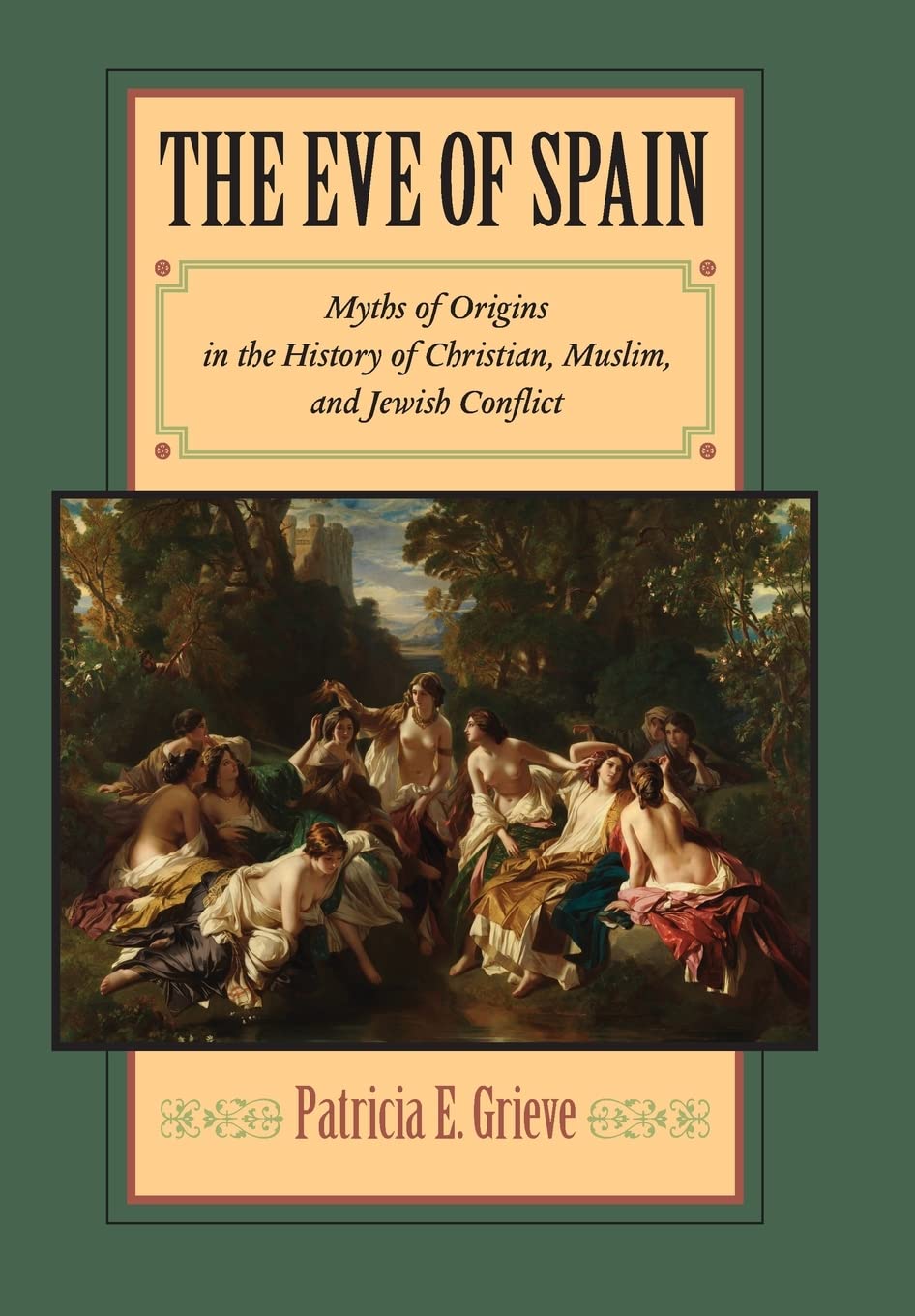
The Eve of Spain: Myths of Origins in the History of Christian, Muslim, and Jewish Conflict
$50.82
by Patricia E. Grieve



The Eve of Spain demonstrates how the telling and retelling of one of Spain’s founding myths played a central role in the formation of that country’s national identity. King Roderigo, the last Visigoth king of Spain, rapes (or possibly seduces) La Cava, the daughter of his friend and counselor, Count Julian. In revenge, the count travels to North Africa and conspires with its Berber rulers to send an invading army into Spain. So begins the Muslim conquest and the end of Visigothic rule. A few years later, in Northern Spain, Pelayo initiates a Christian resistance and starts a new line of kings to which the present-day Spanish monarchy traces its roots. Patricia E. Grieve follows the evolution of this story from the Middle Ages into the modern era, as shifts in religious tolerance and cultural acceptance influenced its retelling. She explains how increasing anti-Semitism came to be woven into the tale during the Christian conquest of the peninsula―in the form of traitorous Jewish conspirators. In the sixteenth century, the tale was linked to the looming threat of the Ottoman Turks. The story continued to resonate through the Enlightenment and into modern historiography, revealing the complex interactions of racial and religious conflict and evolving ideas of women’s sexuality. In following the story of La Cava, Rodrigo, and Pelayo, Grieve explains how foundational myths and popular legends articulate struggles for national identity. She explores how myths are developed around few historical facts, how they come to be written into history, and how they are exploited politically, as in the expulsion of the Jews from Spain in 1492 followed by that of the Moriscos in 1609. Finally, Grieve focuses on the misogynistic elements of the story and asks why the fall of Spain is figured as a cautionary tale about a woman’s sexuality. An impressive, erudite, and multidisciplinary approach . . . Grieve is to be commended for showing that such discourses transcend Iberian literature. Highly recommended. ― Choice Ambitious, deeply researched study . . . The Eve of Spain makes a significant contribution to Hispanic studies . . . Likewise, the study presents a useful model for trans-historical literary scholarship, a feat for which Grieve should be applauded. ―Rachel L. Burk, Caliope Grieve makes it clear why history matters, noting that while medieval and early modern societies do not mirror today's complex world, they 'nonetheless are seedlings of, and bear some relationship to, today's globalized world and geopolitical issues'. ―Rebecca Moore, Journal of Church History In searching for the medieval origins of Spanish nationalism, Grieve's provocative book promises to intervene in some of the thorniest debates in modern Spanish historiography, at the same time as it engages the larger scholarly public interested in the premodern contribution to nation building and nationalism. ―Adam G. Beaver , Journal of Modern History The Eve of Spain is an erudite, engaging, and original excursion into the literary psyche of medieval and early-modern Spain. ―Brian Catlos, Speculum This is a highly professional academic study that very efficiently pursues the myth of La Cava and its reception by various writers through the centuries. ―Henry Kamen, European History Quarterly This is an ambitious work, the scope of which is temporarily and thematically enormous . . . this study adds a very important layer to the ongoing debate about the nature of interfaith relations in pre-modern Iberia and the role ethnic and religious diversity played in shaping Spanish culture from the colonial era through to the twentieth century. ―Nina Caputo, Bulletin of Spanish Studies A fascinating and original study of the topic. No current book in Iberian Studies examines the intersections of (women’s) sexuality, mythmaking, and the politics of narrative and storytelling addressed by Grieve in these pages. ―Josiah Blackmore, University of Toronto A fascinating and original study of the topic. No current book in Iberian Studies examines the intersections of (women’s) sexuality, mythmaking, and the politics of narrative and storytelling addressed by Grieve in these pages. -- Josiah Blackmore Patricia E. Grieve is the Nancy and Jeffrey Marcus Professor in the Humanities at Columbia University and author of "Floire and Blancheflor" and the European Romance and Desire and Death in the Spanish Sentimental Romance (1440–1550) . Used Book in Good Condition