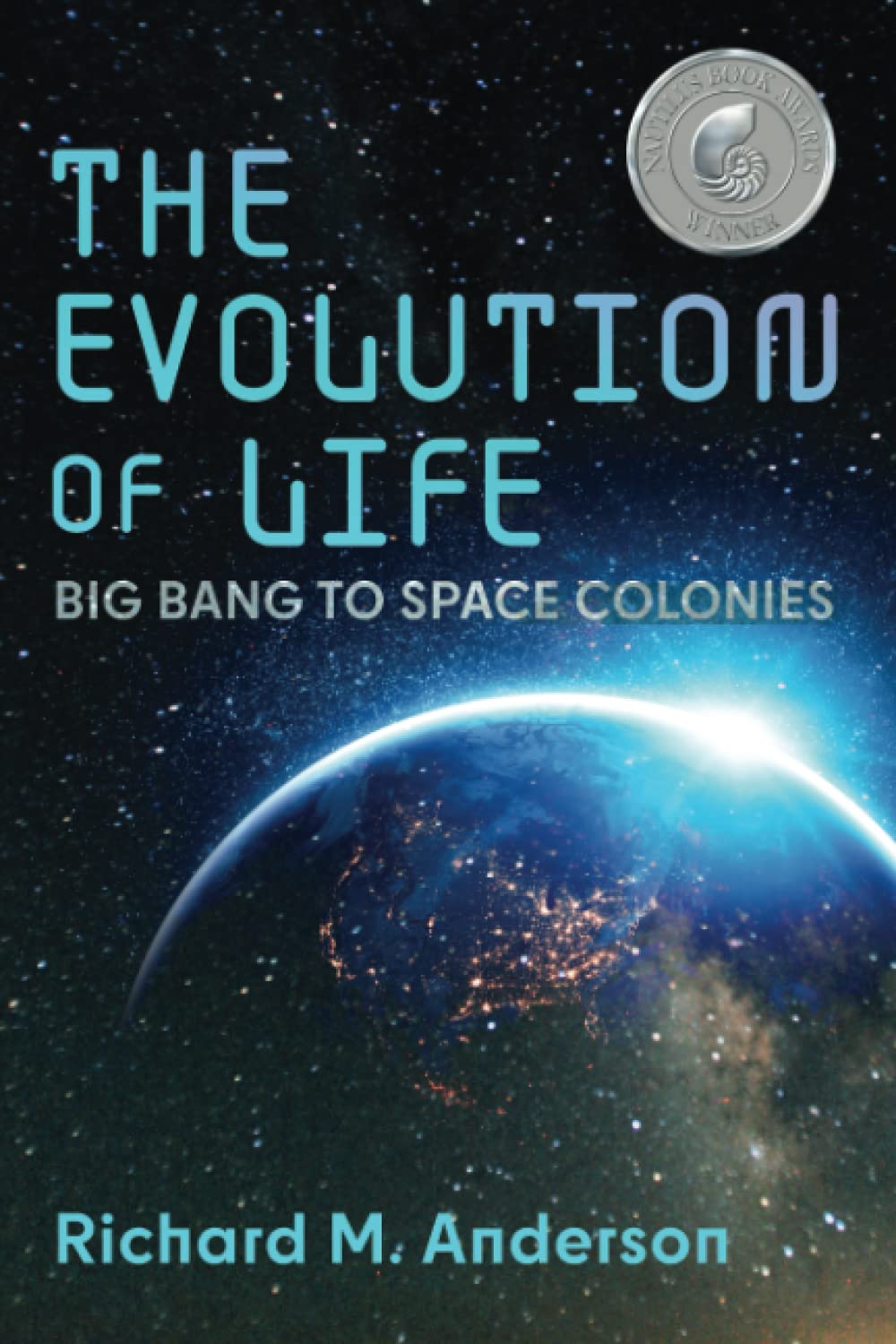



2023 NAUTILUS AWARD SILVER MEDAL WINNER - SCIENCE AND COSMOLOGY CATEGORY How We Came to Be and Where Our Future May Take Us Some 13.8 billion years ago an extraordinary event occurred that we call the "Big Bang.” This primal release of energy formed the universe and everything in it, including us. Author Richard Anderson’s The Evolution of Life: Big Bang to Space Colonies offers a dramatic understanding of this event, the creation of matter, how life evolved on Earth, and the wondrous extraterrestrial future that awaits us as a species, as societies, and as communities. When you read The Evolution of Life, you will be led step-by-step along this magnificent journey to a new possible dawn for humanity. Although it often seems we live in a quagmire of non-ending dysfunction, we only need to review the histories of societies to realize that there has been progress. Forward-looking people may never inherit the Earth, but they will lead us into the future. They may likely create a permanent presence in space for themselves and their progeny. That event could be instrumental in saving our Earth. From the beginning of mankind, we have wondered about the world around us and our place in it. At first it must have been all a mystery. When empirical evidence eluded our distant ancestors, they invented myths, origin stories, and belief systems to explain phenomena beyond their grasp. Slowly, experience and inquiry led to greater knowledge and understanding. The greatest minds of our species have tried to answer the fundamental questions of our existence on earth. ....With an approachable style and tone, supported by easy-to-follow graphics, Anderson’s mastery of the science and compassion for the human dimension bring the mystery and meaning of the universe into focus, allowing even those of us with a casual acquaintance with (or aversion to) science or sociology a deeper understanding of who we are, how we got here and where we may be going in the future. It’s “Big History” at its biggest. It’s quite a ride. —William Briggs, Ed.D., Dean Emeritus, College of Communications, California State University Fullerton, excerpt from the Foreword "Almost everyone, regardless of deeply held personal beliefs, at one time or another, wonders 'Why am I here?'. Richard M. Anderson's book, The Evolution of Life , takes readers through his way of answering the question, starting with the concepts of the evolution of organic molecules from the then prevailing inorganic elements and continuing to the appearance of intelligent humans. He then sets forth the need to tackle poverty, military confrontation, and overpopulation in order to preserve nature for future generations, even if they may be forced to colonize space, what he calls 'A thrilling possibility'. While Mr. Anderson offers his answer to "Why am I here", the reader still has the option of filling in the gaps of this narrative with concepts that the reader is comfortable with, even those based on faith. I suggest that one reads this book very slowly and thinks carefully to appreciate the scientific basis of the evolution of Mr. Anderson's thought process." — John Poothullil, MD, retired physician and author of Diabetes "A thought-provoking and refreshing read on where we came from and where we could be headed as a species. Full of fascinating insights and intriguing possibilities for future civilization, Richard Anderson has written a timely and important book." — Terri Fergason Neal, Zoologist and author of Mr. Liquid Crystal " The Evolution of Life: Big Bang to Space Colonies is a scientific review highly recommended for readers seeking an introductory examination of life's origins and future. It provides a step-by-step journey connecting the universe's growth to humanity's evolutionary process, considering how the two have expanded and grown together. Libraries looking for science-grounded examinations of humanity's evolutionary process and future potential will find much to like about [the book's] wide-ranging approach." — D. Donovan, Sr. Reviewer, Midwest Book Review "In a little more than three hundred pages Mr. Anderson deftly compresses the nearly fifteen billion years of cosmic history into a little more than three hundred pages. With an almost encyclopedic grasp of science--- physical, biological, and social, the author tracks humanity's trajectory from the universe's explosive beginning to its emergence, on this small obscure planet. One cell life to the evolution of complex multicellular life forms to the emergence of intelligent human consciousness to a plausible near-future of space colonies scattered throughout our solar system." —Roy Danchick, Mathematician Shortly before the worldwide COVID-19 pandemic, I began to further explore research areas that had caught my attention during my studies and employment years. As a result of this research, new information came to light that sparked my enthusiasm. And as the pandemic engulfed the worl