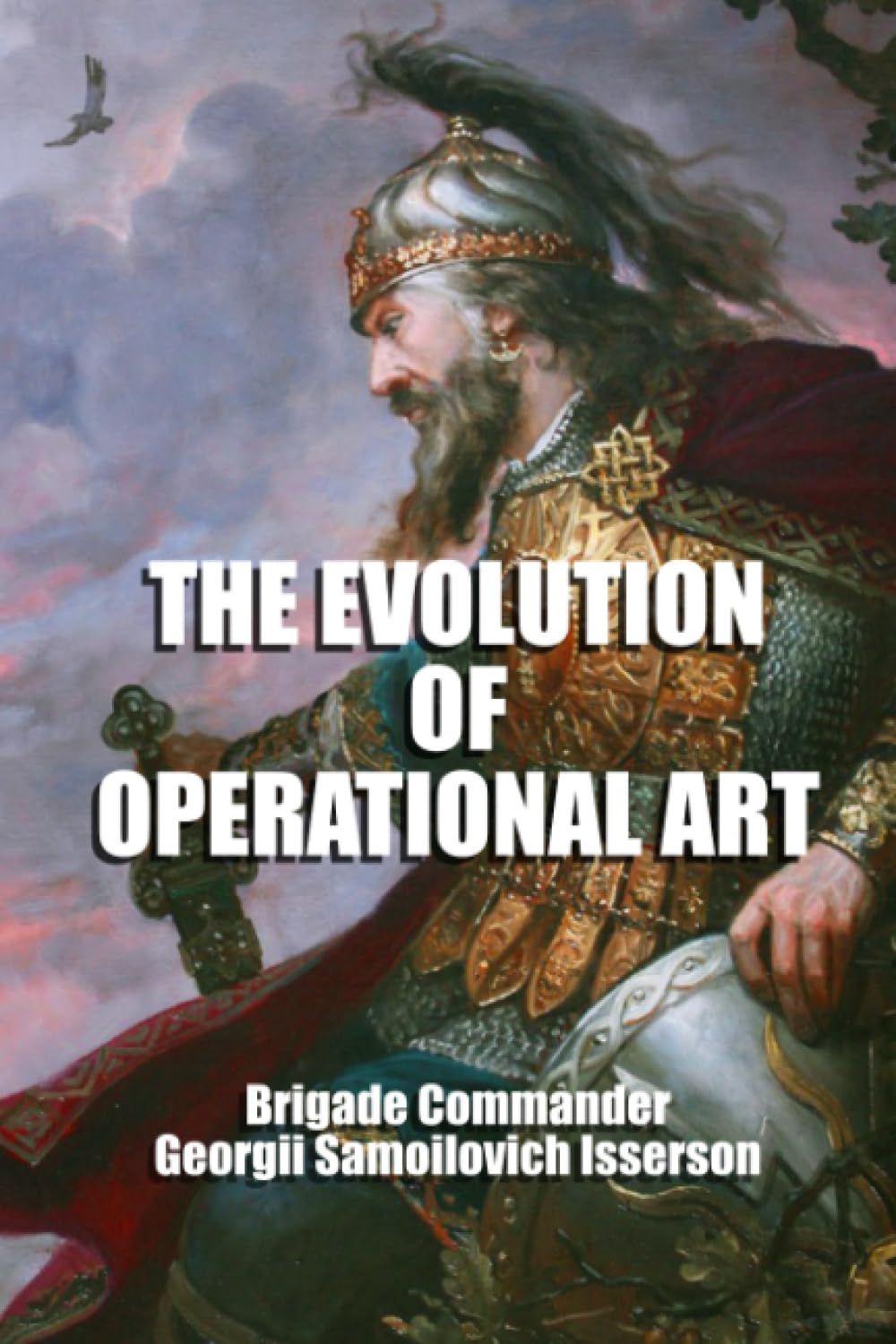
The Evolution of Operational Art: The Soviet Concept of Deep Battle/Operation
$15.99
by Georgii Samoilovich Isserson



The Evolution of Operational Art The Soviet Concept of Deep Battle/Operation Georgii Samoilovich Isserson’s The Evolution of Operational Art is a military classic that has long remained inaccessible to non-Russian readers. More than a mere apologia for the Soviet concept of deep battle/ operation, this book constitutes a military-intellectual tour de force with its critical analysis of evolving military art in historical-theoretical perspective. The book is also an exercise in military foresight on the nature of future war. In fact, Isserson’s final conclusions (page 105-111) could well be understood as a theoretical template for the way that large-scale operations actually unfolded during 1941-45 on the Eastern Front. More importantly in long-term perspective, Isserson’s examination of the prime variables within modern forms for the operation (to use his phraseology) invites the reader to ponder the changing impact and implications of key influences on the evolution of military art. These variables are as modern as today, and they include politico-ideological context, force structures and correlations, command and control, space and depth, time and timing, technology, and technique. On one level, Isserson addresses the challenges inherent in 1930s-vintage future war. On another level, his treatment of overarching issues extends well beyond his time. For example, his examination of Moltke’s quandary after Sedan in 1870 (page 56) appears fully appropriate to an analysis of post-2001 US-led operations in Afghanistan and Iraq. Translation is as much art as science. Russian words and phrases often have no genuine English equivalents, while Russian military terminology is usually quite precise. For example, the Russian word boi usually means “battle,” but with distinct tactical connotations. However, the English equivalent can mean anything from a skirmish to the 1914 confrontation on the Marne. In this and related cases, I have tried to apply common sense standards for translation, differentiating, for example, between “battle” (usually small-scale and tactical) and “main battle” (Russian srazhenie with large-scale operational and probable strategic implications). In all instances the governing principle has been faithfulness to perceptions of the author’s intent.